
AeroPress Water Temperature (2026): The Complete Dial-In Guide, 175–205°F
Editorial standards: this guide draws on AeroPress’s published brewing guidance, specialty brewing practice, and basic extraction science. Temperatures are starting points that vary with coffee, grind, and recipe. CoffeeGearHub does not claim hands-on testing where it has not occurred.
At a glance
Temperature is a refinement lever, not the first fix
Why temperature matters in an AeroPress, starting ranges by roast level, how temperature interacts with grind, time, and agitation, water quality and altitude, iced and cold brew, three ways to control temperature, three recipes, troubleshooting, and the gear that helps.
Editorial analysis
Get grind and ratio right, then use temperature to shape flavor
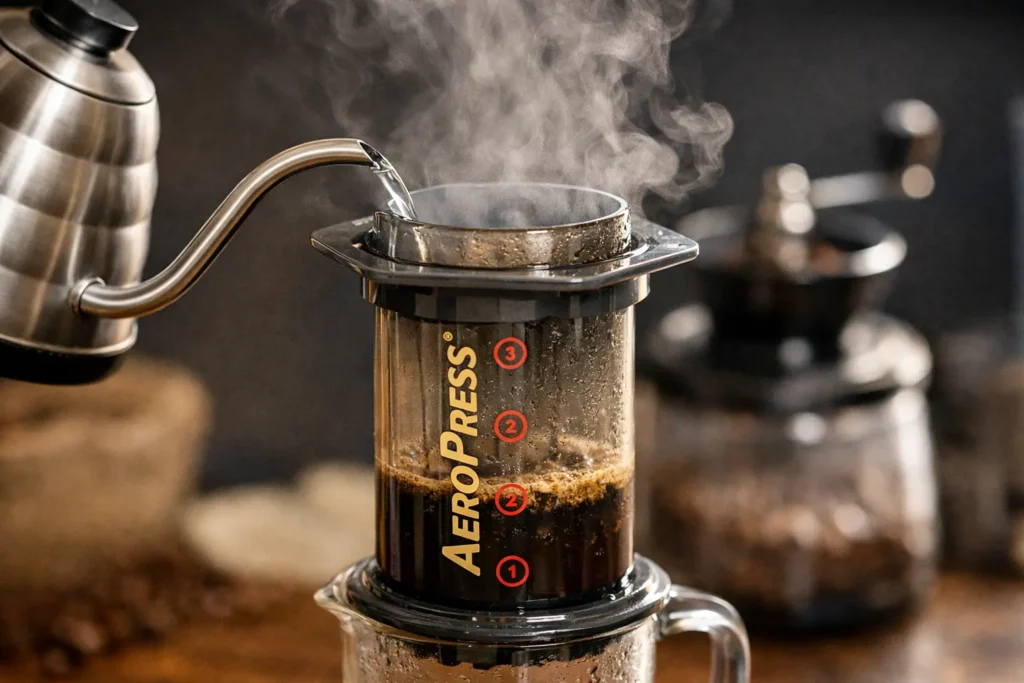
Water temperature changes how quickly coffee extracts. Hotter water pulls out more of everything, including sweetness and bitterness; cooler water extracts more gently and can soften harsh, roasty notes. The AeroPress is unusually tolerant of a wide range, which is why recipes span roughly 175 to 205°F.
Because it is forgiving, temperature works best as a refinement. Fix big problems with grind size and ratio first, then move temperature in steps of about 5°F to tune sweetness, clarity, and smoothness for each coffee.
The 30-Second Answer
Start around 195–205°F (90–96°C) for light roasts, 185–195°F (85–90°C) for medium roasts, and 175–185°F (80–85°C) for dark roasts. If the cup tastes sour or thin, raise the temperature about 5°F; if it tastes bitter or harsh, lower it.
A temperature-controlled kettle makes this easy, but boiling and waiting, or a cheap instant-read thermometer, works too.
Compare current options
Start with these representative choices
Three ways to hit a target temperature reliably: a precision kettle, a value gooseneck, and a thermometer for the kettle you already own.
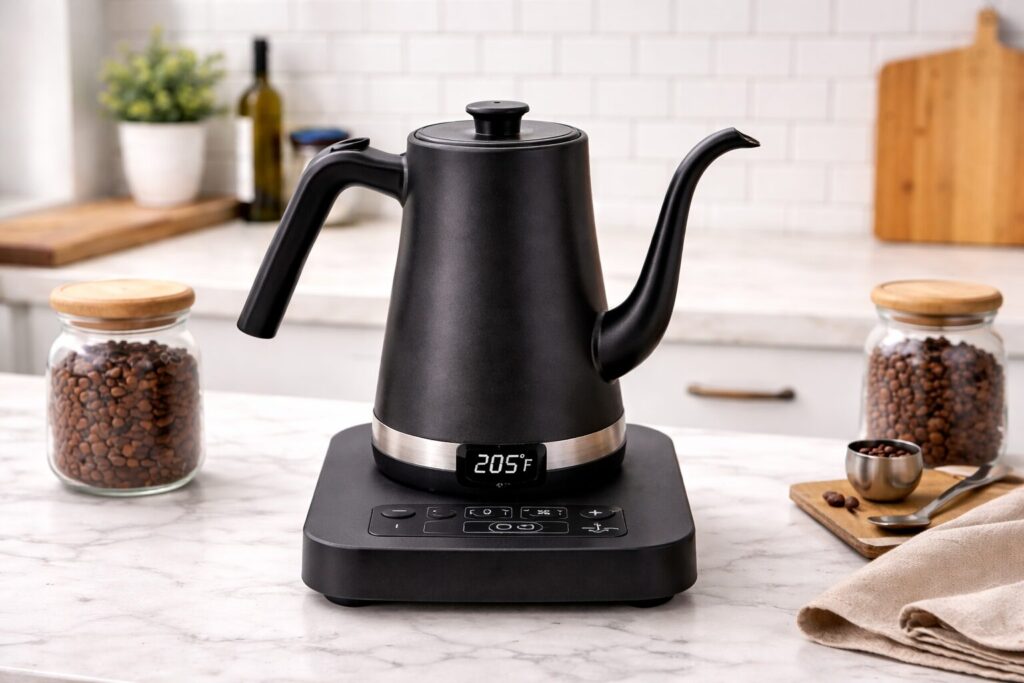
Fellow Stagg EKG — Precision
Set an exact temperature and hold it, with a precise gooseneck spout for controlled pours.
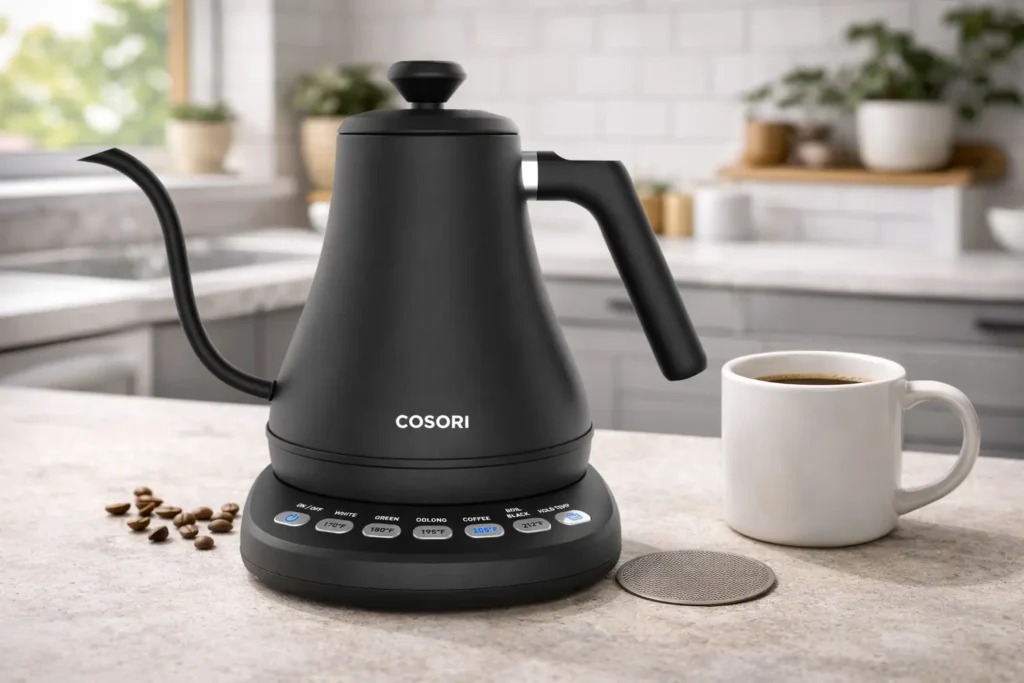
COSORI Gooseneck — Value
Variable temperature presets and a hold function in a more affordable gooseneck kettle.
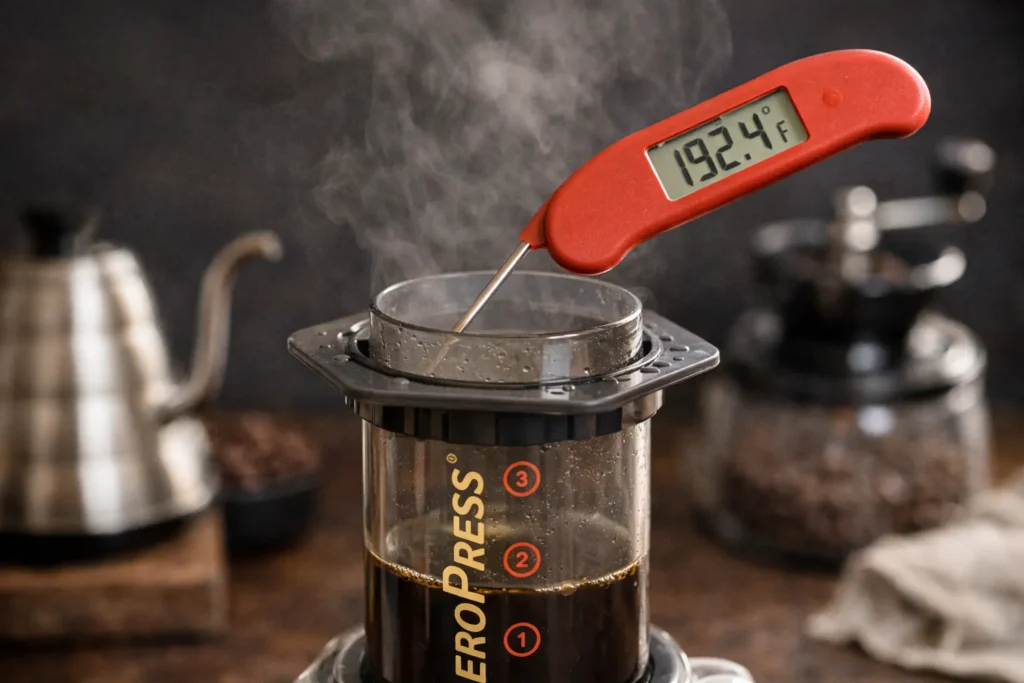
Instant-read thermometer — Budget
Turns any stovetop or electric kettle into a precise tool with a quick reading before you pour.
Affiliate disclosure: Amazon links may earn CoffeeGearHub a commission at no additional cost to you. Prices and availability can change.
Why AeroPress Water Temperature Matters
Water temperature controls how much energy is available to dissolve flavor from the coffee. Hotter water extracts faster, pulling out acids, sugars, and eventually bitter compounds; cooler water extracts more slowly and selectively. In a pour-over, small temperature changes matter a lot because extraction happens in a short, flowing window. The AeroPress combines immersion with a short press, and its relatively short contact time makes it more tolerant, which is why good AeroPress recipes span such a wide range.
That tolerance is useful. It means you can use temperature to shape flavor rather than just to avoid mistakes: a few degrees hotter can bring out sweetness and clarity in a light roast, while a few degrees cooler can tame the bitterness of a dark roast. AeroPress’s original guidance famously favored cooler water than most brewers, and many specialty recipes now use hotter water for lighter roasts; both approaches work when grind and time are adjusted to match.
AeroPress Temperature by Roast Level
Light roasts are dense and less soluble, so they usually need more extraction energy. Start around 195–205°F (90–96°C) to bring out sweetness and fruit and avoid a sour, thin cup. Medium roasts extract more readily; 185–195°F (85–90°C) tends to give caramel sweetness and balanced acidity without harshness.
Dark roasts are the most soluble and the easiest to over-extract, so cooler water around 175–185°F (80–85°C) keeps chocolate and caramel notes while reducing ashy bitterness. Treat these as starting points rather than rules: a dense, high-grown medium roast may like hotter water, and a light-medium blend may taste best in between.
| Roast level | Starting range | If sour or thin | If bitter or harsh |
|---|---|---|---|
| Light | 195–205°F (90–96°C) | Go to the top of the range | Drop 5°F or grind coarser |
| Medium | 185–195°F (85–90°C) | Raise about 5°F | Lower about 5°F |
| Dark | 175–185°F (80–85°C) | Raise about 5°F | Lower toward 175°F |
Temperature by Brewing Method
Contact time changes how hard a given temperature extracts. In the standard upright method with a short steep and press, moderate-to-high temperatures work well. Longer steeps, including many inverted recipes, extract more overall, so you may prefer a slightly cooler temperature or a coarser grind with medium and dark roasts; light roasts often still benefit from hot water in a longer steep. Our inverted method guide covers those recipes.
Concentrate and bypass recipes, where you brew strong and dilute afterward, usually benefit from hotter water because the small amount of brew water must extract a lot from a large dose. The smaller AeroPress Go loses heat a little faster than the original because of its smaller chamber, so some owners brew a few degrees hotter or steep slightly shorter. In every case, taste is the final judge.
Preheating and Heat Loss During the Brew
The temperature in your kettle is not the temperature in the brew. A room-temperature AeroPress, cold coffee grounds, and a cool mug all absorb heat the moment water touches them, so the slurry can sit several degrees below what the kettle displayed. Over a one- to two-minute steep it keeps cooling, especially in the smaller AeroPress Go or in a cold kitchen.
Two simple habits reduce the gap. Rinse the paper filter and preheat the chamber and mug with hot water before brewing, then discard that water. And pour promptly after the kettle reaches temperature rather than letting it sit. If you brew in a cold room or outdoors, aim a few degrees higher than the target, or shorten the steep slightly, to land where you intend.
Temperature for Different Origins and Processes
Roast level is the biggest guide, but the coffee itself matters too. Dense, high-grown coffees such as many from Ethiopia and Kenya often reward the hotter end of their range, because they extract more slowly and their floral and fruit notes need energy to come through. Lower-grown, softer coffees, such as many from Brazil, extract readily and can taste harsh if brewed too hot.
Processing also plays a part. Natural and honey-processed coffees carry more sugars and fruit character and can turn heavy or winey at very high temperatures, so starting a few degrees lower often keeps them clean. Washed coffees tend to be more transparent and handle hotter water well. Decaf coffees are often more soluble after processing, so start toward the lower end for their roast. Our AeroPress beans guide suggests coffees to try.
Temperature, Grind, Time, and Agitation
Temperature never works alone. Grind size and temperature interact directly: a finer grind already extracts faster, so it pairs well with slightly cooler water, while a coarser grind can use hotter water. If you change one significantly, you may need to adjust the other. Time works the same way: a longer steep at a lower temperature can reach a similar extraction to a shorter steep at a higher one, though the flavor balance differs.
Agitation multiplies the effect of temperature. Stirring brings fresh water into contact with the grounds, so vigorous stirring at high temperature extracts much more than a gentle swirl at a lower one. Hot water also releases carbon dioxide from fresh coffee faster during the bloom. The practical lesson is to change one variable at a time: settle on a grind and stir routine, then use temperature to fine-tune. Our AeroPress grind size guide explains the grind side.
Water Quality: The Hidden Variable
If every temperature produces a flat, dull cup, the water itself may be the problem. Very soft or distilled water lacks the minerals that help extract flavor and tastes thin, while very hard water can mute flavor and leave scale in kettles, which also affects how accurately they heat. Chlorine or chloramine in tap water adds off-flavors that no temperature change will fix.
Filtered tap water is a good baseline for most kitchens. If you suspect water, brew the same recipe with a low-mineral bottled water or a specialty coffee mineral packet and compare. Descale your kettle regularly, especially with hard water, so its temperature readings stay accurate.
Altitude and AeroPress Temperature
Water boils at a lower temperature as elevation rises: roughly 212°F (100°C) at sea level, about 208°F at 2,500 feet, around 202°F at 5,000 feet, about 197°F at 8,000 feet, and near 194°F above 10,000 feet. At high elevation, the hottest water you can make may already be below the light-roast range in this guide.
You cannot make water hotter than its boiling point, so compensate with grind and time instead. At around 5,000 feet, brew light roasts just off the boil, grind a step or two finer, and extend the steep by 15 to 20 seconds. Higher up, grind finer still and steep longer. The inverted method helps at altitude because its longer full immersion gives more extraction time.
Iced and Cold Brew AeroPress
For flash-iced coffee, brew a strong, hot concentrate at the top of your range, around 200–205°F, directly onto weighed ice, for example 18 to 20 grams of coffee with about 150 grams of hot water over roughly 100 grams of ice. The hot brew extracts fully and the ice chills and dilutes it quickly, giving a bright, aromatic iced cup. Weigh the ice, because melted ice is part of your brew water.
You can also cold brew in an AeroPress with no heat at all. Steep a medium-coarse grind at a strong ratio, around 1:6 to 1:8, at room temperature or in the fridge for many hours, then press. The result is smooth, low-acid concentrate for diluting or for milk drinks. Expect a firmer press than with hot brewing.
How to Control AeroPress Water Temperature
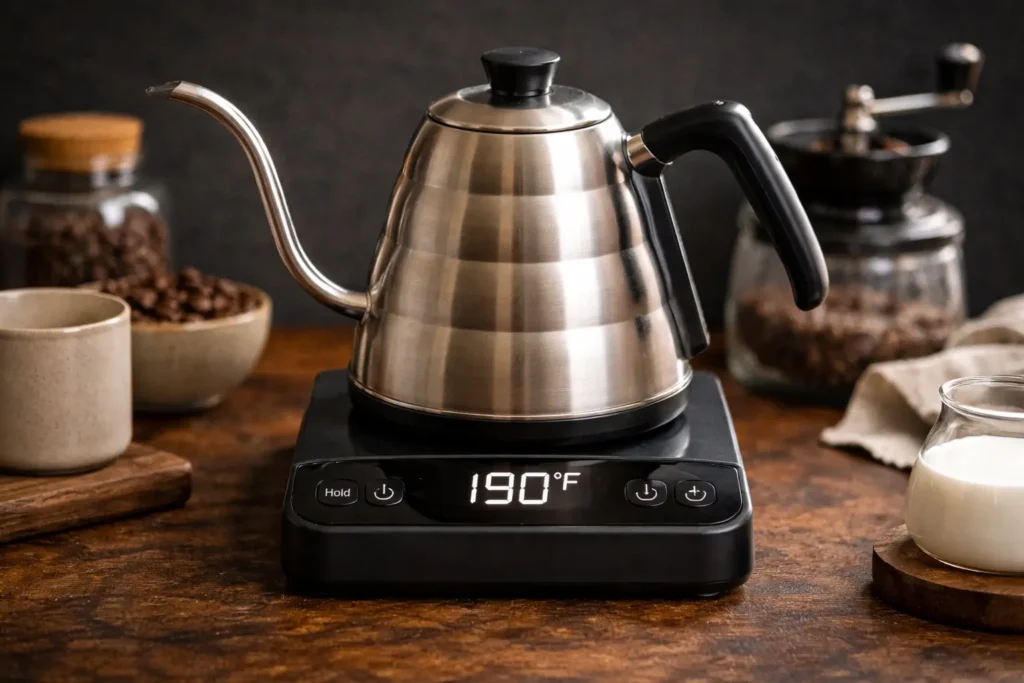
A temperature-controlled kettle is the most precise and repeatable option: set your target and it holds there, which removes guesswork from daily brewing. The Fellow Stagg EKG and COSORI gooseneck both offer variable temperature and a hold function. Our AeroPress kettle guide compares more options.
Without one, boil and wait. As a rough guide, water is about 205°F about 30 seconds off the boil, around 200°F after a minute, about 195°F after 90 seconds, around 190°F after two minutes, and in the low-to-mid 180s after three to four minutes, though kettle material, volume, and room temperature all change this. For precision with any kettle, an instant-read thermometer gives a reading in a few seconds and is the cheapest way to brew repeatably.
Three Temperature-First AeroPress Recipes
For a balanced medium roast, use 16 g of medium-fine coffee and 240 g of water at about 190°F (88°C) in the standard position. Pour over 10 to 15 seconds, stir a few times, steep until about 1:00, then press over 20 to 25 seconds, stopping at the hiss. Expect caramel sweetness, medium body, and balanced acidity.
For a bright light roast, use 16 g of coffee and 240 g of water at about 200°F (93°C), with a slightly longer steep of around 1:30 to 2:00 and a gentle stir, to bring out fruit and floral notes without sourness. For a smooth dark roast, use 16 to 17 g of coffee with 240 g of water at about 180°F (82°C), a brief stir, and a short steep of about 1:00, which keeps chocolate and caramel while minimizing bitterness.
When adapting any recipe to a new coffee, start with the temperature for its roast level, brew once, and taste. If it is sour, raise the temperature about 5°F; if it is bitter, lower it. Then fine-tune grind and time. Weighing with a scale with a timer keeps the comparison fair.
Troubleshooting Temperature Problems
If your coffee is always sour even at 200°F or more, temperature is probably not the limiting factor. Grind finer, steep longer, or increase the dose, and check that your kettle actually reaches the temperature it displays. If you lowered the temperature but bitterness remains, the grind may be too fine, the steep too long, the stir too vigorous, or the coffee itself very dark or stale; change those before dropping temperature further.
If the coffee tastes flat at every temperature, suspect stale beans or poor water. Try fresher coffee and filtered or low-mineral water. If cups are inconsistent despite a consistent temperature, look at dosing, grind consistency, and timing, and use a scale and timer so each variable is controlled. Our AeroPress troubleshooting guide covers more problems.
Common Temperature Mistakes
The most common mistake is changing temperature to fix a problem caused by grind or ratio. Another is changing temperature and grind at the same time, which makes it impossible to tell which helped. Brewers also trust a kettle’s display without checking it, pour from a stovetop kettle that has cooled for an unknown time, or ignore that a cold AeroPress and mug absorb heat. Preheating the brewer and mug with hot water helps keep the brew at the intended temperature.
Finally, many people use one temperature for every coffee. A single setting can work well for a single roast level, but switching from a light to a dark roast without adjusting usually produces a sour or bitter cup. Keep a simple note of the temperature that works for each coffee you buy.
Recommended Gear for Temperature Control
A temperature-controlled gooseneck kettle is the most convenient upgrade for AeroPress brewers who switch between roasts. The Fellow Stagg EKG holds a precise set temperature and pours smoothly, while the COSORI gooseneck offers presets and a hold function for less money.
If you prefer to keep your current kettle, an instant-read thermometer gives you the same precision for the cost of a small accessory. Add a coffee scale with a timer so dose, water, and steep time are as controlled as temperature. Together, those tools make every cup repeatable.
Dial In Temperature With Confidence
A temperature-controlled kettle makes roast-specific brewing effortless.
As an Amazon Associate, CoffeeGearHub earns from qualifying purchases.
Editorial bottom line: Start at 195–205°F for light roasts, 185–195°F for medium, and 175–185°F for dark, then move about 5°F at a time by taste. Fix grind and ratio first, and use a temperature-controlled kettle or thermometer for repeatable cups.
Frequently Asked Questions
What is the best water temperature for AeroPress?
There is no single best temperature. Start around 195–205°F for light roasts, 185–195°F for medium, and 175–185°F for dark, then adjust about 5°F at a time by taste.
Can I use boiling water in an AeroPress?
You can, especially for light roasts, but water just off the boil often tastes better for medium and dark roasts. Letting boiled water rest for 30 to 90 seconds brings it into the high 190s to around 205°F, depending on kettle and volume.
Why does my AeroPress coffee taste sour even with hot water?
Temperature may not be the problem. The grind could be too coarse, the steep too short, or the dose too low. Grind finer or steep longer before raising the temperature further.
Is lower temperature better for dark roasts?
Usually. Dark roasts extract easily, so cooler water around 175–185°F reduces bitterness and ashy notes while keeping chocolate and caramel sweetness.
Does altitude affect AeroPress temperature?
Yes. Water boils at a lower temperature at altitude, around 202°F at 5,000 feet. If you cannot reach your target, grind slightly finer and steep a little longer instead.
How can I control temperature without a special kettle?
Boil water and wait: roughly 30 seconds for about 205°F, 1 minute for about 200°F, and 2 to 3 minutes for 185–190°F, depending on the kettle. An instant-read thermometer makes it precise.
Sources and Further Reading
Brewing guidance draws on AeroPress’s published instructions and common specialty practice, with extraction concepts from the Specialty Coffee Association’s brewing standards. Boiling points at altitude follow standard atmospheric approximations. Cooling times after boiling vary with kettle material, volume, and room temperature, so treat them as estimates.
CoffeeGearHub product shortlist
Continue with related products on CoffeeGearHub
Review product categories and current verified merchant offers on CoffeeGearHub before leaving the site.
Continue Learning
In this guide
- The 30-Second Answer
- Why Temperature Matters
- Temperature by Roast
- Temperature by Method
- Preheating and Heat Loss
- Origins and Processes
- Grind, Time, and Agitation
- Water Quality
- Altitude
- Iced and Cold Brew
- How to Control Temperature
- Three Recipes
- Troubleshooting
- Common Mistakes
- Recommended Gear
- FAQ
- Sources
- Continue Learning