
Last Updated: March 2026 • 25–35 min read • Cornerstone Guide: Beginner Home Coffee Setup + Extraction Science + Brew Method Comparison + Troubleshooting
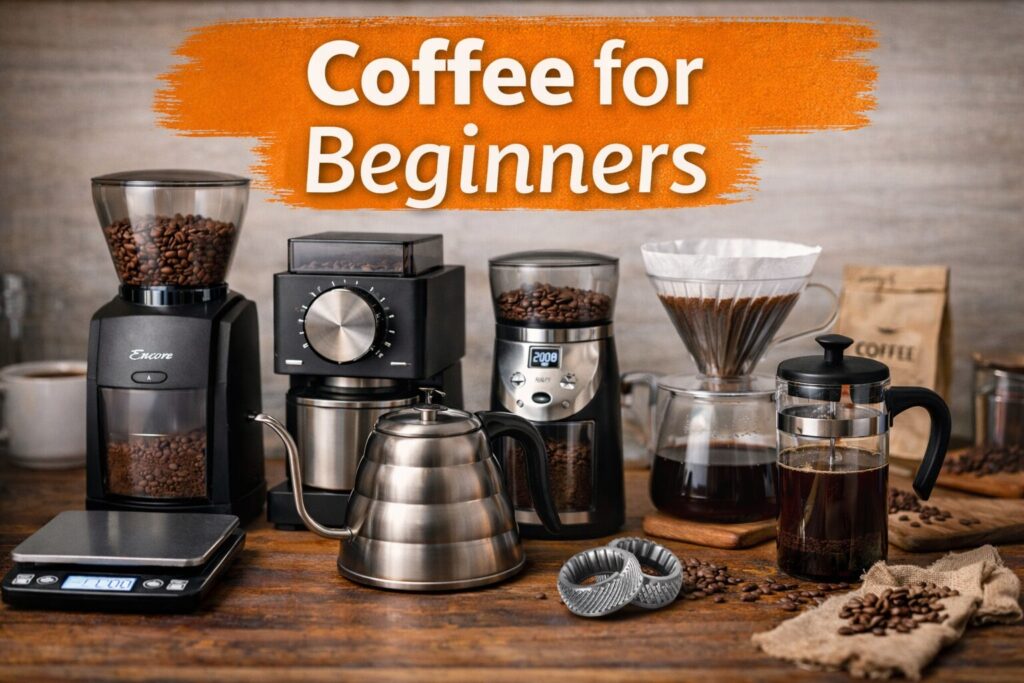
This is our coffee for beginners guide. Making great coffee at home is not complicated — but the internet makes it feel that way. Browse any coffee forum for ten minutes and you’ll find debates about water mineral content, 14-step pour recipes, and grinders that cost more than a kitchen appliance. None of that is where you need to start. The reality is that most of the improvement in home coffee quality comes from four things: grinding fresh, using consistent ratios, controlling water temperature, and choosing a brew method you’ll actually use every morning. Get those four things right and you’ll make coffee that rivals most cafés — regardless of whether your kettle has Bluetooth. This guide covers everything a beginner needs to know, in the order you need to know it: what gear actually matters (and what to skip), how grind size works and why it’s the variable beginners most often get wrong, how to choose a brew method that fits your life, and the extraction science behind why each of these variables affects what ends up in your cup. Follow this guide in order and you will brew excellent coffee by the end of it.
| If you want… | Best choice | Why |
|---|---|---|
| The easiest beginner setup | KINGrinder K6 + Bodum Chambord + OXO Brew Scale | Most forgiving brew method, simplest daily routine |
| The best setup for learning coffee | KINGrinder K6 + Hario V60 + OXO Brew Scale | Best for understanding extraction, grind, and ratio |
| The best first upgrade | KINGrinder K6 | Largest quality improvement per dollar |
Start Here: The Best Beginner Coffee Setup
If you want the shortest path to better coffee, start with a burr grinder, one simple brewer, and a digital scale. That combination fixes the biggest beginner problems immediately: inconsistent grind, weak or bitter brews, and guesswork.
| Setup | Best for | Recommended products | Why it works |
|---|---|---|---|
| Easy Starter Setup | Beginners who want simple, forgiving coffee | KINGrinder K6 + Bodum Chambord + OXO Brew Scale | French press is easy to learn and forgiving with grind variation |
| Learn-the-Basics Setup | Beginners who want cleaner coffee and more control | KINGrinder K6 + Hario V60 + OXO Brew Scale | V60 teaches grind, ratio, and extraction with very low startup cost |
Quick decision path for readers who want the answer fast before reading the full guide.
If You Just Want the Easiest Beginner Setup
Buy this: KINGrinder K6 + Bodum Chambord + OXO Brew Scale. It is the simplest, most forgiving setup on the page, and it teaches the fundamentals without overwhelming you.
- Best grinder: KINGrinder K6
- Best easy brewer: Bodum Chambord French Press
- Best consistency tool: OXO Brew Scale
✍️ Editorial note: This guide is researched and written by the editors at CoffeeGearHub.com using published brewing science, SCA brewing standards, manufacturer specifications, and established specialty-coffee community knowledge. Recommendations reflect research consensus and community reputation. All product links are affiliate links — we may earn a commission at no cost to you. Affiliate Disclosure: CoffeeGearHub.com participates in the Amazon Services LLC Associates Program. As an Amazon Associate, we earn from qualifying purchases.
The 30-Second Answer
The fastest path to great home coffee: buy a burr grinder, pick one brew method, and use a scale. You do not need expensive gear, barista training, or a complicated recipe. A KINGrinder K6 manual burr grinder (~$70), a Hario V60 plastic dripper (~$12), a basic digital scale (~$20), and a bag of fresh whole-bean coffee gets you to café-quality results in a single morning. Grind size and ratio matter more than the equipment you brew in — the grinder is the only piece of gear that has a direct, measurable impact on cup quality at every price point. Everything else improves convenience or refines the experience around the edges. Start simple, brew consistently, and improve one variable at a time.
- Best Beginner Burr Grinder: KINGrinder K6 — 100-click adjustment, 48mm conical burrs, all-metal body
- Best Beginner Pour-Over: Hario V60 Plastic Dripper (01 or 02) — the community standard, forgiving, virtually indestructible
- Best Beginner French Press: Bodum Chambord — proven design, good filter, easy to clean
- Best Beginner Scale: Any digital kitchen scale with 0.1g resolution and a timer — Timemore, OXO, or a basic $15 option all work
- Total setup cost: $100–$200 for a complete, café-quality beginner kit
Who This Guide Is For — Jump to What You Need
🆕 Complete Beginner
Start at What You Actually Need, then follow in order — each section builds on the last.
🔧 Upgrading Your Setup
Jump to Recommended Gear for product picks at every budget, with K6 grind settings for each.
☕ Choosing a Brew Method
Go to the Brew Method Guide for a full comparison of pour-over, French press, and drip — with a clear recommendation per lifestyle.
🔬 Troubleshooter
Jump to the Troubleshooting Matrix — sour cup, bitter cup, weak coffee, stalling draws, and grinder issues all covered.
Table of Contents
- What beginners actually need: 4 essentials and nothing more
- The grinder-first rule: why grind quality is everything
- Grind size explained: how it controls your cup
- Brew method guide: pour-over vs French press vs drip
- Recommended beginner gear: top picks by category
- Step-by-step: how to brew your first great cup
What Beginners Actually Need: 4 Essentials and Nothing More
The coffee equipment market is engineered to make you feel like more gear equals better coffee. It doesn’t. The relationship between equipment cost and cup quality has a steep early curve — the jump from blade grinder to burr grinder, or from pre-ground to freshly ground, is enormous and cheap. Beyond a certain point, the curve flattens dramatically and additional investment returns diminishing improvements that most palates cannot detect. Beginners should spend money on the variables that produce the biggest quality jumps per dollar. There are four of them, in order of impact.
| Essential | Why it matters | What to buy | What to skip |
|---|---|---|---|
| 1. Burr grinder | Produces uniform particle size — the prerequisite for consistent, balanced extraction. No other upgrade has a higher impact on cup quality per dollar spent. | Manual burr grinder (KINGrinder K6) or entry-level electric burr grinder. Anything with conical or flat burrs. | Blade grinders. Pre-ground coffee. “Grinding” in a blender. All produce chaotic particle sizes that cannot extract evenly. |
| 2. A simple brewer | Determines brew method — immersion (French press) or percolation (pour-over, drip). Both produce excellent coffee; the difference is in technique requirements and cup profile. | Hario V60 plastic dripper ($10–$15) for pour-over; Bodum Chambord ($25–$35) for French press. Either is excellent for beginners. | Pod machines (pre-ground, sealed, no grind control), moka pots as a first brewer (more variables to manage), or expensive automatic machines before you understand the variables. |
| 3. Digital scale with timer | Makes your recipe reproducible. Eyeballing coffee and water volume introduces inconsistency that makes diagnosing problems impossible — you cannot know what went wrong if you don’t know what went in. | Any kitchen scale with 0.1g resolution and a built-in timer. Timemore Basic, OXO Brew, or any $15–$20 option with these features. | Volume-only measuring (scoops, tablespoons). Cup lines on a French press. All are inconsistent batch to batch. |
| 4. Fresh whole-bean coffee | Ground coffee begins losing volatile aromatics within days of grinding. Beans roasted within 2–4 weeks and ground immediately before brewing contain aromatics that pre-ground coffee — often weeks or months old — has already lost. You cannot extract what is no longer there. | Whole-bean coffee from a local roaster or quality online roaster with a visible roast date. Medium roast is the most forgiving starting point. | Pre-ground supermarket coffee. Anything without a roast date. “Best before” dates are not roast dates — they tell you nothing about freshness. |
Best First Upgrade for Most Beginners
If you are using a blade grinder or buying pre-ground coffee, the best first upgrade is a real burr grinder. It will improve extraction consistency more than any brewer upgrade and make every future gear decision easier.
Most impactful upgrade for beginners who want better flavor without overcomplicating the setup.
The Grinder-First Rule: Why Grind Quality Changes Everything
If you take one thing from this guide before reading any further, make it this: the grinder is the most important piece of equipment in a home coffee setup. Not the brewer. Not the kettle. Not the scale. The grinder. This is counterintuitive — most beginners assume the machine they brew in defines the quality ceiling. It doesn’t. The brew device is just a vessel for hot water and ground coffee. The quality of the grind determines whether the extraction that happens inside that vessel is consistent, balanced, and reproducible — or random.
Here is the mechanism: every coffee ground in a batch needs to extract at approximately the same rate to produce a balanced cup. If you have a mix of fine particles, medium particles, and coarse chunks in the same brew — which is what a blade grinder produces — the fine particles over-extract (bitter) while the coarse chunks under-extract (sour) simultaneously. The resulting cup is not simply “medium” — it is muddy, harsh, and without the clarity that makes good coffee good. A burr grinder, by contrast, sets a physical gap between two abrasive surfaces. Every bean must pass through that gap, producing grounds within a narrow particle-size range. Consistent particle size → consistent extraction rate → consistent, balanced cup. This is why upgrading from a blade grinder to a burr grinder produces an improvement that most people describe as transformative — not incremental.
🔬 The burr grinder advantage: The KINGrinder K6’s 48mm conical stainless burrs produce a particle-size distribution at pour-over settings (24–38 clicks) that generates very low fines — the ultra-fine dust particles that disproportionately contribute to bitter, over-extracted flavour even in an otherwise well-dialled grind. At French press settings (60–80 clicks), the same burrs produce a coarse, open grind with minimal fine migration through the metal filter — the primary cause of muddy, gritty French press. Consistent burr geometry is what separates a $70 grinder from a $10 blade grinder, not materials or weight.
Grind Size Explained: How It Controls Your Cup
Grind size is the variable beginners most often overlook and the one that most directly explains why a cup tastes wrong. Understanding grind size means understanding extraction rate — and once you understand extraction rate, you can diagnose any cup problem methodically rather than randomly changing things until something improves.
| Grind level | Texture reference | Used for | K6 click range (from zero) | What goes wrong if you use this for the wrong method |
|---|---|---|---|---|
| Extra Fine | Powdery — like flour | Turkish coffee | 1–8 clicks | Used in pour-over: clogs filter completely; brew stalls and drowns |
| Fine | Table salt — fine but not powdery | Espresso, moka pot | 8–18 clicks | Used in pour-over: massive over-extraction, harsh bitterness |
| Medium-Fine | Slightly coarser than table salt | V60, Kalita Wave, AeroPress | 18–32 clicks | Too coarse for this range: sour, thin cup; too fine: stalling draw-down |
| Medium | Coarse sand | Chemex, drip coffee makers | 28–40 clicks | Too fine: bitter extraction, slow drip; too coarse: flat, thin, sour |
| Medium-Coarse | Rough sand | Clever Dripper, cold brew (short) | 38–55 clicks | Used in French press: fine particles pass through metal filter, gritty cup |
| Coarse | Breadcrumbs — chunky, visible pieces | French press, cold brew | 55–80 clicks | Used in V60: under-extraction, water rushes through, watery sour cup |
The practical rule for beginners: if the cup tastes sour or thin, grind finer; if it tastes bitter or harsh, grind coarser. Make one change at a time, in small increments (2–3 clicks on the K6), and re-brew before changing anything else. Most beginner cup problems are grind problems — not brew-time problems, not ratio problems, and not equipment problems. Solve grind first. For a complete visual reference across all methods, see our Coffee Grind Size Chart.
Struggling With Bitter or Weak Coffee?
Most beginners try to fix bad coffee by changing everything at once. In practice, the biggest improvements usually come from better grind consistency and measuring your brew by weight.
Brew Method Guide: Pour-Over vs French Press vs Drip
Beginners do not need to master every brew method — they need to choose one, learn it well, and produce consistent results before exploring. The choice should be based on your lifestyle, your tolerance for technique, and the kind of cup you want to drink every morning. Here is the honest comparison across every variable that matters for a beginner decision.
| Pour-Over (V60 / Kalita Wave) | French Press | Drip Coffee Maker | |
|---|---|---|---|
| Brew type | Percolation — water flows through the grounds and a paper filter | Immersion — grounds steep in water for the full brew time | Percolation — automated; water drips through a paper or mesh filter |
| Cup profile | Clean, bright, high clarity — best for tasting the nuance in specialty beans | Full-bodied, oil-rich, heavy — best for bold, round flavour | Balanced, straightforward — consistent results with minimal attention |
| Beginner difficulty | Moderate — pour technique matters; draw-down time is a feedback signal; requires practice | Easy — add grounds, add water, wait 4 minutes, press and pour; forgiving of grind variation | Very easy — fill, press start; negligible technique requirement once set up |
| Active brew time | 3–4 minutes, active — you must pour in stages (bloom + 2–3 more pours) | 4–5 minutes, mostly passive — pour once, set a timer, press and pour | 6–10 minutes, fully passive — the machine handles everything |
| Equipment cost | Very low — Hario V60 plastic $10–$15; paper filters $8–$12 per 100 | Low — Bodum Chambord $25–$35; no filters required | Moderate to high — a quality drip maker (Technivorm, Breville) $100–$350 |
| Grind sensitivity | High — grind size directly controls draw-down speed and extraction rate; tight target window | Low — immersion brewing is more forgiving of grind variation within the coarse range | Moderate — depends on machine quality; better machines are more grind-sensitive |
| Best for beginners who… | Want to understand coffee deeply; enjoy a ritual; drink high-quality single-origin beans; have 5–10 minutes in the morning | Want simplicity and reliability; prefer bold, heavy cups; don’t want to buy filters; have less patience for technique | Brew for multiple people; want coffee ready on a schedule; prioritise convenience above all else |
| CoffeeGearHub recommendation | ✅ Start here if you’re serious about learning specialty coffee | ✅ Start here if you want simplicity and great results immediately | Secondary upgrade — buy a quality drip maker only after understanding what good coffee tastes like |
Our recommendation for most beginners: start with a Hario V60 or a French press, not a drip machine. Both teach you what good coffee tastes like and give you clear feedback on your technique. A drip machine automates the process before you understand what it’s doing — which makes diagnosing problems difficult and improvement slow. Once you know what a correctly extracted cup tastes like from a V60 or French press, you’ll know exactly what you want a drip machine to replicate. See our full guide: Best Pour-Over Coffee Makers.
Choose This If You Want Easy, Forgiving Coffee
Bodum Chambord French Press is the better choice for beginners who want simplicity, fuller body, and fewer variables to manage.
Choose This If You Want Cleaner Coffee and More Control
Hario V60 Plastic Dripper is the better choice for beginners who want to learn extraction and get a cleaner, brighter cup.
Want to go deeper? Compare your next step here: French Press vs Pour Over, Best Pour-Over Coffee Makers, Coffee Grind Size Chart, and How to Brew Better Drip Coffee at Home.
Recommended Beginner Buying Path
- Buy first: burr grinder
- Choose next: French press for simplicity or V60 for control
- Add for consistency: scale with timer
- Upgrade later: better beans, gooseneck kettle, quality drip machine
Recommended Beginner Gear: Top Picks by Category
These picks represent the best beginner coffee equipment at each category — selected for low price-to-quality ratio, low learning curve, and community-verified reputation. All affiliate links use the CoffeeGearHub Amazon Associates tag (coffeegearhub-20). Verify ASINs before publishing.
| Category | Top pick | Best for | Why we like it |
|---|---|---|---|
| Grinder | KINGrinder K6 | Most beginners | Strong grind quality for the price and broad brew range |
| Pour-over brewer | Hario V60 Plastic 02 | Clean cups and learning control | Cheap, durable, and the standard learning dripper |
| French press | Bodum Chambord 34 oz | Easy, forgiving brewing | Reliable and simple to use |
| Scale | OXO Brew Digital Scale with Timer | Consistent ratios | Easy interface and built-in timer |
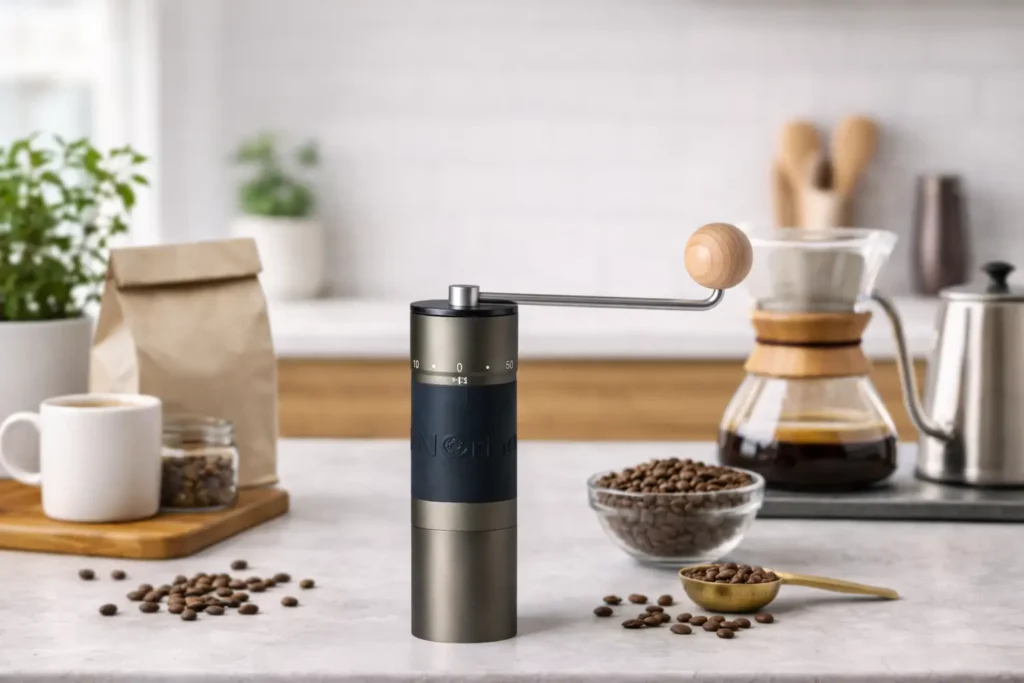
Best Beginner Burr Grinder: KINGrinder K6
The KINGrinder K6 is the CoffeeGearHub standard manual grinder recommendation across all brewing content, and for beginners specifically it represents the best value in the burr grinder market. The 48mm stainless conical burrs produce the consistent particle-size distribution that makes extraction predictable — and the 100-click adjustment system gives you precise, repeatable grind settings across every brew method from espresso to French press. For pour-over at the medium-fine range (24–38 clicks), the K6 produces low fines that prevent filter stalling on V60 and Chemex. At French press coarse settings (60–80 clicks), it produces clean chunky grounds that don’t migrate through the metal press filter into your cup. A 5-click adjustment at any setting produces a perceptible flavour shift — which makes it one of the most useful dial-in tools for a beginner learning to read extraction. The all-metal body handles daily 15–22g doses without flex or wear, and the magnetic catch cup stays closed during grinding without locking mechanisms. At ~$70, there is no burr grinder at this price point that produces meaningfully better results for home brewing.
- Burrs: 48mm stainless conical — low fines at pour-over settings, clean coarse at French press
- Adjustment: 100 clicks from zero — 5-click steps at pour-over produce measurable extraction shifts
- Pour-over starting point: V60 medium roast: 26–32 clicks; Chemex medium roast: 32–38 clicks
- French press starting point: 65–75 clicks for medium-dark roast; adjust 5 clicks at a time
- Best for: V60, Chemex, Kalita Wave, AeroPress, French press — covers the full beginner range
Disclosure: CoffeeGearHub may earn from qualifying purchases.

Best Beginner Pour-Over: Hario V60 Plastic Dripper (Size 02)
The Hario V60 is the pour-over world’s most replicated dripper design — used in specialty cafés worldwide and the standard reference point against which every other pour-over dripper is compared. For beginners, the plastic version (not the glass or ceramic) is the correct starting point: it is virtually indestructible, retains heat as well as glass due to its thin wall, costs under $15, and performs identically to the more expensive versions. The conical shape with a single large drain hole produces a variable draw-down speed that responds to grind size — which makes it the best learning tool available for understanding how grind affects extraction. The spiral ribs inside the cone prevent the filter from collapsing against the wall, maintaining consistent water flow. Size 02 (the medium, which brews 1–4 cups) is the right choice for most beginners — it is forgiving enough for a single 15g dose and large enough for a 30g two-cup brew without overflow risk. Use with Hario tabbed filters (the tabs fold differently — follow the fold direction marked on the filter packet).
- Material: BPA-free plastic — heat-retentive, durable, drop-safe; identical brew performance to glass or ceramic
- Size: 02 — brews 1–4 cups; the standard recommendation for solo and two-person households
- Filters: Hario V60 tabbed paper filters — buy 100-count; rinse each filter with hot water before use to remove paper taste
- K6 starting grind: 26–32 clicks for medium roast; draw-down should complete in 2:30–3:30 total
- Best for: beginners who want to understand extraction; anyone drinking single-origin specialty coffee
Disclosure: CoffeeGearHub may earn from qualifying purchases. Verify ASIN B002IR1O3A before publishing.
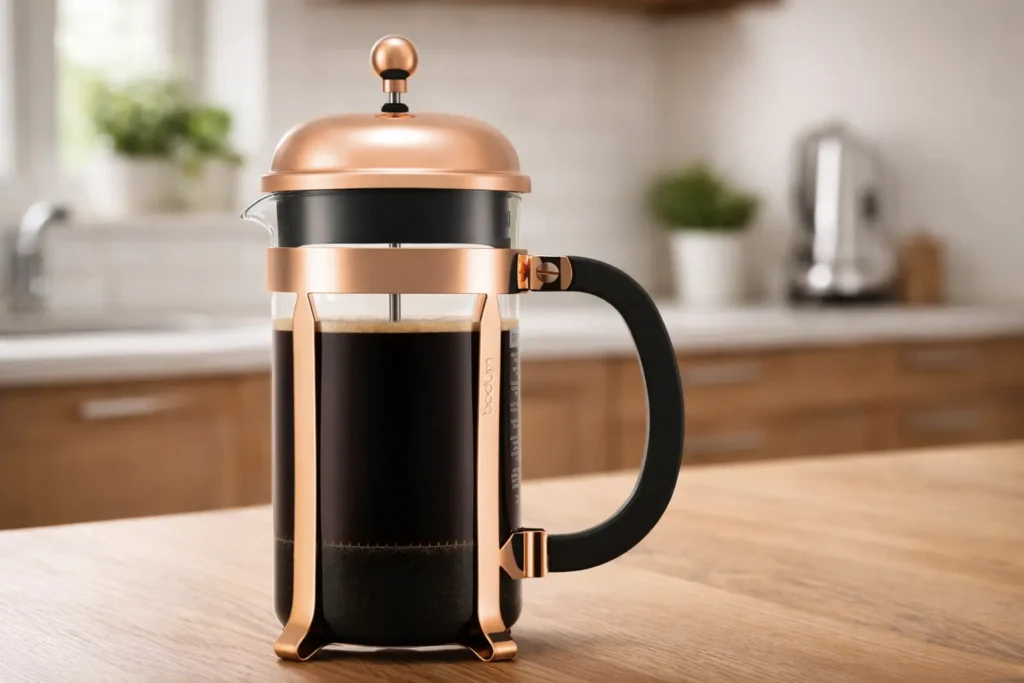
Best Beginner French Press: Bodum Chambord (34 oz / 1L)
The Bodum Chambord is the default French press recommendation for beginners — not because it is the highest-performing French press available, but because it is the most reliable at its price point, widely available, easy to replace parts for, and virtually impossible to brew a bad cup from if you use a burr grinder and a consistent recipe. The stainless steel frame and borosilicate glass carafe handle daily use without cracking or discolouring, the three-part mesh plunger produces a cleaner cup than cheaper single-mesh competitors, and the 1.0L (34 oz) capacity is the right size for one to two cups without requiring a large coffee dose. French press is the most forgiving brew method for beginners — immersion brewing is far less sensitive to grind variation and pour technique than pour-over, which means a new brewer can produce a good cup on the first attempt without dialling in. The trade-off is a heavier, oilier cup than paper-filtered methods — which most beginners who drink their coffee with milk prefer from the start.
- Capacity: 34 oz / 1.0L — brews 2–3 cups; the right size for most solo or two-person households
- Filter: Three-part stainless mesh — cleaner press than single-mesh competitors; rinse thoroughly after each use
- Brew time: 4 minutes steep from first pour; press and serve immediately to stop extraction
- K6 starting grind: 65–75 clicks for medium-dark roast; press plunger should feel like moderate resistance at 4 minutes
- Best for: beginners who want simplicity; anyone who prefers a bold, full-bodied cup; households making 2+ cups at once
Disclosure: CoffeeGearHub may earn from qualifying purchases. Verify ASIN B00008XEWJ before publishing.
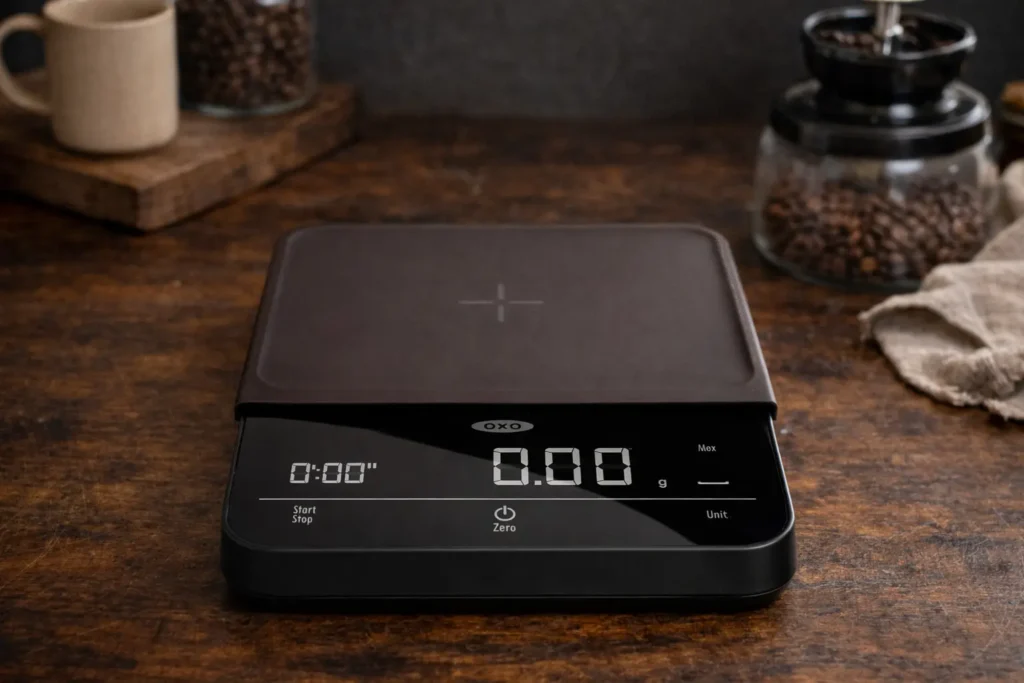
Best Beginner Coffee Scale: OXO Brew 6 lb. Digital Scale with Timer
A scale is the piece of equipment beginners most often skip and most often regret skipping. Without weighing both coffee and water, your ratio changes every brew — and when the cup tastes wrong, you have no baseline to adjust from. The OXO Brew is the right scale for beginners: 0.1g resolution for accurate coffee doses, a pull-out timer that activates automatically when you place a vessel on the platform, a platform large enough to fit a V60 with a server or a French press without blocking the display, and a straightforward interface with no menus or modes to learn. The auto-timer feature is specifically useful for pour-over — the timer starts counting when you set your dripper on the scale, which means you don’t need a separate stopwatch and can keep both hands on the kettle. If the OXO is out of budget, any kitchen scale with 0.1g resolution and a built-in timer works — the Timemore Black Mirror Basic ($35) is the enthusiast favourite at a similar price.
- Resolution: 0.1g — sufficient for accurate coffee dosing at 15–30g doses; essential for consistent ratios
- Timer: Pull-out timer with auto-start when vessel placed on platform — keeps hands free for kettle
- Platform: Large enough for V60 + server or French press without blocking the display
- Best for: beginners learning pour-over; anyone who wants to brew by weight without a separate timer
- Budget alternative: Any digital kitchen scale with 0.1g resolution + timer — Timemore Basic at $35 is the enthusiast favourite
Disclosure: CoffeeGearHub may earn from qualifying purchases. Verify ASIN B079C4SMPH before publishing.
Best Beginner Coffee Setup: Our Simple Recommendation
For most readers, the easiest all-around beginner setup is this: KINGrinder K6 + Bodum Chambord + OXO Brew Scale. It is affordable, forgiving, repeatable, and teaches the fundamentals without overwhelming you.
Step-by-Step: How to Brew Your First Great Cup
Use this recipe as your starting point — it applies to either the V60 pour-over or French press with the grind setting adjusted for the method. The goal is not a perfect cup on the first brew; it is a consistent cup you can adjust from. Follow this exactly for your first three brews, taste carefully, and then make one change at a time based on the feedback.
☕ V60 Pour-Over Recipe (Beginner)
- Dose: 15g coffee, 225g water (1:15 ratio). Place V60 on your scale with a server or mug underneath.
- Grind: K6 at 28–30 clicks (medium-fine, slightly coarser than table salt). Grind directly into the filter.
- Rinse filter: Pour hot water through the paper filter into the server to remove paper taste and preheat the dripper. Discard the rinse water.
- Bloom (0:00–0:45): Add 30g of water (2× the coffee dose) in a slow spiral starting from the centre. All grounds should be wet. Wait 30–45 seconds — you’ll see CO₂ bubbling as the bed expands.
- Main pour (0:45–2:30): In 2–3 pours, add the remaining 195g of water in slow spirals. Pour to the brim of the V60 and wait for the level to drop before the next pour. Keep total pour time under 2:30.
- Draw-down (2:30–3:30): Let the remaining water drain through the grounds. Total brew time (first pour to final drip) should be 3:00–3:30. Grind finer if it drains faster; grind coarser if it stalls or takes longer than 4:00.
- Taste and adjust: Sour → grind 2–3 clicks finer. Bitter → grind 2–3 clicks coarser. Weak → reduce water to 200g. Too strong → increase water to 240g.
🧱 French Press Recipe (Beginner)
- Dose: 20g coffee, 300g water (1:15 ratio). Remove the plunger from the French press and set it aside.
- Grind: K6 at 68–72 clicks (coarse — chunky, like rough breadcrumbs). Add grounds to the empty carafe.
- Preheat: Optional but worthwhile — rinse the empty carafe with hot water first, discard, then add grounds. Reduces heat loss during steep.
- Pour (0:00): Add all 300g of water at 93°C (or water that has rested 30–40 seconds off the boil) in one slow pour. Ensure all grounds are saturated — stir gently if needed.
- Steep (0:00–4:00): Place the lid on the carafe (plunger pulled all the way up, not pressed) to retain heat. Set a 4-minute timer. Do not stir again during the steep.
- Press and serve (4:00): Press the plunger down slowly with steady, even pressure over 20–30 seconds. Pour immediately — coffee left in the press continues extracting from the sediment at the bottom.
- Taste and adjust: Gritty → grind coarser (more clicks); plunger too easy → grind coarser; bitter → grind coarser or steep 30 seconds less; sour / weak → grind finer (fewer clicks).
Want more help choosing gear? See our related guides for deeper comparisons: Best Pour-Over Coffee Makers, French Press vs Pour Over, and Coffee Grind Size Chart.
Extraction Science: Why These Variables Affect Your Cup
You don’t need to understand extraction science to brew good coffee — the recipe above will produce a consistently good cup without it. But understanding the mechanism behind the variables makes you a faster learner. Instead of randomly adjusting things when something tastes wrong, you can diagnose the problem methodically. Here is what is actually happening during your brew and why each variable matters.
- Coffee is approximately 30% extractable — and you only want 18–22% of it. The Specialty Coffee Association defines ideal extraction yield as 18–22% of the coffee’s dry weight. Under 18% (under-extraction): the easily soluble compounds dissolve first — acids and salts — but the sugars and heavier flavour compounds don’t fully dissolve. The result is sour, sharp, thin coffee. Over 22% (over-extraction): bitter phenolics and harsh tannins that are harder to dissolve start coming through. The result is bitter, dry, astringent coffee. Grind size, water temperature, brew time, and water-to-coffee contact all affect extraction yield. Your job is to hit the target window consistently.
- Grind size controls surface area and extraction rate. Finer grinding increases the surface area of each coffee particle exposed to water — more surface area means faster extraction. This is why grind size is the most powerful variable: a 3-click change on the K6 can move your cup from under-extracted to balanced or balanced to over-extracted, faster than changing any other variable. The practical implication: always solve grind before adjusting brew time, ratio, or temperature. Most cup problems are grind problems.
- Water temperature determines which compounds dissolve and how fast. Higher temperature (94–96°C) accelerates dissolution of all extractable compounds — both the desirable fruit acids and sugars and the undesirable bitter phenolics. For light roasts (denser, less soluble), higher temperature is necessary to achieve adequate extraction yield. For dark roasts (highly soluble, delicate bitter balance), lower temperature (88–92°C) avoids over-extracting the bitterness that the longer roast has already begun developing. The practical implication: if your cup tastes bitter despite correct grind and ratio, lower temperature by 2°C before changing anything else. If it tastes sour at correct grind, raise temperature. For beginners without a variable temperature kettle, letting just-boiled water rest 30–40 seconds puts you at approximately 93–94°C — the ideal starting point for most medium roast pour-over.
- Ratio sets the concentration — not the extraction quality. The 1:15 ratio (1g coffee per 15g water) produces a balanced medium-strength cup. Going to 1:13 produces a stronger, more concentrated cup from the same grounds. Going to 1:17 produces a lighter, thinner cup. Importantly, ratio does not fix extraction problems — it only changes strength. A sour cup at 1:15 is still sour at 1:13 (and now also stronger). Always fix extraction first (grind, temperature, time), then adjust ratio for strength preference.
🔬 The bloom phase: The 30–45 second bloom pour at the start of pour-over serves a specific function — it releases CO₂ trapped in freshly roasted coffee grounds. Beans continue off-gassing CO₂ for days to weeks after roasting. CO₂ in the grounds during brewing acts as a barrier that prevents water from penetrating the grounds evenly. The bloom forces this gas out before the main extraction begins, so that the following pours saturate the grounds more evenly. Beans roasted within 2 weeks bloom aggressively (dome rises visibly); older beans bloom less. Consistent, vigorous blooming is a reliable freshness indicator — if your grounds don’t bloom at all, the beans are stale regardless of what the bag says.
Coffee for Beginners Coffee-to-Water Ratios: The Numbers That Matter
Use this table as your ratio reference across brew methods. All ratios produce a balanced starting-point cup at medium roast — adjust to taste once you’ve dialled in your grind. Always use weight (grams), never volume (tablespoons, scoops). The density of whole beans and different coffees varies too much for volume to be reliable.
| Brew method | Starting ratio | Example dose (coffee) | Example water weight | Cup strength | Adjust if… |
|---|---|---|---|---|---|
| V60 Pour-Over | 1:15 | 15g | 225g | Medium — clean, balanced | Too strong → use 240g water (1:16); Too weak → use 210g water (1:14) |
| Chemex | 1:15 to 1:16 | 30g | 450–480g | Medium-light — Chemex paper removes more oils, producing slightly lighter body | Grind slightly coarser than V60 at same ratio due to thicker paper filter |
| French Press | 1:15 | 20g | 300g | Medium-full — heavier body than paper-filtered methods | Too strong → add 20–30g more water; Too weak → increase dose by 3–5g |
| AeroPress (standard) | 1:12 to 1:15 | 18g | 216–270g | Medium-strong to strong — AeroPress produces a more concentrated output than pour-over | Lower ratio for espresso-style concentrate; higher ratio for filter-style cup |
| Cold Brew (concentrate) | 1:5 to 1:7 | 80g | 400–560g | Concentrate — dilute 1:1 with cold water or milk before drinking | Steep 12–24 hours in the refrigerator; adjust steep time before changing ratio |
| Drip Coffee Maker | 1:15 to 1:17 | 55–65g | 1000g (1L) | Medium — use the higher end of the water range for batch brewing | Most drip makers are calibrated for 1:17 — start there, adjust dose up if too weak |
Water Temperature Guide by Brew Method and Roast Level
Water temperature is the variable beginners most commonly ignore — and it explains a large share of bitter or sour cups that seem like grind problems. Use this table as your starting reference. If you don’t have a thermometer, the “off-boil rest” time provides a practical approximation at sea level. At altitude, water boils at a lower temperature — rest time may need to be reduced. All K6 click settings from zero (burrs touching).
| Brew method | Roast level | Target temp | Off-boil rest (approx.) | K6 grind (clicks) | Adjustment signal |
|---|---|---|---|---|---|
| V60 / Kalita Wave | Light | 94–96°C | 10–15 sec | 28–34 | Sour / bright: raise 1°C; Bitter: lower 1°C |
| V60 / Kalita Wave | Medium | 92–94°C | 30–40 sec | 26–32 | Standard starting point for most specialty pour-over |
| V60 / Kalita Wave | Dark | 88–92°C | 60–90 sec | 24–30 | Bitter: drop to 88°C; Flat / dull: raise to 92°C |
| Chemex | Light–Medium | 93–95°C | 20–30 sec | 32–38 | Thicker paper requires slightly coarser grind vs V60 at same temp |
| French Press | Medium–Dark | 92–94°C | 30–40 sec | 65–78 | Immersion is less temperature-sensitive than pour-over; grind is the primary lever |
| AeroPress | Medium–Dark | 88–93°C | 40–60 sec | 18–26 | See full AeroPress temperature guide for light roast recipes |
| AeroPress | Light | 78–85°C | 3–4 min | 22–28 | Fruit-forward, tea-like; low temp preserves volatile aromatics; needs variable temp kettle for reliability |
⚠️ The boiling water mistake: The single most common beginner temperature error is using water straight off the boil (100°C / 212°F). At 100°C, the rate of bitter compound extraction accelerates dramatically — particularly for medium and dark roasts. Even light roasts rarely benefit from full boiling water. The 30–40 second off-boil rest gets you to approximately 93–94°C without a thermometer and is the minimum effort intervention that eliminates this common problem. If your pour-over consistently tastes harsh despite a correct grind setting, temperature is the next variable to check. A variable temperature kettle — like the Fellow Stagg EKG or Bonavita — removes this variable entirely. See our Best Gooseneck Kettles guide for full recommendations.
Troubleshooting Matrix: Beginner Coffee Problems → Causes → Fixes
Use this table to diagnose your cup. The most important rule in coffee troubleshooting: change one variable at a time, re-brew, and taste before changing anything else. Changing multiple variables simultaneously makes it impossible to know what fixed the problem — or whether anything did.
| Symptom | Most likely cause | Fix (in order) |
|---|---|---|
| Sour, sharp, thin cup | Under-extraction — grind too coarse, water too cool, or brew time too short | Grind 3 clicks finer → if still sour, raise water temperature 2°C → if still sour, extend brew time by 20 seconds → check bean freshness |
| Bitter, harsh, dry aftertaste | Over-extraction — grind too fine, water too hot, or brew time too long | Grind 3 clicks coarser → if still bitter, lower water temperature 2°C → for dark roasts, target 88–91°C specifically → reduce brew time |
| Flat, dull, no aroma | Stale coffee — beans too old, no CO₂ left, aromatic compounds dissipated | Buy fresher beans with a visible roast date under 3–4 weeks old — no grind or temperature adjustment can restore aromatics that are no longer there |
| Weak, watery cup despite correct grind | Ratio too high (too much water relative to coffee) or grind too coarse | Increase coffee dose by 3g (same water) → if still weak, grind 2–3 clicks finer → confirm you’re weighing coffee accurately with a 0.1g scale |
| V60 draw-down stalls mid-brew | Grind too fine; fine particles clogging paper filter; filter not seated flat | Grind 3–4 clicks coarser → check that filter has no folds against the wall of the dripper → rinse filter flat before adding grounds → pour bloom more gently (aim for slow, circular spiral) |
| French press is gritty in the cup | Grind too fine — fine particles passing through the metal mesh filter | Grind coarser (5–8 more clicks on K6) → if still gritty at correct coarse setting, let the press sit 1 minute after pressing before pouring — sediment settles → do not tilt the press to the last drop; leave last 20ml in the carafe |
| Inconsistent cups from same recipe | Not measuring coffee or water by weight; grind setting shifting between sessions; water temperature varying | Weigh coffee with a 0.1g scale every brew → zero the scale after placing the dripper — weigh water poured, not estimated → confirm K6 click setting after every grind (burr position can shift) |
| Good first cup, worse second cup (same session) | Kettle temperature has dropped between brews; dripper cooled between pours; stale grounds from pre-grinding | Grind each dose immediately before brewing, not in advance → preheat dripper again between consecutive brews → reheat kettle water to target temp if more than 5 minutes have elapsed |
| Coffee cools too fast in the cup | Serving vessel not preheated; thin-walled mug; large surface area relative to volume | Preheat your mug with a rinse of hot water before brewing → use a smaller-diameter, taller mug — less surface area = slower cooling → brew directly into a thermal carafe for 20+ minute heat retention |
| Blade grinder gives uneven results despite recipe adherence | Fundamental equipment limitation — blade grinders cannot produce consistent particle size; no recipe adjustment fixes this | Replace with a burr grinder — the KINGrinder K6 is the recommended starting point. This is the one problem in coffee that cannot be solved with technique. |
What to Upgrade Next — and When
Once your beginner setup is dialled in and you’re producing consistent, good-tasting cups, the question becomes: what next? The answer depends on what bothers you most about your current routine — not on what the coffee community considers prestigious. Here is an honest map of the meaningful upgrades and when they are worth spending money on.
| Upgrade | Buy it when… | What it actually improves | Estimated cost |
|---|---|---|---|
| Variable temperature gooseneck kettle (Fellow Stagg EKG or Bonavita) | You brew pour-over 3+ times per week and want to dial in temperature without guessing; or you want to brew light roasts at 95°C and dark roasts at 90°C without managing off-boil timing | Temperature consistency and precision; pour control for V60 bloom; removes the biggest uncontrolled variable after grind | $40–$120 |
| Electric burr grinder (Baratza Encore or similar) | You are grinding for 2+ cups daily and want faster, hands-free grinding; or you have wrist issues that make manual grinding uncomfortable | Speed and convenience — not meaningfully better grind quality than the K6 at pour-over settings at this price tier | $130–$200 |
| Specialty coffee subscription | You are consistently producing balanced cups with your current setup and want to taste what different origins and processing methods actually taste like | Bean diversity and freshness — the biggest flavour upgrade that costs nothing in equipment | $16–$25/bag |
| Chemex (if you’re a V60 user) | You regularly brew for 2+ people and want a larger brewer with a cleaner cup profile; or you enjoy the ritual aspect of coffee preparation | Capacity and a slightly cleaner, brighter cup — the thicker Chemex filter removes more oils than V60 | $35–$50 |
| Quality drip coffee maker (Technivorm Moccamaster or Breville Precision) | You want convenience above all and understand what good extraction tastes like — so you can verify the machine is producing it | Automation and consistency for daily volume brewing; SCA-certified machines hit the correct temperature and brew time automatically | $100–$350 |
🔬 The upgrade order that actually matters: Burr grinder first → fresh whole beans second → a scale third → better water (filtered) fourth. Everything after this has a meaningfully smaller impact. The gooseneck kettle with variable temperature is the next logical equipment purchase for pour-over brewers — not a better grinder (the K6 already outperforms most brewing variables at home), not a different dripper, and not a more expensive scale. Gear acquisition is not the same as improvement. Most quality gains at the beginner-to-intermediate stage come from technique consistency and bean freshness — both of which cost nothing after the initial equipment investment.
Final Recommendation: What Should a Beginner Actually Buy?
If you want the simplest answer, buy a KINGrinder K6, pick either a Bodum Chambord for simplicity or a Hario V60 for control, and add a digital scale with timer. That setup covers the biggest beginner quality gains without overspending.
- Best grinder: KINGrinder K6
- Best easy brewer: Bodum Chambord French Press
- Best learning brewer: Hario V60 Plastic Dripper
- Best consistency tool: OXO Brew Scale
FAQs: Coffee for Beginners
What coffee equipment do beginners actually need?
The four essentials are: a burr grinder, a brewer (pour-over dripper or French press), a digital scale with timer, and fresh whole-bean coffee. Everything else is optional. If you only buy one thing first, make it the burr grinder — it has more impact on cup quality than any other single piece of equipment. A complete beginner setup costs $100–$200 and produces coffee that rivals most cafés.
What is the best brew method for beginners?
Pour-over (Hario V60) and French press are both excellent beginner methods, but for different reasons. Pour-over produces the cleanest, most nuanced cup and teaches you the most about extraction — but requires more attention. French press is more forgiving (immersion brewing is less sensitive to grind inconsistency), produces a full-bodied cup, and is harder to ruin. Recommendation: start with French press if you want simplicity; start with V60 if you want to understand coffee deeply. Both methods make excellent coffee with a burr grinder and fresh beans.
How much should I spend on beginner coffee gear?
A complete, capable beginner setup costs $100–$200: a KINGrinder K6 manual burr grinder ($65–$75), a Hario V60 plastic dripper ($10–$15), a basic digital scale ($15–$30), and a bag of fresh whole-bean specialty coffee ($16–$22). You can build this gradually — start with just the grinder if budget is tight, as it delivers the biggest quality improvement per dollar of any single upgrade.
Why does grind size matter so much for coffee?
Grind size determines how fast water flows through the coffee grounds and therefore how much is extracted during the brew. Too coarse: water passes through too quickly, under-extracting the grounds and producing weak, sour coffee. Too fine: water passes through too slowly, over-extracting bitter compounds. Every brew method has a target grind range — and consistent particle size (which only a burr grinder produces) is what makes extraction repeatable. Blade grinders produce uneven particle sizes that cause simultaneous over- and under-extraction in the same brew.
Does water temperature matter for beginner brewing?
Yes — water temperature is a major extraction variable that beginners often ignore. Too hot (above 96°C / boiling): extracts bitter compounds too aggressively. Too cool (below 85°C): under-extracts, producing flat, sour coffee. For most beginner-friendly brew methods, 91–94°C is the standard target — letting just-boiled water rest for 30–45 seconds off heat gets you close without a thermometer. For precision, a variable temperature electric kettle removes this variable entirely.
What is a burr grinder and why is it better than a blade grinder?
A burr grinder crushes coffee beans between two abrasive surfaces (burrs) set at a fixed distance apart, producing uniform particle sizes. A blade grinder chops beans with a spinning blade like a blender, producing a chaotic mix of powder, fine particles, and large chunks in the same grind. Uniform particle size is the prerequisite for consistent extraction — all particles need to extract at the same rate for the brew to taste balanced. Blade-ground coffee cannot produce a consistently good cup regardless of recipe or technique.
How do I know when my coffee is ground correctly?
Taste is the primary feedback: sour or weak means too coarse (grind finer); bitter or harsh means too fine (grind coarser). For pour-over, draw-down time is a secondary signal — a V60 with 15g of coffee and 225g of water should complete in 2:30–3:30 from the first pour. For French press, the plunger should press with moderate resistance at 4 minutes — too easy means too coarse, too hard means too fine. Adjust in small increments (2–3 clicks on a KINGrinder K6) and change only grind between brews until the cup is balanced.
Is specialty coffee worth buying for beginners?
Yes — but only once you grind fresh and brew consistently. Specialty coffee (roasted within 2–4 weeks, whole bean, from a local roaster or quality online retailer) tastes noticeably better than supermarket pre-ground when brewed correctly. However, technique matters more than bean quality at the beginner stage: fresh beans through a consistent grinder and a fixed recipe will outperform expensive specialty coffee brewed poorly. Start with specialty coffee from the beginning — it gives you better feedback on your technique — but do not buy it until you have a burr grinder to justify the investment.
What coffee-to-water ratio should beginners use?
Start with a 1:15 ratio — 1 gram of coffee per 15 grams of water. For a standard pour-over or French press single serve: 15g of coffee to 225g of water, or 20g of coffee to 300g of water. This ratio produces a balanced, medium-strength cup that is neither weak nor overpowering, and is the SCA standard starting point for filter brewing. Adjust to taste: stronger (1:13–1:14) if the cup tastes thin; weaker (1:16–1:17) if it tastes too intense. Always weigh both coffee and water — volume measurements are inconsistent and make diagnosing problems impossible.
What are the biggest beginner coffee mistakes?
The five most common beginner mistakes: (1) Using a blade grinder — produces uneven grinds that cannot extract consistently. (2) Using pre-ground coffee — grounds lose peak flavour within days of grinding; weeks-old pre-ground supermarket coffee has no aroma left to extract. (3) Not measuring coffee or water by weight — eyeballing ratios makes diagnosing problems impossible. (4) Using boiling water directly — water straight off the boil (100°C) extracts bitter compounds aggressively; let it rest 30 seconds or use a variable temperature kettle set to 93°C. (5) Changing multiple variables at once — if the cup tastes wrong, change one thing at a time so you know what fixed it.
Continue Learning
GEAR GUIDES
Ready to choose your first grinder? Our dedicated beginner grinder guide covers every option from $30 to $150 — with K6 grind settings for each brew method, a full burr vs blade explainer, and a clear recommendation for every budget and brewing style.
☕
Written by the CoffeeGearHub Editorial Team
CoffeeGearHub is a specialty coffee equipment resource run by home brewers and coffee enthusiasts. Our guides are researched using published brewing science, SCA standards, grinder manufacturer specifications, and established specialty-coffee community knowledge. We review and update our pillar content regularly. About CoffeeGearHub →