
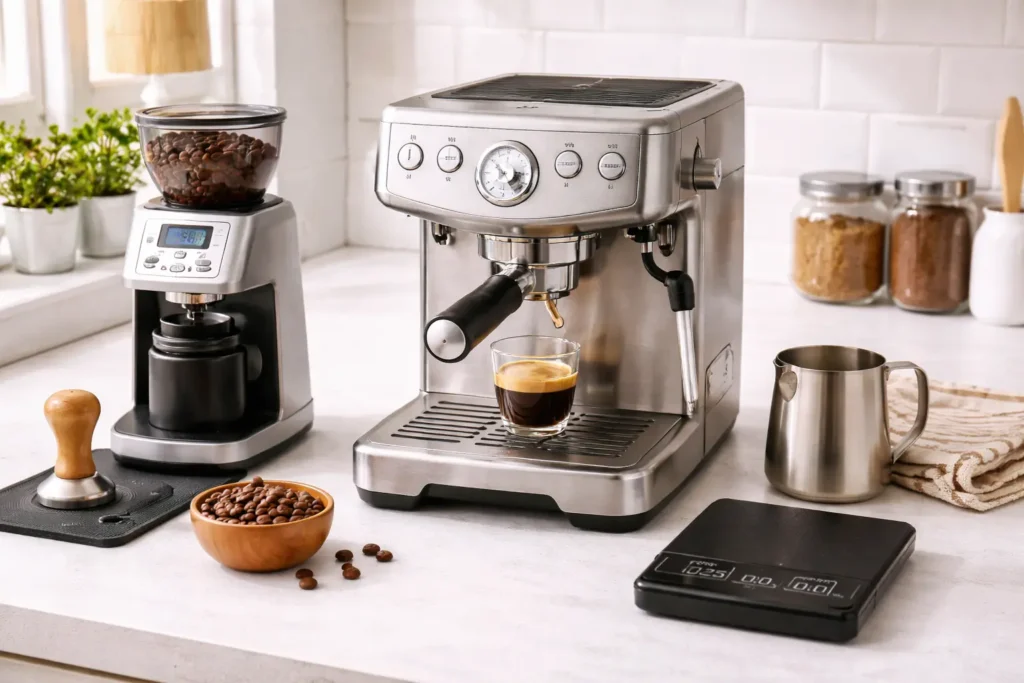
Espresso at home is achievable — but only if you understand what actually determines shot quality. It is not the machine brand. It is not the beans. It is the grinder, the grind setting, the dose, and the yield — in that order. This hub covers every part of the home espresso setup: choosing the right machine for your workflow, the grinder that actually matters, how to dial in your first shots, essential accessories, maintenance, and beans. Start with the section that matches where you are.
📋 Affiliate Disclosure: CoffeeGearHub.com participates in the Amazon Services LLC Associates Program and other affiliate programmes. Links from this page lead to CoffeeGearHub buying guides, which may contain affiliate links — we may earn a commission at no cost to you if you purchase through them. Our editorial recommendations are independent of any commercial relationship.
Quick Start: Your Espresso Setup in 3 Steps
- Pick a machine based on your workflow — milk drinks vs straight shots, fast heat-up vs traditional pressure control. See Espresso Machine Types Explained if you are unsure which type suits you.
- Choose a grinder that can hit espresso-fine consistently — this matters more than the machine upgrade most people think they need first. See Do You Need a Grinder for Espresso? for the honest answer.
- Dial in using dose, grind size, and yield time — then lock it in with a scale. The full process is in Beginner Espresso Guide: Setup, Dial-In, and Your First Perfect Shot.
Espresso Machines
The machine type you choose determines your daily workflow, your learning curve, and how much control you have over shot quality. For beginners, the most important variable is not features — it is fit. A machine you will actually use every day is better than a technically superior machine that frustrates you into giving up. Start with Espresso Machine Types Explained if you are not yet sure which category is right for you.
Start here
Best Espresso Machines for Beginners
The most practical beginner machines compared — including which is safest to buy without an espresso background, and which requires the most learning curve.
Head-to-head
Bambino Plus vs Gaggia Classic Pro
Automatic milk steaming and 3-second heat-up vs traditional workflow and upgrade potential. The two most commonly recommended beginner machines compared directly.
Understanding your options
Espresso Machine Types Explained
Manual, semi-automatic, automatic, and super-automatic — what each type controls, what it gives up, and which is the right starting point for home espresso.
Espresso Grinders (The Upgrade That Matters Most)
If your espresso tastes sour, bitter, or inconsistent shot to shot, the grinder is the most likely cause — not the machine, not the beans, and not your technique. Espresso requires a fine, stable grind that can be adjusted in tiny increments. Most drip-focused grinders cannot reliably produce this. The grinder is the one piece of equipment where buying correctly the first time matters most in an espresso setup.
Main guide
Best Espresso Grinders for Beginners
Dedicated espresso grinders for beginners — what features actually determine espresso quality, which grinders cover pressurised vs non-pressurised baskets, and what you can safely ignore at the entry level.
Grinder dial-in
How to Dial In Espresso
The grinder is only as useful as your ability to use it. The complete dial-in system — grind adjustment, dose, yield, and temperature — applied in the correct order for consistent shots every session.
First question
Do You Need a Grinder for Espresso?
Can you use pre-ground coffee or store-ground beans for espresso? The honest answer — and what difference a dedicated grinder actually makes to shot consistency at home.
Espresso Technique: Setup, Dial-In, and Troubleshooting
The most common reason home espresso fails is not equipment — it is not understanding what the variables do and changing too many of them at once. Espresso has a narrow extraction window: a slightly wrong grind, dose, or yield time produces a clearly wrong cup. Learning to read that cup and make one adjustment at a time is the skill that turns inconsistent home espresso into something repeatable and excellent.
Start here
Beginner Espresso Guide (2026)
The complete setup and dial-in guide for home espresso beginners — machine setup, grind dialling, dose, yield, and a step-by-step process for pulling your first consistent shot.
The numbers
Espresso Brew Ratio Guide
Dose, yield, and the 1:2 ratio standard — what the numbers mean, how ristretto and lungo ratios work, and how ratio interacts with grind and roast level to produce the cup you are aiming for.
Fix bad shots
Espresso Troubleshooting Guide
Sour, bitter, channeling, weak, inconsistent — every common espresso problem diagnosed with the specific adjustments that fix each one. Covers grind, dose, yield, temperature, puck prep, and machine cleanliness.
Espresso Beans
Bean selection is the most commonly underestimated variable in home espresso. Espresso’s high pressure and concentrated extraction amplifies everything the bean has — its sweetness, its acidity, its bitterness, and its defects. Medium to medium-dark roast blends from Brazil and Colombia are the most forgiving starting point for beginners because they have a wider extraction window and produce consistent crema. Light roast single-origins are possible but demanding — they require a more precise grinder and tighter parameters.
Top picks
Best Coffee Beans for Espresso (2026)
Top picks by roast level and flavour profile — from forgiving beginner blends to single-origins for experienced home baristas. Which beans dial in easily and which require precision.
Roast and ratio
Espresso Brew Ratio by Roast Level
Light, medium, and dark roast espresso all require different ratios and temperatures to extract correctly. How roast level changes the parameters you dial in to — and why dark roast needs a shorter yield than light roast.
Labelling explained
Espresso Beans vs Coffee Beans
Are espresso beans actually different from regular coffee beans? The real answer — what the label means, what it does not mean, and how to choose beans for espresso regardless of what the bag says.
Espresso Accessories
Once the machine and grinder are in place, a small set of accessories makes espresso consistently better and easier to repeat. The scale is the most impactful first purchase — without weighing dose and yield, every shot is different and you have no reliable way to know what changed. After that, accessories that improve puck prep reduce channeling, which is the single most common cause of inconsistent espresso extraction.
Best Coffee Scales for Home Brewing
A scale accurate to 0.1g is the most impactful espresso accessory after the grinder. Weighing dose and yield turns every shot into a repeatable recipe rather than a guess.
Best Milk Frothers for Lattes
For home espresso drinkers who make lattes, cappuccinos, and flat whites — which milk frother produces actual microfoam vs dry bubbles, and what the difference means for your drink.
Best Coffee Gear for Beginners
A full beginner checklist covering every piece of equipment worth buying — grinder, scale, kettle, and accessories — with the honest answer about what actually improves espresso at home vs what is optional.
What to prioritise: Scale first (biggest consistency impact), then a proper tamper that fits your portafilter basket, then a distribution tool if you are experiencing channeling. Knock box, WDT tool, and puck screen are worth adding once the fundamentals are locked in. All espresso machine and grinder links on this page go to CoffeeGearHub buying guides — not directly to Amazon.
Espresso Machine Maintenance
Espresso machines contain boilers, pumps, solenoid valves, and seals that degrade predictably over time — but only if not maintained. The most common cause of declining shot quality in an otherwise good home machine is neglected cleaning: old coffee oils in the group head, mineral scale in the boiler, and a portafilter basket clogged with dried grounds. A basic maintenance routine takes under five minutes per session and extends machine life significantly. Descaling frequency depends on your water hardness — in hard water areas it is needed more often than most machine manuals specify.
Espresso Machine Maintenance Guide
The complete long-term care guide for home espresso machines — daily habits, weekly cleaning, monthly checks, descaling schedule, and what to do when performance drops.
How to Descale an Espresso Machine
Step-by-step descaling for home espresso machines — when to do it, which descaler to use, and how to tell if your machine is scaling up faster than expected.
Grinder Cleaning and Retention
Espresso grinder burrs accumulate coffee oils that go rancid faster than most home brewers expect — producing a flat, stale taste that gets blamed on beans. How to clean correctly and how often.
FAQs: Espresso at Home
Is espresso at home hard for beginners?
It does not have to be. Choose a beginner-friendly machine, pair it with a grinder that can grind consistently fine, and start with simple dial-in rules: dose, yield, and time. Most frustration comes from using a grinder that cannot reliably hit the espresso grind range. Read the Beginner Espresso Guide for the full setup process.
Do I really need a special grinder for espresso?
For true espresso, yes. Espresso needs a fine, consistent grind that stays stable shot to shot. Most drip-focused grinders cannot grind fine enough or produce too many inconsistent particles at the espresso range, which makes dialling in extremely difficult. See Do You Need a Grinder for Espresso? and Best Espresso Grinders for Beginners for specific picks.
What’s better for beginners: Bambino Plus or Gaggia Classic Pro?
The Bambino Plus heats up in 3 seconds, has automatic milk steaming, and is genuinely beginner-proof. The Gaggia Classic Pro is more hands-on, more upgrade-friendly, and better for someone who wants to develop espresso technique over time. The right choice depends on whether you want convenience or a more traditional workflow. The full comparison is at Bambino Plus vs Gaggia Classic Pro.
What accessories improve espresso the most?
A scale is the biggest single consistency upgrade — it turns every shot into a repeatable recipe. After that, a good tamper that fits your basket and a simple distribution tool reduce channeling significantly. If you make milk drinks, a proper milk pitcher and thermometer matter more than most people expect. Best Milk Frothers for Lattes covers the frothing options.
What’s a realistic budget for a beginner home espresso setup?
A practical beginner setup combines an entry to mid-range semi-automatic machine — such as the Breville Bambino Plus or Gaggia Classic Pro — with a dedicated entry-level espresso grinder that can reliably hit the espresso grind range. The Breville Smart Grinder Pro and Baratza Virtuoso+ are the standard entry espresso grinder recommendations. The grinder matters more than the machine upgrade — a better grinder on a modest machine outperforms a great machine with an inadequate grinder. Budget for both from the start rather than buying the cheapest option in each category.
What roast level is best for home espresso?
Medium to medium-dark roast is the most forgiving range for home espresso — it produces consistent crema, tolerates a wider extraction window, and pairs well with milk. Light roast espresso is possible but requires a more precise grinder and tighter parameters. Very dark roast can taste bitter if over-extracted, which happens easily at espresso’s fine grind and high pressure. See Best Coffee Beans for Espresso for roast-matched picks.
How often should I clean my espresso machine?
Rinse the portafilter and group head after every session. Run a backflush cycle weekly if your machine supports it. Clean the steam wand immediately after every use — milk dries and clogs the tip within minutes. Descale every 2–3 months in average water hardness, more often in hard water areas. Full schedule at Espresso Machine Maintenance Guide.
☕
About CoffeeGearHub
CoffeeGearHub is a specialty coffee equipment resource run by home brewers and coffee enthusiasts. Our guides are researched using published brewing science, SCA standards, manufacturer specifications, and established specialty-coffee community knowledge. All buying guides on this site may contain affiliate links — we may earn a commission at no cost to you. About CoffeeGearHub →