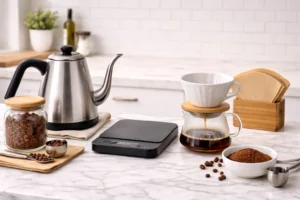
Last Updated: March 2026 • 15–20 min read • Complete Guide: Scale Science + Feature Breakdown + Product Picks + Usage Guide + Troubleshooting Matrix
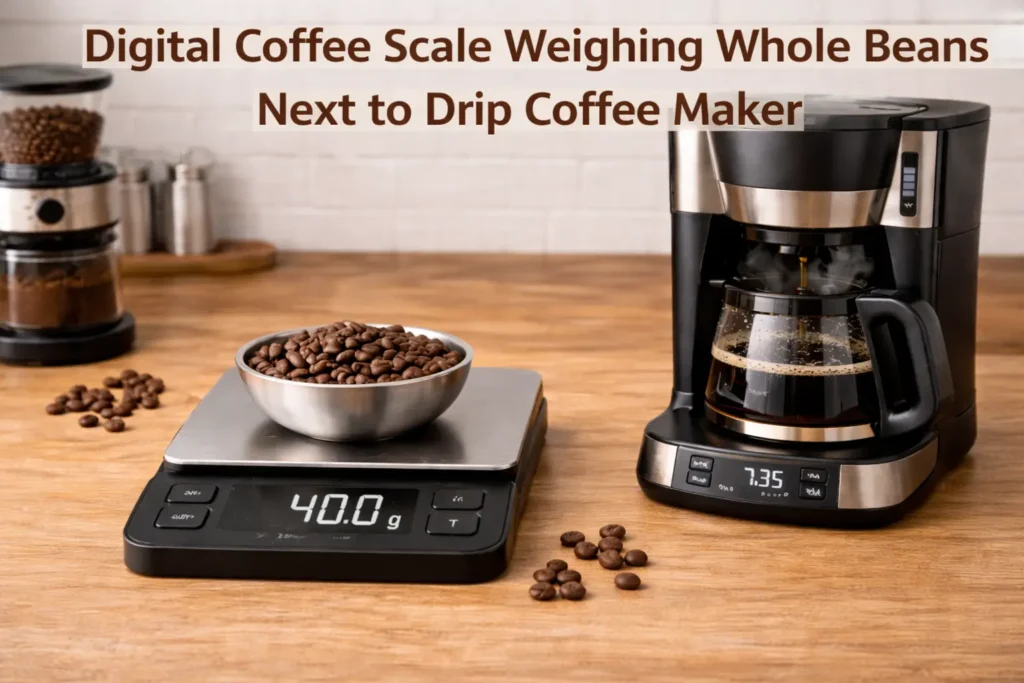
Are you searching for the best coffee scales? A coffee scale is the single most impactful brewing accessory available for most home brewers — more than a new coffee maker, more than a grinder upgrade, and more than any recipe change. Measuring coffee and water by weight instead of scoops makes your ratio repeatable, makes weak or bitter results diagnosable, and makes every adjustment you make to grind size or recipe actually mean something. This guide covers what actually matters in a coffee scale, which features help depending on your brewing method, product picks at every budget, a step-by-step usage guide for drip and pour-over, and a complete troubleshooting matrix for the most common scale problems.
✍️ Editorial note: This guide is researched and written by the editors at CoffeeGearHub.com using brewing science, SCA standards, and established specialty-coffee community knowledge. All product links are affiliate links — we may earn a commission at no cost to you. Affiliate Disclosure: CoffeeGearHub.com participates in the Amazon Services LLC Associates Program. As an Amazon Associate, we earn from qualifying purchases.
The 30-Second Answer
For most home brewers, the Timemore Black Mirror Basic Plus is the correct recommendation — fast response, 0.1g accuracy, a built-in timer, and a clean interface that works for drip, pour-over, and beginner espresso. If budget is the only constraint, the Greater Goods Digital Coffee Scale delivers accurate ratios for drip coffee at a fraction of the cost. For dedicated pour-over brewers who want a coffee-specific classic, the Hario V60 Drip Scale remains a reliable, simple option. Whatever you choose: a scale with 0.1g resolution and at least 2kg capacity is all you need for any home brewing setup.
- Best overall: Timemore Black Mirror Basic Plus — fastest response, works for every brew method
- Best budget: Greater Goods Digital Coffee Scale — accurate drip ratios, no unnecessary features
- Best pour-over classic: Hario V60 Drip Scale — simple timer interface, coffee-first design
- Resolution needed: 0.1g minimum — 1g resolution hides meaningful dose changes
- Capacity needed: 2kg+ — full carafes and drip basket combined can exceed lower limits
- Timer: Essential for pour-over and espresso; optional for automatic drip
Quick-Pick Comparison Table
Use this table to find the right scale for your setup in under a minute. Detailed reviews, usage instructions, and troubleshooting follow below.
Disclosure: CoffeeGearHub may earn a commission on qualifying purchases. All links use the coffeegearhub-20 Associates tag.
| Our Pick | Best For | Resolution | Capacity | Timer | Key Advantage | Link |
|---|---|---|---|---|---|---|
| 🏆 Timemore Black Mirror Basic Plus | All-around daily use — drip, pour-over, espresso beginners | 0.1g | 2kg | Yes — built-in | Fastest refresh rate in class; USB-C charging; reliable day-to-day for every method | Check Price → |
| ⚡ Greater Goods Digital Coffee Scale | Budget drip brewing — accurate ratios, no extra features | 0.1g | 3kg | No | Highest capacity in its tier; simple controls; best price-to-accuracy ratio for drip | Check Price → |
| ☕ Hario V60 Drip Scale | Pour-over focused brewers who want a coffee-specific design | 0.1g | 2kg | Yes — integrated | Purpose-built for coffee; dead-simple interface; established community resource | Check Price → |
Jump to What You Need
☕ Ready to buy
Use the Quick-Pick Table above or go to Product Picks for full reviews with buy links.
🔬 Want to understand the features
See What Actually Matters in a Scale and the Brew Method Feature Table before deciding.
📋 How to use your scale
See How to Use a Coffee Scale for exact steps by brew method — drip, pour-over, and espresso.
🔧 Fixing scale problems
Jump to the Troubleshooting Matrix for drift, slow readings, calibration, and battery issues.
Table of Contents
Why a Scale Improves Coffee More Than Any Other Accessory
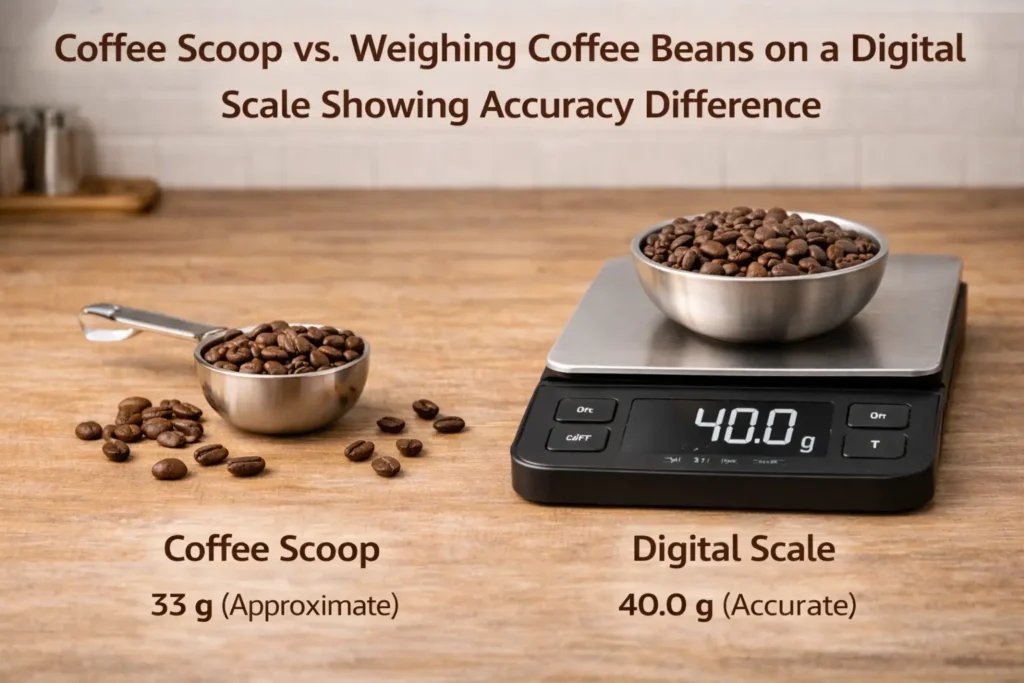
Volume scoops introduce variation that compound silently. Beans vary in density by roast level — a scoop of light-roast beans weighs measurably less than a scoop of dark roast, which means your “same recipe” is a different ratio every time you switch beans. Grind coarseness further changes how much fits in a scoop. And water volume markings on carafes and machines are regularly inaccurate by 5–15%. Every one of those variables produces a different cup while everything else appears unchanged.
A scale collapses all of that variation into one controlled number. Once dose and water weight are fixed, flavor problems become traceable: a cup that tastes weak is under-extracted or under-dosed; one that tastes bitter is over-extracted or too fine. Without a scale, you’re adjusting variables you’re not actually measuring — which means every fix is still a guess.
🚫 Volume scoops cannot produce consistent coffee — by design. A standard coffee scoop is defined by volume, not weight. Coffee density varies by up to 20% between different roast levels and grind sizes. That means the same scoop delivers a measurably different dose every time the bean or grind changes. No recipe tweak, no technique adjustment, and no machine upgrade fixes this — only weighing eliminates it.
☕ New to home brewing? Start with the Coffee Brewing Foundations guide before adding a scale to your routine.
What Actually Matters in a Coffee Scale
Most coffee scale marketing focuses on the wrong things. App connectivity, flow rate tracking, and automatic brew mode detection are real features — but none of them affect whether you produce a consistently good cup. These four specifications do.
| Specification | Why it matters | What to look for | What to avoid |
|---|---|---|---|
| Resolution (0.1g) | 1g resolution hides meaningful dose changes — a 1g difference in a 20g dose is a 5% ratio shift, which is perceptible in the cup | 0.1g resolution minimum for any serious brewing; 0.01g for espresso | Kitchen scales with 1g or 2g resolution; scales that round to the nearest gram |
| Response speed (refresh rate) | Slow scales lag during pour-over, making it impossible to read and adjust flow rate in real time; lag also creates frustrating waits during dosing | Look for 20Hz refresh rate or faster; any review mention of “snappy” or “fast response” signals adequate speed | Budget kitchen scales that update every 2–3 seconds; scales described as “sluggish” in community reviews |
| Capacity (2kg+) | Drip brewers need to weigh a full carafe of water plus a mug or server; combined weight easily exceeds 1.5kg on a 12-cup setup | 2kg minimum for drip coffee; 3kg if you frequently brew large batches | Scales marketed as “espresso scales” with 500g–1kg capacity limits — unsuitable for drip use |
| Timer (built-in) | For pour-over, bloom timing and total brew time are the primary control variables; a separate phone timer adds an extra step that interrupts flow | Built-in independent timer that starts with a tap without interrupting the weight display | Scales without timers for pour-over use; timers that reset when the scale is tared |
Features by Brew Method
Not every feature matters equally for every brewing style. Use this table to identify which specifications are non-negotiable for your setup before comparing products.
| Brewing style | Resolution | Response speed | Capacity | Timer | Priority note |
|---|---|---|---|---|---|
| Automatic drip coffee | 0.1g | Moderate — you set and walk away | 2kg+ essential | Optional — machine controls brew time | Capacity and accuracy are the critical specs; timer is a bonus, not a requirement |
| Pour-over (V60, Kalita Wave) | 0.1g | Fast — essential for real-time pour adjustment | 1kg sufficient for most sessions | Yes — bloom and total time are primary controls | Response speed and timer are both non-negotiable; this is where Timemore outperforms budget options most clearly |
| Espresso | 0.1g minimum; 0.01g ideal | Very fast — dose and yield both measured in seconds | 500g–1kg sufficient | Yes — shot time is a key extraction variable | Dedicated espresso scales exist; the Timemore covers beginner espresso adequately at 0.1g resolution |
| French press and cold brew | 0.1g | Slow acceptable — long brew, no active pours | 2kg+ helpful for large batches | Optional — steep time usually managed separately | Any 0.1g scale with adequate capacity works; no need for fast response |
Product Picks: Full Reviews
Disclosure: CoffeeGearHub may earn a commission on qualifying purchases through affiliate links on this page. CoffeeGearHub.com participates in the Amazon Services LLC Associates Program. As an Amazon Associate, we earn from qualifying purchases. Our editorial recommendations are independent of any commercial relationship.
🏆 CoffeeGearHub Pick — Best Overall Coffee Scale
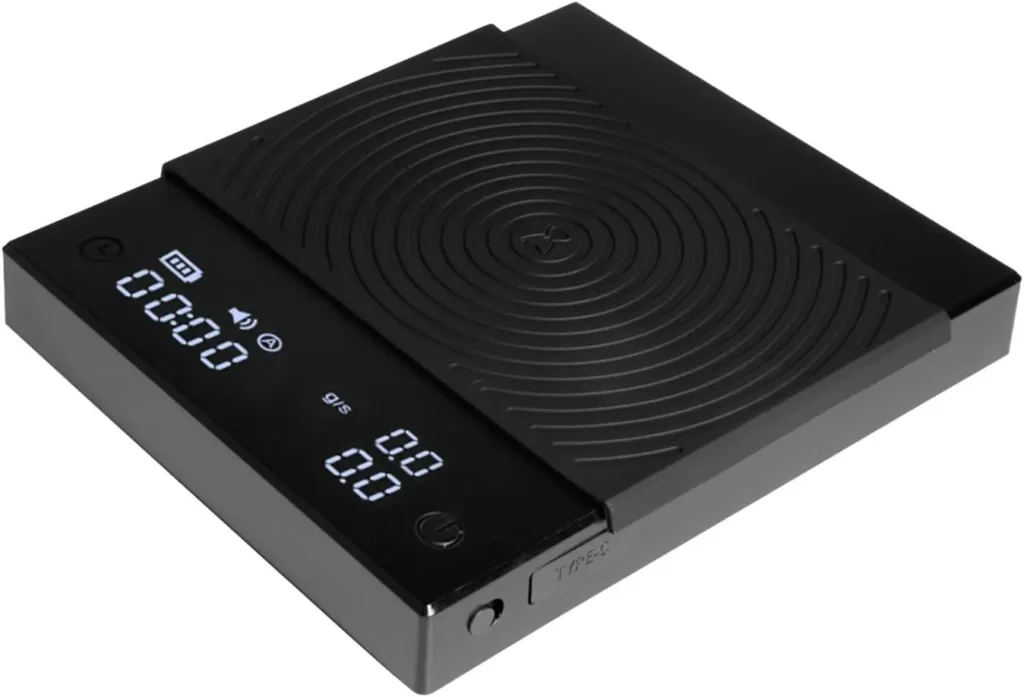
Timemore Black Mirror Basic Plus — Best Overall Coffee Scale
The Timemore Black Mirror Basic Plus is the CoffeeGearHub recommendation for home brewers who want one scale that works correctly for every method. Its 20Hz refresh rate — approximately five times faster than most budget scales — is what makes it meaningfully different in real brewing conditions: during a V60 pour, you can read and adjust flow rate in real time rather than chasing a lagging number. The 0.1g resolution handles drip and pour-over precisely, and the built-in dual-mode timer (count up or countdown) covers bloom timing without reaching for your phone. USB-C charging means no proprietary cable or battery replacement cycle. The flat glass surface is easy to wipe down, and the minimal interface — two buttons — removes all cognitive overhead from the brewing routine. For home brewers who use their scale daily across multiple brew methods, this is the purchase that removes scale performance as a limiting variable entirely.
- Resolution: 0.1g — correct for drip, pour-over, and beginner espresso
- Response speed: ~20Hz — fastest in its price tier; real-time pour adjustment is genuinely usable
- Capacity: 2kg — covers full drip carafes and large pour-over batches
- Timer: Built-in dual-mode (count up / countdown) — operates independently of weight display
- Power: USB-C rechargeable — no AA batteries; charges via any USB-C cable
- Best for: Daily home brewers using any combination of drip, pour-over, and beginner espresso
Disclosure: CoffeeGearHub may earn from qualifying purchases.
⚡ Best Budget Pick — Accurate Drip Ratios, No Extra Cost
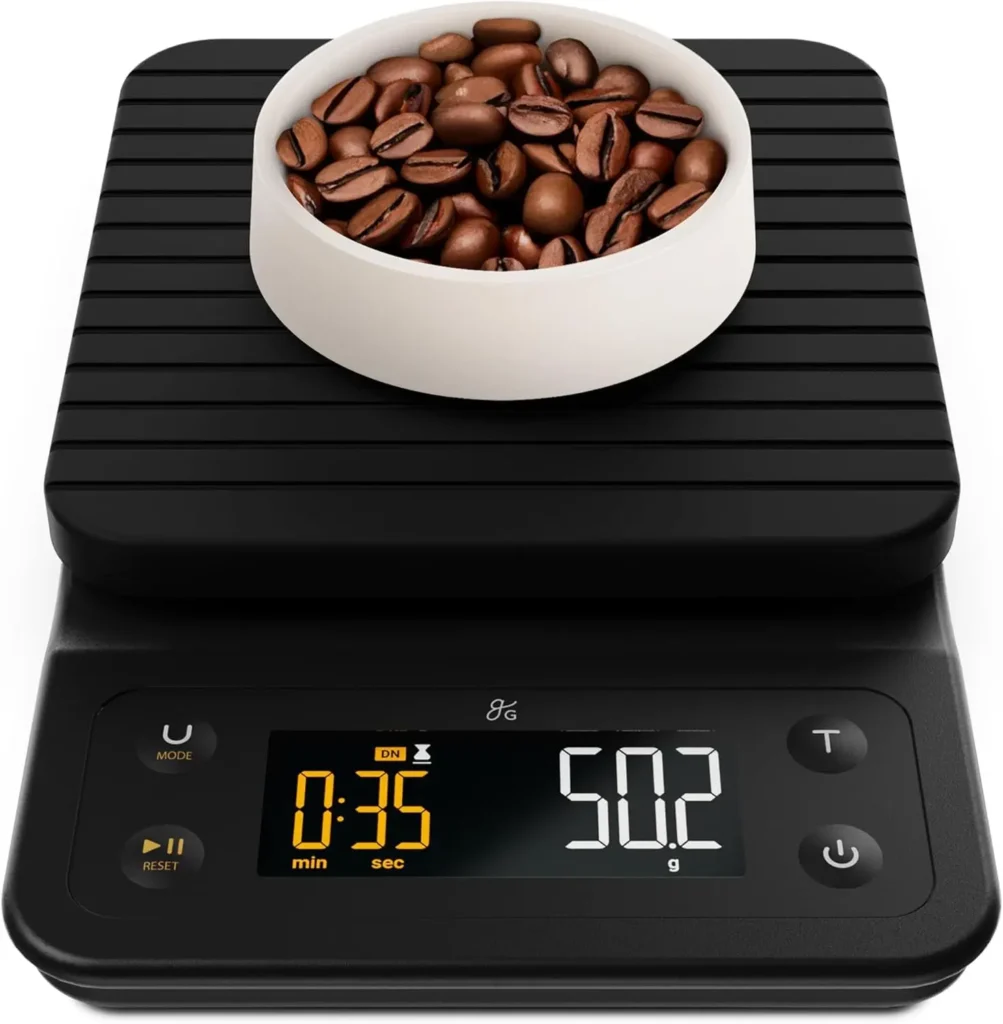
Greater Goods Digital Coffee Scale — Best Budget Pick
The Greater Goods Digital Coffee Scale is the clearest recommendation when budget is the primary constraint and your main brewing method is automatic drip. For drip coffee, you set your dose, walk away, and the machine does the rest — which means the scale’s slower refresh rate and lack of built-in timer are non-issues. The 0.1g resolution produces accurate, repeatable ratios from the first use, which is the entire job for drip brewing. The 3kg capacity is the highest available at this price tier and ensures full 12-cup carafe setups have room to spare. Simple two-button operation means nothing to learn and nothing to go wrong. If your goal is to stop guessing and start hitting a consistent 1:16 drip ratio every morning, this scale does that job completely without any unnecessary features inflating the price.
- Resolution: 0.1g — accurate for drip coffee and basic pour-over
- Capacity: 3kg — highest in its price tier; no capacity issues on any drip setup
- Timer: No built-in timer — not a problem for automatic drip; a limitation for active pour-over
- Interface: Two buttons — tare and unit toggle; nothing to learn
- Best for: Drip coffee brewers who want accurate ratios on a budget; anyone who doesn’t need a timer
Disclosure: CoffeeGearHub may earn from qualifying purchases.
☕ Pour-Over Classic — Coffee-First Design, Simple Interface
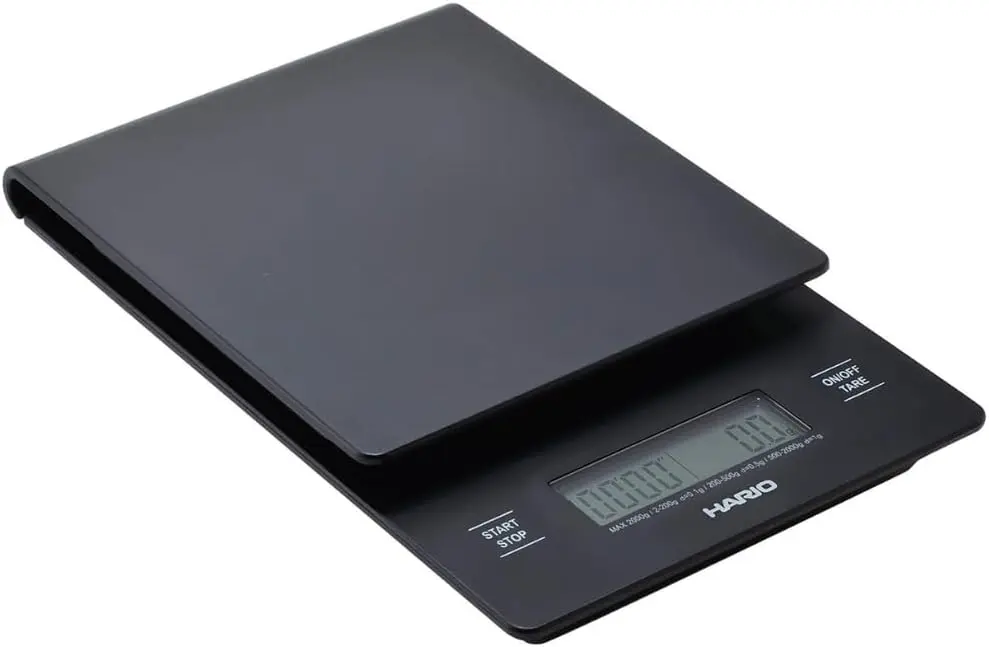
Hario V60 Drip Scale — Best Pour-Over Classic
The Hario V60 Drip Scale has been the reference pour-over scale for over a decade — not because it has the most features, but because it has exactly the right ones and nothing extra. The interface is two buttons: one for power and tare, one for the timer. That simplicity is the point. The scale is coffee-first in its design: the flat, compact footprint sits cleanly under a V60 dripper and server without overhang, the display is readable at counter height, and the timer starts and stops without interrupting the weight reading. Its refresh rate is slower than the Timemore, which becomes noticeable during fast aggressive pours — but for brewers following a controlled, steady spiral technique, it performs correctly. The Hario’s position as a community standard also means every pour-over recipe guide, YouTube video, and technique reference uses it as a baseline, which eliminates translation friction when following external resources.
- Resolution: 0.1g — accurate for drip and pour-over; adequate for beginner espresso
- Capacity: 2kg — sufficient for most pour-over and small drip setups
- Timer: Built-in — two-button interface; starts and stops without interrupting weight display
- Design: Coffee-first footprint — compact, flat surface sized for V60 dripper + server
- Community standard: Used in the majority of pour-over recipes and tutorials — no translation needed
- Best for: Pour-over focused brewers; anyone following Hario V60 recipes and community resources
Disclosure: CoffeeGearHub may earn from qualifying purchases.
☕ Scale sorted — now dial in your ratio. The drip coffee ratio guide covers exact gram targets for every carafe size using the SCA Golden Cup standard.
How to Use a Coffee Scale: Step-by-Step by Brew Method
The mechanics of using a scale are simple — tare, dose, tare, water — but the exact sequence differs slightly by brew method. These are the minimum steps needed to produce a consistent, ratio-controlled cup with any of the three recommended scales.
🔬 The SCA Golden Cup standard for drip coffee is 55g of coffee per litre of water (approximately 1:18). Most home brewers use significantly less — typically 30–40g per litre — which produces weak, dilute results that are often mistaken for a bean or grinder problem. Start at 55g/L and adjust from there. For pour-over, start at 1:15 (60g/L) for a slightly stronger, more expressive cup.
| Brew method | Step-by-step | Starting ratio | Common mistake |
|---|---|---|---|
| Automatic drip coffee | 1. Place empty carafe on scale, tare. 2. Remove carafe. 3. Weigh coffee into filter basket using your target dose. 4. Fill water reservoir — weigh water directly into reservoir or by filling a separate vessel. 5. Brew. | 55g per litre (1:18) — SCA Golden Cup | Weighing coffee but measuring water by the machine’s markings — the markings are almost always inaccurate |
| Pour-over (V60, Kalita) | 1. Place dripper + server on scale, tare. 2. Add ground coffee, tare again. 3. Start timer. 4. Pour bloom water (2–3× coffee weight) — watch scale and stop at target. 5. Continue pours to total water target. 6. Note total time when dripper empties. | 1:15 (60g/L) — e.g. 20g coffee : 300g water | Not taring after adding grounds — means water weight reads as combined coffee+water weight, making ratio useless |
| French press | 1. Place empty French press on scale, tare. 2. Add ground coffee, tare. 3. Add hot water to target weight. 4. Start timer separately. 5. Steep 4 minutes, press, pour. | 1:15 to 1:17 depending on preference | Adding water by volume (kettle fill marks) instead of weighing — introduces the same scoop-level variation |
| Espresso (beginner) | 1. Tare portafilter on scale. 2. Dose ground coffee to target weight (typically 18–20g). 3. Place shot glass or cup on scale under group head, tare. 4. Pull shot — stop when yield reaches target (typically 36–40g out). 5. Note shot time. | 1:2 ratio (18g in : 36g out) — standard double | Measuring dose but not yield — controlling input without controlling output produces unpredictable extraction |
Troubleshooting Matrix: Coffee Scale Problems → Causes → Fixes
Scale problems are usually one of three things: surface or placement issues, battery or power issues, or the scale itself being the wrong tool for the brew method. Identify your symptom below and fix in the order listed before changing anything else about your recipe.
| Symptom | Most likely cause | Fix — in order |
|---|---|---|
| Reading drifts or changes slowly while brewing | Vibration from the brewing machine transmitted through the counter to the scale; or a slow refresh rate struggling to settle on a reading during active pour | Place the scale on a separate surface from the machine — a folded silicone mat or a different counter section breaks vibration transmission → if still drifting, the scale may have a slow refresh rate unsuitable for active pour-over; consider the Timemore for faster response |
| Scale shows different readings for the same weight between sessions | Debris or coffee grounds under the weighing platform affecting the load cell; or the scale was stored tilted or in temperature extremes | Remove the weighing platform and brush all load cell contact points clean with a dry brush → place on a flat surface and power cycle → weigh a known object (sealed bottle with printed fill weight) to verify |
| Scale reading is too slow for pour-over — I can’t react to it | Low refresh rate (2–4Hz) — common in budget and kitchen scales; the display updates only every 250–500ms, making real-time pour control impossible | This is a hardware limitation — the only fix is upgrading to a faster scale; the Timemore Black Mirror Basic Plus refreshes at ~20Hz and is the correct tool for active pour-over control |
| Scale turns off mid-brew | Auto-off function activating during the brew when no weight change is detected — common when waiting during bloom or steep | Check the scale settings for an auto-off timer and disable it or extend it → tap the scale surface gently to reset the auto-off countdown during long wait periods → some scales have a dedicated “brew mode” that disables auto-off; check your manual |
| Battery dies quickly | Old or low-quality AA/AAA batteries; or the scale is not auto-powering off between uses | Replace with fresh alkaline batteries (not rechargeable NiMH — voltage is lower and causes erratic behavior on some scales) → confirm auto-off is enabled → USB-C rechargeable scales like the Timemore eliminate this problem entirely |
| Coffee still tastes different even with consistent scale readings | Dose is consistent but water is still being measured by volume (machine markings) rather than weight; or grind setting is changing between sessions | Confirm you are weighing water by grams, not using the machine’s reservoir markings → confirm your grinder setting has not shifted — manual grinders can drift if the adjustment ring is not locked → verify beans are from the same roast batch (different batches extract differently at the same dose) |
| Scale reads zero or error when large carafe is placed on it | Over-capacity error — the combined weight of the vessel plus liquid exceeds the scale’s maximum capacity | Check your scale’s maximum capacity — most affordable scales are rated at 1–2kg; a full 12-cup carafe plus glass server can approach 1.8–2kg → if over capacity, the Greater Goods (3kg) or a kitchen scale with higher capacity is the correct tool for this setup |
| Scale accurate for small doses but reads inconsistently above 500g | Load cell designed for espresso-range precision losing accuracy at the high end of its range; or scale needs recalibration | Verify the scale’s rated accuracy across its full range — some “espresso scales” are accurate to 0.1g below 300g but degrade at higher weights → recalibrate if the scale has a manual calibration mode → for drip coffee, choose a scale rated for accuracy across its full 2kg capacity |
🔧 Still getting inconsistent cups despite weighing? The problem is likely grind or ratio — use the drip coffee mistakes guide for a step-by-step diagnosis.
FAQs: Best Coffee Scales for Home Brewing
Do I really need a coffee scale for home brewing?
If you want consistent coffee, yes. A scale makes your coffee-to-water ratio repeatable — so you can recreate good cups and fix bad ones without guessing. It is the single most impactful accessory upgrade available for most home brewers.
What is the best accuracy for a coffee scale?
A coffee scale with 0.1g resolution is ideal for drip and pour-over. It is precise enough that a 1g dose change produces a noticeable ratio shift — which is exactly what you need for meaningful recipe control. For espresso, 0.01g resolution provides additional precision for yield measurement, but 0.1g is adequate for beginners.
Can I use a regular kitchen scale instead of a coffee scale?
You can, but many kitchen scales update slowly (every 2–3 seconds) and lose accuracy at low weights. That lag makes pour-over timing harder and small recipe adjustments less readable — even if the scale technically produces a number. For pure drip coffee where you set and walk away, a kitchen scale with 0.1g resolution works adequately.
Do I need a coffee scale with a built-in timer?
A timer is helpful for pour-over and espresso — where bloom timing and shot duration directly affect flavor — but it is optional for automatic drip coffee, where the machine controls brew time. Accuracy and fast response speed matter more than a timer for most home setups.
What capacity should a coffee scale have for drip coffee?
Look for at least 2kg (2000g) capacity. Full 12-cup carafes plus the weight of the glass server can approach 1.8kg, which pushes low-capacity scales into error territory. The Greater Goods scale at 3kg capacity is the highest available in the budget tier.
Why does my scale drift or change numbers while brewing?
Drift usually comes from vibration transmitted from the brewing machine through the counter surface to the scale, a slow refresh rate that cannot settle fast enough during active pouring, or debris under the weighing platform affecting the load cell. Placing the scale on a separate surface from the machine resolves most drift problems.
What is the easiest way to use a coffee scale for drip coffee?
Place your empty carafe on the scale and tare it. Remove the carafe, weigh coffee into your filter basket, then fill the water reservoir by weight — 55g of coffee per litre of water is the SCA Golden Cup starting point. For a 6-cup (750ml) carafe, that is approximately 41g of coffee and 750g of water. This removes all volume guesswork in one step.
Will a coffee scale actually make my coffee taste better?
Indirectly, yes. A scale does not change your beans or grinder, but it makes brewing consistent enough that flavor problems become diagnosable and fixable. Once dose and water weight are controlled, adjusting grind size or ratio produces a clear, repeatable result rather than a guess. Most brewers notice an improvement within the first week.
How do I calibrate a coffee scale?
Most consumer coffee scales are factory-calibrated and do not require manual calibration. If readings seem consistently off, check for debris under the weighing platform, verify the scale is on a completely flat surface, and test with a known-weight sealed object. Many scales have a calibration mode accessible through a button hold sequence — consult your manual for the specific procedure.
Is the Timemore Black Mirror worth the extra cost over budget scales?
Yes for most home brewers. The Timemore’s faster refresh rate — approximately 20Hz versus 2–4Hz on budget scales — makes a meaningful difference for pour-over, where you adjust flow rate in real time based on the scale reading. For pure drip coffee where you set and walk away, the difference is smaller, but the Timemore’s USB-C charging, durability, and clean interface make it the better long-term purchase at a relatively small price premium.
Continue Learning
DIAL IN YOUR TECHNIQUE
Scale sorted — now lock in your grinder. The Best Coffee Grinders guide covers every option from the KINGrinder K6 through entry electric picks — the next most impactful upgrade after a scale for most home brewers.
☕
Written by the CoffeeGearHub Editorial Team
CoffeeGearHub is a specialty coffee equipment resource run by home brewers and coffee enthusiasts. Our guides are researched using published brewing science, SCA standards, and established specialty-coffee community knowledge. We review and update our pillar content regularly. About CoffeeGearHub →