
Coffee Grind Sizes
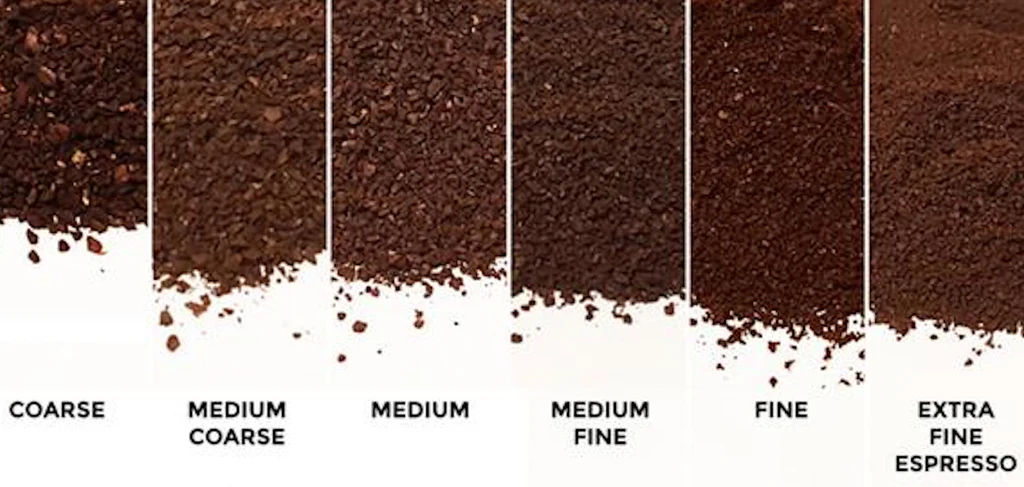
Editorial standards: grind-size labels and grinder numbers are treated as starting references. Final settings should be confirmed on the actual grinder, brewer, coffee, and recipe.
At a glance
What this guide covers
A coarse-to-fine chart, brew-method starting ranges, extraction science, a repeatable dial-in workflow, ratio vs grind, troubleshooting, environmental variables, and grinder selection.
Editorial analysis
Use the chart to start—use taste to finish
“Medium,” “fine,” and grinder setting numbers are not standardized. The useful setting is the one that produces the right flow and flavor on your equipment. Treat charts as navigation, not calibration.
The 30-Second Answer
Start from the brew method, then dial in by flow and taste. Espresso is generally fine, pour-over medium-fine to medium, drip medium, French press medium-coarse to coarse, and cold brew coarse—but grinder numbers and visual textures are not universal.
Coffee Grind Sizes Chart: Starting Ranges
Use this chart as a directional starting point, not a universal setting. Grinder numbers and particle-size labels are not standardized.
| Brew method | Starting grind direction | What moves you finer | What moves you coarser |
|---|---|---|---|
| Turkish | Extra fine / powder-like | Weak body or incomplete extraction | Excessive sludge or difficult preparation |
| Espresso | Fine | Target yield arrives too fast and tastes thin | Shot stalls or tastes harsh/dry |
| Moka pot | Fine, usually coarser than espresso | Weak, fast brew | Stalling, sputtering, harshness |
| AeroPress | Medium-fine to medium | Short recipe tastes thin | Long immersion becomes harsh or difficult to press |
| Pour-over | Medium-fine to medium | Fast drawdown, sour/thin cup | Stalled drawdown, harsh/dry cup |
| Drip coffee | Medium | Weak cup with fast contact | Slow basket flow or harshness |
| French press | Medium-coarse to coarse | Weak or hollow immersion | Excessive silt, bitterness, difficult plunge |
| Cold brew | Coarse | Weak concentrate at the chosen steep time | Harshness or difficult filtration |
Why Coffee Grind Sizes Matter (Extraction Science Without the Confusion)
Grind size is the most powerful variable in coffee brewing because it controls two distinct physical processes at once. The first is surface area: a finer grind exposes far more of the coffee particle to water, which dramatically increases how quickly flavor compounds dissolve. The second is flow resistance: finer particles pack together more tightly, slowing water movement and increasing contact time. Change grind size and you’re changing both chemistry and physics simultaneously — which is why a single grind adjustment can transform a cup more than any other tweak.
Coffee doesn’t extract all at once. Flavor compounds dissolve in a predictable sequence: quick-releasing acids and bright aromatics come out first, followed by sugars and body-building compounds, and finally the heavy bitter tannins and astringent phenols that nobody wants. The goal of correct coffee grind sizes isn’t maximum extraction — it’s stopping in the sweet middle, after the sugars are out but before the bitterness takes over. Grind too coarse and water moves too fast to reach that zone. Grind too fine and water lingers too long and goes past it.
Under-Extraction vs Over-Extraction: What You’re Actually Tasting
When a cup tastes sour, sharp, or hollow, the water didn’t spend enough time in contact with the grounds to pull out the full range of flavor — specifically the sweetness and body that balance early-extracting acids. When a cup tastes bitter, harsh, or drying, the opposite happened: water contacted the grounds for too long or too intimately, dragging out compounds that should have stayed in the grounds. Understanding this helps make grind adjustments feel intuitive rather than arbitrary.
| What You Taste | What It Means | Best First Fix |
|---|---|---|
| Sour, sharp, salty, thin | Under-extraction — acids present, sweetness missing | Grind finer (or slightly extend brew time) |
| Bitter, harsh, drying, woody | Over-extraction — bitter compounds pulled | Grind coarser (or shorten contact time) |
| Hollow, flat, “empty” | Usually under-extracted or uneven flow | Grind slightly finer; improve pouring consistency |
| Muddy, silty, heavy sediment | Excessive fine particles for the brew method | Grind coarser; consider upgrading grinder |
Why Consistency Beats Having the “Perfect” Setting
A grind setting only produces predictable results when it creates a uniform particle distribution. The real enemy of good coffee isn’t wrong grind size — it’s uneven grind size. Budget blade grinders and worn burr sets produce a mix of extremely fine dust and oversized chunks in the same batch. The fine particles over-extract (contributing bitterness) while the large chunks under-extract (contributing sourness) — which is why cheap-grinder coffee can taste both sour and bitter at once, a combination that seems contradictory until you understand what’s happening in the cup.
This is also why changing grind settings on a low-quality grinder often doesn’t produce the expected result: you’re shifting the center of a very wide, chaotic distribution rather than making a clean, precise adjustment. If adjustments feel unpredictable, the issue may be the grinder rather than your technique.
A Repeatable Grind-Size Dial-In Workflow
1. Lock the recipe first
Keep coffee dose, water amount, brewer, filter, temperature, and pouring or steeping structure as stable as practical. Otherwise you cannot tell whether grind caused the change.
2. Watch flow or resistance
Use brew time, drawdown, press resistance, or espresso flow as diagnostics—not universal pass/fail targets. Compare with a previous brew that tasted good on the same setup.
3. Adjust grind by taste and flow together
If the brew is sharp, thin, and clearly moving too fast, go finer. If it is harsh, drying, stalled, or unusually slow, go coarser. If flavor is balanced but strength is wrong, ratio may be the better variable.
4. Fine-tune secondary variables later
Once grind is close, use ratio, temperature, agitation, or steep structure as secondary levers. Change one variable at a time.
Make grind changes measurable
A capable grinder plus a scale is enough to start
Grind-size troubleshooting gets easier when the grinder can make repeatable changes and the recipe stays fixed.
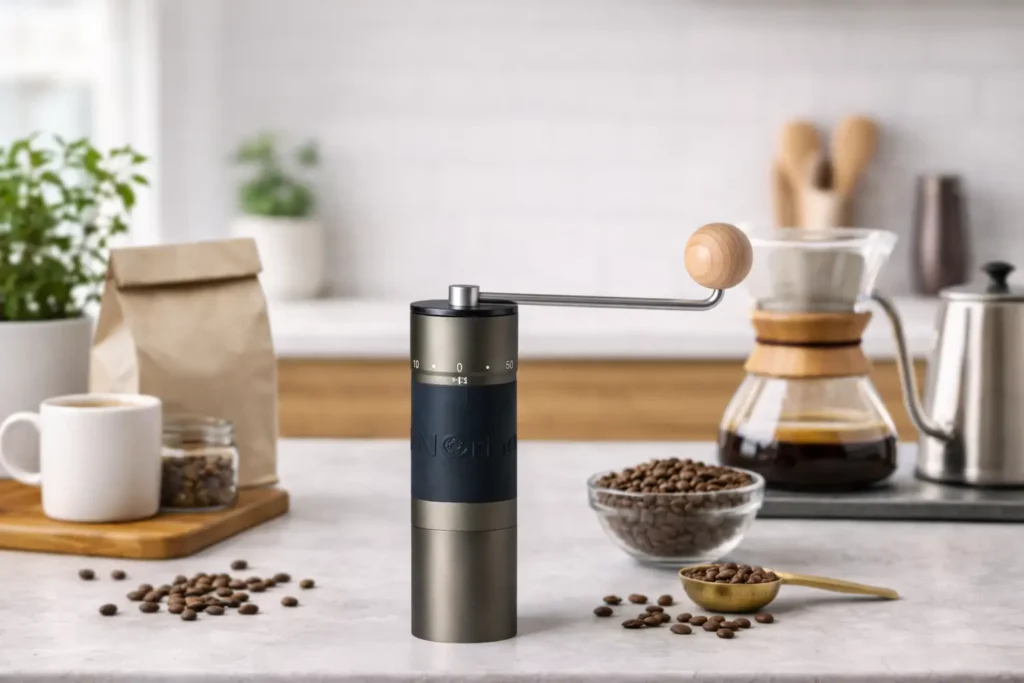 KINGrinder K6Manual fine adjustment across multiple brew methods.Check current Amazon listing →
 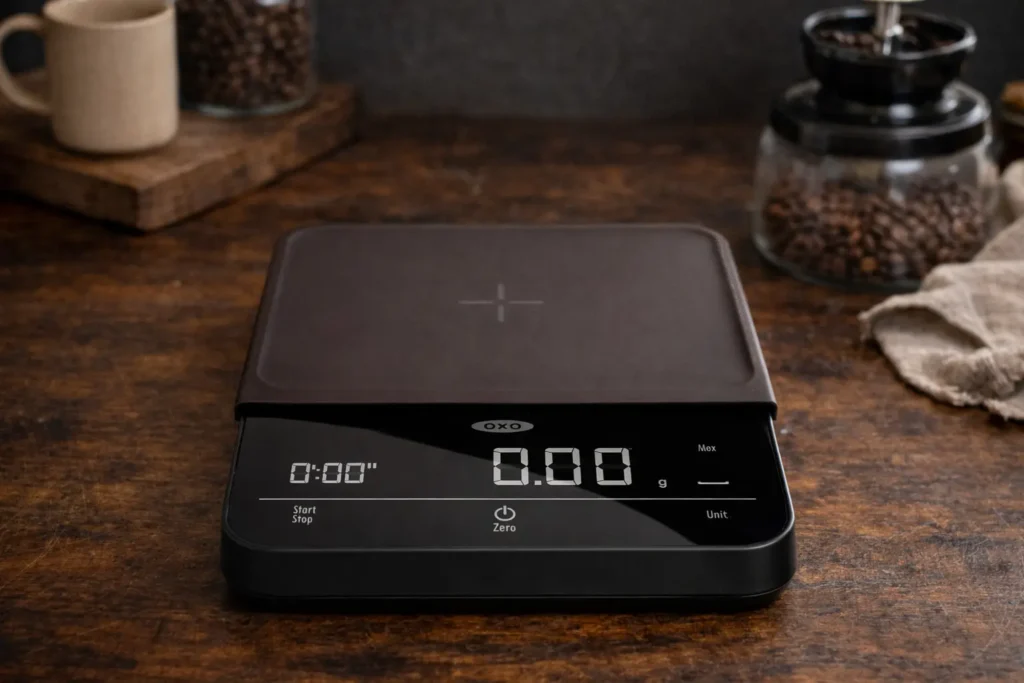 Coffee scale with timerKeeps dose and water stable while you test grind changes.Check current Amazon listing →
Affiliate disclosure: Amazon links may earn CoffeeGearHub a commission at no additional cost to you. Prices and availability can change.
Coffee Grind Sizes by Brew Method
French Press: Coarse to Medium-Coarse
French press is immersion brewing, so the useful setting depends on steep time, agitation, mesh filter, and desired body. Coarse is a safe starting direction, not a law.
Cold Brew: Coarse
Coarse grinding simplifies long immersion and filtration. If concentrate is weak, adjust ratio or steep time before automatically going much finer.
Drip Coffee Maker: Medium
Automatic brewers vary widely in basket shape, batch size, showerhead design, and flow rate. Start medium and adjust to keep the basket flowing cleanly while the cup tastes balanced.
Pour-Over: Medium to Medium-Fine
Cone and flat-bottom brewers can need different settings. Use drawdown plus taste: finer usually adds resistance and extraction; coarser usually speeds flow.
AeroPress: Flexible
Medium-fine is a common starting point, but short, high-agitation recipes can work finer while longer immersion recipes can work coarser.
Espresso: Fine and Highly Adjustable
Espresso needs enough puck resistance to control flow, but no visual texture guarantees the right setting. Dial in on the actual machine, basket, dose, yield, and coffee.
Moka Pot: Fine, Usually Coarser Than Espresso
Moka pot should flow without stalling. Move coarser when the brew chokes or turns harsh; finer when it runs quickly and tastes weak.
Turkish Coffee: Extra Fine
Turkish brewing intentionally uses powder-fine coffee that remains in the cup. This is one of the few methods where extremely fine grinding is part of the method itself.
Brew Ratio: Keep Strength Separate From Grind
Grind controls extraction rate and flow; ratio controls concentration. Do not use grind to solve every weak or strong cup.
| Method | Useful starting-ratio direction | Why it varies |
|---|---|---|
| Pour-over / drip | Moderate filter-coffee ratio | Roast, brewer, batch size, desired strength |
| French press | Moderate-to-strong filter ratio | Immersion time and desired body |
| AeroPress | Very flexible | Concentrate vs standard-cup recipes |
| Espresso | Often around 1:2 as a baseline | Coffee, basket, roast, desired concentration |
| Cold brew | Depends on concentrate vs ready-to-drink | Dilution plan and steep time |
For specific numbers and calculations, use the Coffee Brew Ratio Guide.
Troubleshooting Grind Size by Taste and Flow
| Symptom | Grind may be… | Check before changing | Useful next move |
|---|---|---|---|
| Sour, thin, fast | Too coarse | Ratio, temperature, channeling | Try finer |
| Harsh, dry, slow | Too fine | Agitation, temperature, filter clogging | Try coarser |
| Balanced but weak | May be fine already | Ratio | Use more coffee or less water |
| Balanced but too strong | May be fine already | Ratio | Use less coffee or more water |
| Sour and bitter together | Possibly inconsistent | Channeling, grinder distribution, puck/bed prep | Improve evenness before chasing one setting |
Advanced Variables That Interact With Coffee Grind Sizes
Once your grind is dialed in, you’ll notice that the setting occasionally needs small adjustments even when you haven’t changed your recipe. That’s because grind size doesn’t operate in isolation — it interacts with roast level, bean freshness, environmental conditions, pouring technique, and water chemistry in ways that can shift your extraction balance without you touching the grinder. Understanding these interactions is what separates a brewer who dials in once and stays frustrated from one who consistently produces excellent cups.
Roast Level and How It Changes Your Grind Target
Roast level directly affects how easily a bean extracts, because the roasting process changes the physical and chemical structure of the bean. Light roasts are denser and harder — the cellular walls are largely intact, flavor compounds are tightly bound, and water has more difficulty dissolving them. This means light roasts often benefit from a slightly finer grind, higher water temperature, or both. Dark roasts are more porous and fragile — roasting has broken down the cell structure and volatile compounds are closer to the surface, making them extract quickly and easily. A dark roast at the same grind setting as a light roast will almost always taste over-extracted. Going one or two steps coarser on dark roasts is often enough to bring them into balance.
Bean Freshness and CO₂ Degassing
Freshly roasted beans release carbon dioxide — a natural byproduct of the roasting process — for days to weeks after roasting. In pour-over and espresso, this CO₂ repels water during the early part of extraction, which can create channels in the bed and produce uneven, underdeveloped results. If you’re brewing with very fresh beans and getting unexpectedly sharp or flat cups, the cause may be excess degassing rather than grind. A slightly finer grind combined with a longer bloom period (30–45 seconds letting grounds absorb a small amount of water before the main pour) helps compensate. In espresso, extremely fresh beans often produce unstable, sputtering shots — letting them rest three to seven days after roasting before grinding produces much more predictable results.
Humidity, Temperature, and Why Your Grind Seems to Change on Its Own
It’s not your imagination: the same grind setting that produced a perfect shot on Monday may run slow on a rainy Wednesday. Humidity changes how coffee grounds clump together after grinding, which affects how densely they pack in the bed and therefore how much resistance they offer to water flow. In high humidity, grounds clump more and pack tighter; in dry conditions, static increases and grounds can distribute unevenly. For espresso, where tiny changes in puck density have large effects, this can require a grind adjustment of one to two clicks just to compensate for weather. For pour-over and drip, the effect is smaller but still noticeable over large humidity swings between seasons.
Agitation and Its Relationship With Grind
In pour-over brewing, agitation — swirling the slurry, stirring mid-brew, or using an aggressive spiral pour — increases extraction by constantly presenting fresh water to coffee particles. Done correctly, a little agitation can improve sweetness and body. Done excessively, it drives fine particles into the filter paper, compresses the bed, and causes stalling or channeling. If your pour-over regularly stalls or produces bitter, over-extracted cups despite a reasonable grind, less swirling may solve the problem more effectively than going coarser. Agitation and grind interact: a coarser grind can tolerate more agitation; a finer grind demands a gentler pour.
Water Chemistry and Flavor Ceiling
Water is roughly 98% of your brewed coffee, and its mineral content significantly affects how flavor compounds are extracted and perceived. Water that’s too soft lacks the magnesium and calcium ions that bind to and extract aromatic compounds, producing flat, lifeless cups no matter how well-dialed the grind. Water that’s too hard over-extracts easily and can produce harsh or chalk-edged cups. Grind is still the first variable to adjust when something tastes wrong — but if your cups consistently taste flat despite correct grind and good technique, water quality is the likely ceiling. Filtered water or purpose-made coffee water typically sits around 50–150 ppm total dissolved solids and produces noticeably cleaner, sweeter cups than hard tap water.
Blade vs Burr Grinders: Why Adjustment Matters
A burr grinder sets a repeatable gap between burrs, giving you a defined adjustment system. A blade grinder chops for time, so there is no repeatable burr-gap setting to return to.
That does not mean every burr grinder produces identical particles or every blade-ground cup is undrinkable. The practical advantage is control: a burr grinder lets you intentionally move finer or coarser and repeat the setting.
For more detail, see Burr vs Blade Coffee Grinders.
Gear That Makes Grind Dial-In Easier
KINGrinder K6 — manual fine adjustment
A manual grinder with external adjustment that works across several brew methods. Use its markings as references on your own unit rather than assuming one universal click number.
Coffee scale — keep the recipe stable
A scale makes it possible to change grind without accidentally changing dose or water at the same time.
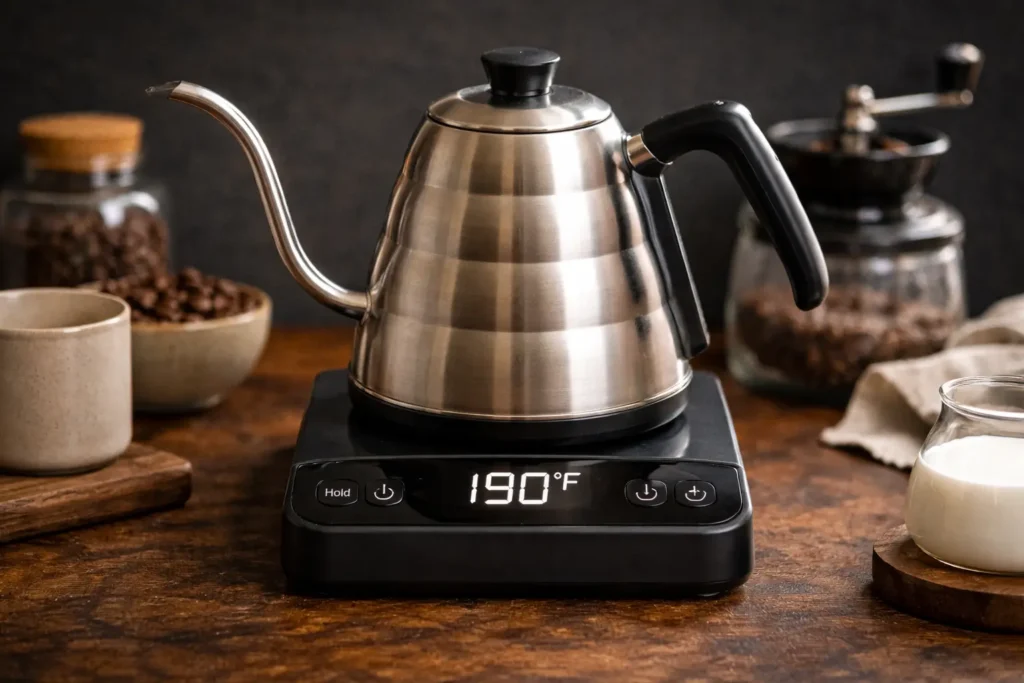
Temperature-controlled gooseneck kettle
Useful for filter brewing when you want temperature and pour structure to remain stable while you test grind changes.
What to Compare in a Grinder
| Feature | Why it matters |
|---|---|
| Adjustment resolution | Smaller useful changes make dial-in easier, especially for espresso |
| Particle distribution | Affects flow, clarity, fines, and repeatability |
| Retention | Old grounds can blur small setting changes |
| Workflow | Manual vs electric, hopper vs single-dose, noise, speed |
| Cleaning and support | Impacts long-term consistency and ownership |
Three Rules for Choosing the Right Grind Size
- Start from the brew method, not a universal texture chart. Method tells you the general range; your exact brewer and coffee determine the final setting.
- Use flow plus taste. Fast and sour usually points finer; stalled and harsh usually points coarser; balanced-but-weak often points to ratio instead.
- Change one variable at a time. A grind change only teaches you something when dose, water, temperature, and technique stay reasonably stable.
FAQs: Coffee Grind Sizes
What grind size should I use for pour-over?
What grind size works for drip coffee?
What grind size works for French press?
How fine should espresso be ground?
What grind size works for AeroPress?
What grind size works for moka pot?
Can different grinders use the same setting number?
Does humidity change grind needs?
Final Takeaway
Grind size is one of the most powerful variables in coffee because it changes surface area and flow. But it is not the only variable. The best setting is the one that works with your brewer, coffee, ratio, water, and technique and produces the flavor you want.
CoffeeGearHub shortlist
Choose the grinder and recipe together
These CoffeeGearHub guides cover grinder selection, ratio, and grinder-type differences.
Continue Learning
Method-specific grind guides
Extraction & troubleshooting
In this guide
- The 30-Second Answer
- Coffee Grind Sizes Chart: Starting Ranges
- Why Coffee Grind Sizes Matter (Extraction Science Without the Confusion)
- A Repeatable Grind-Size Dial-In Workflow
- Coffee Grind Sizes by Brew Method
- Brew Ratio: Keep Strength Separate From Grind
- Troubleshooting Grind Size by Taste and Flow
- Advanced Variables That Interact With Coffee Grind Sizes
- Blade vs Burr Grinders: Why Adjustment Matters
- Gear That Makes Grind Dial-In Easier
- What to Compare in a Grinder
- Three Rules for Choosing the Right Grind Size
- FAQs: Coffee Grind Sizes
- Final Takeaway
- Continue Learning