
Best Coffee Grinders for Espresso
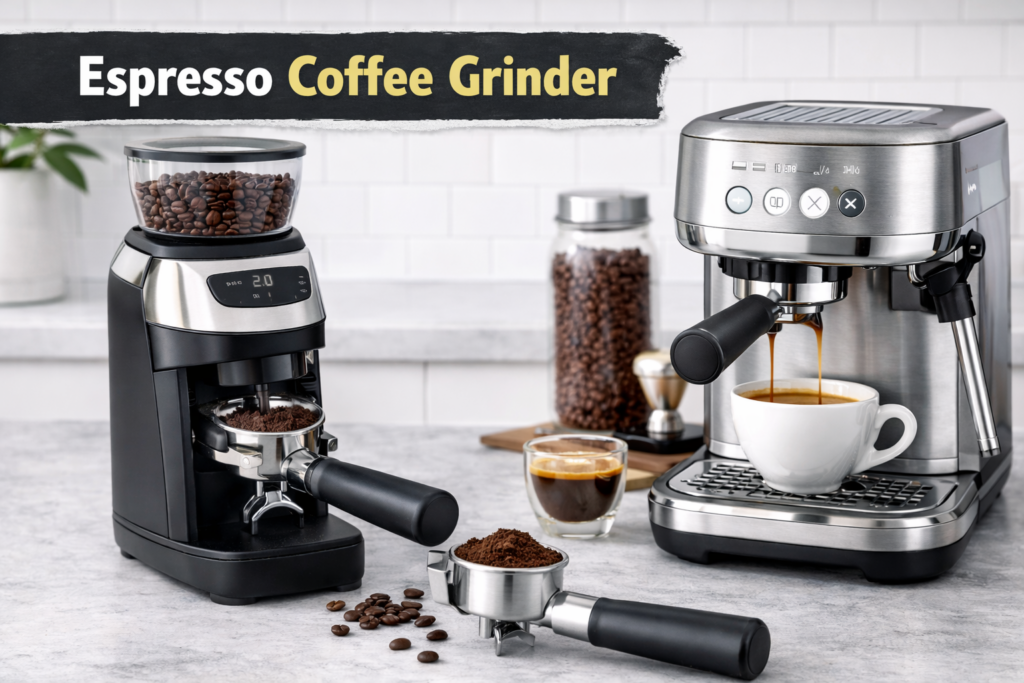
Editorial standards: this guide separates manufacturer specifications from our editorial interpretation. We do not claim hands-on testing where it has not occurred, and we avoid treating one burr shape, one shot time, or one budget tier as universally correct.
At a glance
What this guide covers
Espresso adjustment resolution, pressurized vs single-wall baskets, burr design, retention, dosing workflow, current beginner picks, multi-brew trade-offs, dial-in technique, maintenance, and troubleshooting.
Editorial analysis
Buy adjustment control before chasing premium specifications
For espresso, the useful question is not simply whether a grinder can grind “fine.” It is whether you can make small, repeatable changes within the espresso range and return to a known setting. Workflow and repeatability matter as much as burr diameter or motor power.
Encore ESP for simple value, Smart Grinder Pro for timed hopper convenience, and Mignon Silenzio for a stepless step-up.
The 30-Second Answer
For most beginners using a single-wall espresso basket, start with a grinder designed around an espresso adjustment range rather than a general-purpose grinder that merely reaches a fine setting. The Baratza Encore ESP is the best value-oriented starting point here; the Breville Smart Grinder Pro is the better fit for timed hopper dosing and multi-brew convenience; the Eureka Mignon Silenzio is the step-up for stepless control and quieter operation. Choose by adjustment precision and workflow—not by one universal shot-time target.
Quick comparison
Two approachable starting points
The Encore ESP prioritizes simple espresso-focused adjustment. The Smart Grinder Pro adds timed dosing and a portafilter cradle for a more automated hopper workflow.
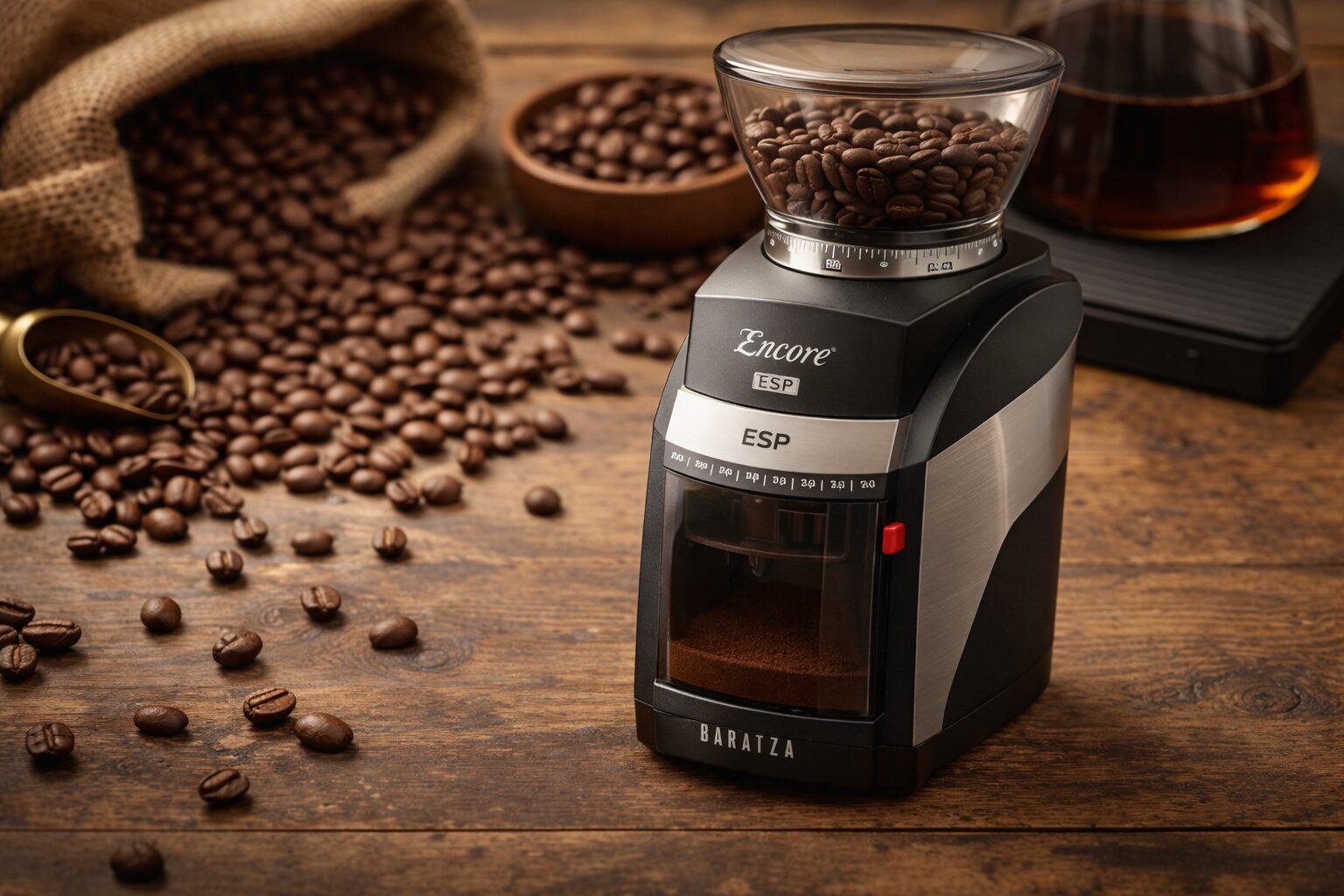 Baratza Encore ESPHigher-resolution espresso range with a simple stepped workflow.View CoffeeGearHub product page →
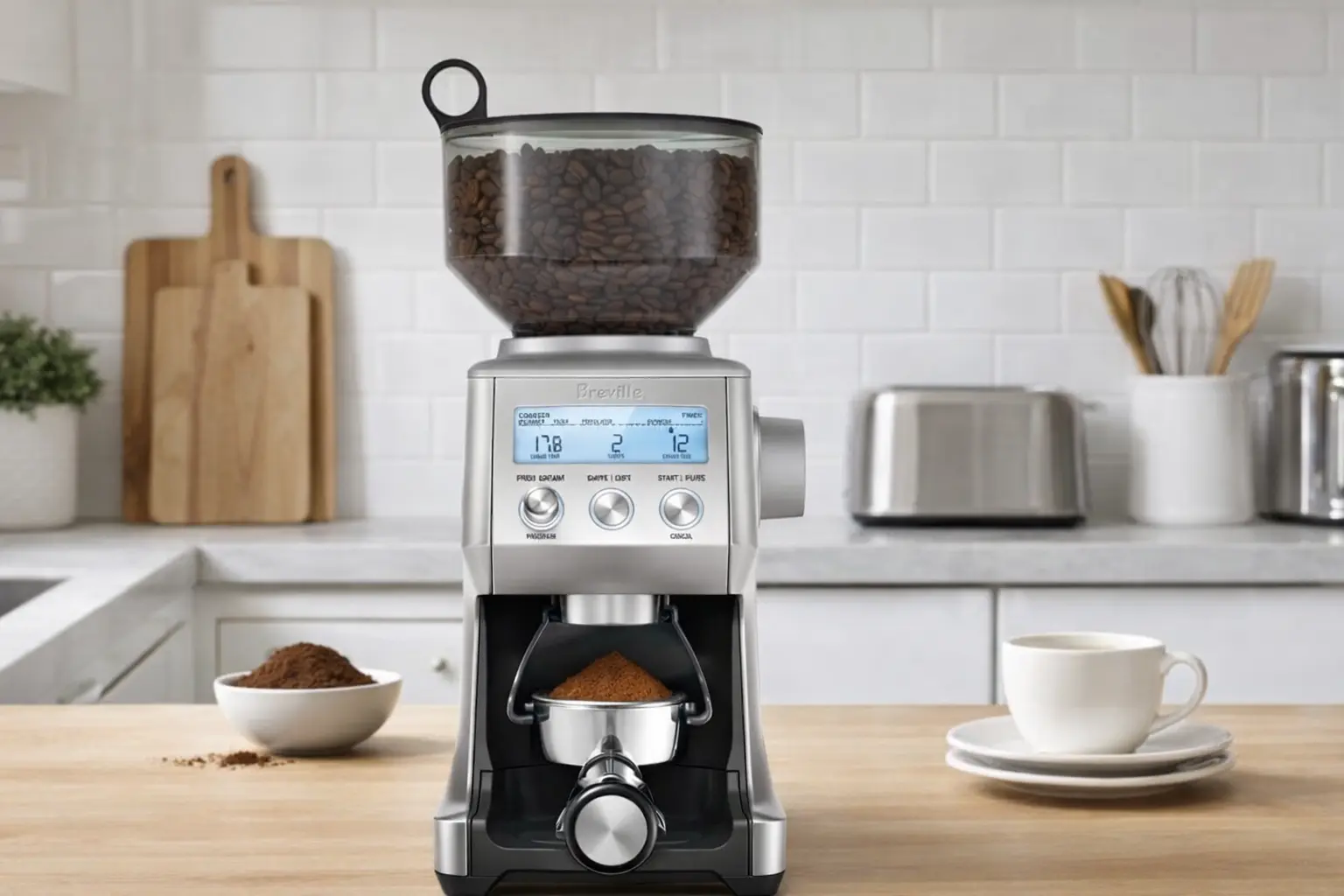 Breville Smart Grinder ProTimed dosing, 60 settings, and direct-to-portafilter workflow.Check current Amazon offer →
Affiliate disclosure: Amazon links may earn CoffeeGearHub a commission at no additional cost to you. Prices and availability can change.
Why Espresso Grinders Are Categorically Different
Espresso and drip coffee both combine ground coffee and water, but espresso uses a compact puck and pressurized brewing, so small changes in grind and puck resistance can produce much larger changes in flow. That is why espresso benefits from a grinder with finer adjustment resolution and repeatable settings.
At 9 bar of pressure, water finds the path of least resistance through the coffee puck. If your grind is slightly too coarse, water flows through the puck too quickly — under 20 seconds total, producing a watery, sour, under-extracted shot. If your grind is slightly too fine, water cannot push through at all — the machine either chokes entirely or the shot runs so slowly that the coffee over-extracts to bitterness before the yield is complete. The margin between these two failure states is narrow: in most espresso setups, the entire range from “too fast” to “too slow” spans fewer than five grind adjustment steps. A drip grinder with 15 settings that are 50–100 microns apart cannot operate at this level of precision. An espresso grinder with 60 settings at 10–20 microns per step can. This is why espresso grinders are not simply “better” grinders — they are a different category of tool designed to operate within a fundamentally different brewing constraint.
Pressurized vs Non-Pressurized Portafilter: Which Grinder Do You Need?
The most important variable in matching a grinder to your espresso setup is not machine brand or machine price — it is portafilter type. Most beginners do not know which type their machine uses. This single factor determines whether the Baratza Encore ESP will work for you or whether you need a dedicated espresso grinder from the start.
| Pressurized (Double-Wall) Basket | Non-Pressurized (Single-Wall) Basket | |
|---|---|---|
| How it works | A second layer with a small hole creates artificial back-pressure regardless of grind consistency — compensates for grind imprecision | No compensation mechanism — extraction pressure is determined entirely by how well the puck is prepared and how precise the grind is |
| Grind sensitivity | Low — a wider range of grind sizes produce an acceptable shot | High — grind must be precise to within a narrow micron range to extract correctly |
| Who uses them | Standard on entry machines: Breville Bambino, DeLonghi Dedica, De’Longhi Stilosa, and most entry-tier machines | Standard on semi-professional machines: Gaggia Classic Pro, Breville Barista Express, Rancilio Silvia |
| Minimum grinder | Baratza Encore ESP — entry-level capable; 40 settings is adequate for pressurized work | Breville Smart Grinder Pro or Eureka Mignon Silenzio minimum — dedicated espresso micro-adjustment required |
| Upgrade path | The Encore ESP is a practical first espresso-focused grinder; move to a timed-dosing or stepless grinder when your workflow or adjustment needs justify it. | Do not start with the Encore — the grind imprecision will produce inconsistent shots that are hard to diagnose and learn from |
| How to check your machine | Look inside your portafilter basket — two holes at the bottom (one large, one very small above it) = pressurized | Multiple small holes across the entire basket bottom in a uniform pattern = non-pressurized |
What to Look for in a Beginner Espresso Grinder: 5 Variables That Matter
Espresso grinder marketing is full of specifications that are meaningful to experienced home baristas but useless to beginners. These five are the ones that actually determine whether a beginner grinder will produce consistent, diallable espresso shots.
| Factor | Why it matters for espresso | What to look for | What to avoid |
|---|---|---|---|
| Fine adjustment range | Espresso operates in a narrow precision window — your grinder needs enough resolution to make meaningful micro-adjustments within that window | 40+ settings minimum; dedicated espresso micro-adjustment dial; stepless or near-stepless adjustment preferred | Fewer than 20 settings; large jumps between adjacent settings that skip past the espresso range entirely |
| Burr size and quality | Larger burrs produce more consistent particle output at espresso fineness; cheap burrs produce excessive fines at fine settings, causing channeling and bitterness | 40mm+ conical or flat burrs for entry espresso grinders; hardened steel or titanium-coated burrs for durability at fine settings | Small plastic burr carriers; undisclosed burr specifications; grinders without a stated espresso capability |
| Grind retention | Coffee retained in the grinding pathway between doses stales between shots and contaminates the next dose with old grounds | Low-retention designs under 1g preferred; single-dose hoppers avoid stale beans between sessions | Large bean hoppers holding 200g+ — fine for drip, problematic for espresso where shot-to-shot consistency requires fresh grounds |
| Motor stability | Espresso grinding at fine settings requires consistent motor speed — speed variation changes particle size even at the same setting | DC motors produce more consistent speed than AC motors; look for motor ratings designed for fine-grind continuous operation | Entry drip grinders repurposed for espresso — their AC motors are not rated for the heat and friction of sustained fine grinding |
| Repeatability | Once you find a good shot setting you need to return to it reliably every session — a grinder with click settings or numbered positions makes this possible | Clear numbered settings; click or stepped adjustment that returns accurately; digital timer for dose repeatability | Stepless grinders without reference markings — hard for beginners to reproduce settings between sessions |
Flat Burr vs Conical Burr for Espresso
Both flat and conical burr designs produce excellent espresso. At the beginner tier the distinction matters less than burr size and adjustment range — but understanding it helps explain why certain grinders produce certain flavour profiles and why the Fellow Ode (flat burr, excellent grinder) is not an espresso grinder despite its quality.
| Conical Burr (Espresso) | Flat Burr (Espresso) | |
|---|---|---|
| Particle distribution | Conical designs vary widely; some produce more fines and body, but burr geometry matters more than burr shape alone. | Flat designs vary widely; some emphasize clarity and tighter distributions, but burr geometry and alignment matter more than shape alone. |
| Fines production | More fines at espresso fineness — contributes to crema and body but can cause channeling if excessive | Fewer fines — cleaner extraction; requires very consistent puck prep to avoid channeling |
| Espresso flavour profile | Richer body, more sweetness, slightly lower clarity — well-suited to milk-based espresso drinks | Higher clarity, defined acidity, cleaner finish — better suited to straight espresso tasting |
| Entry tier availability | Entry — conical burrs dominate beginner and intermediate espresso grinders | Intermediate / Prosumer — not necessary at beginner level |
| Beginner recommendation | ✓ Correct at beginner and intermediate levels | ⚠ Not necessary for beginners; revisit at intermediate/prosumer level |
🔬 Why the Fellow Ode is not an espresso grinder: The Fellow Ode Gen 2 is an excellent flat burr grinder for drip and pour-over. It does not grind fine enough for espresso by design — its adjustment range stops well above the 200–400 micron particle size that espresso requires. This is not a flaw in the Ode; it is a deliberate design choice that makes it exceptional for brewed coffee. If espresso is your goal, the Ode is not the correct purchase regardless of how positively it is reviewed for drip use.
How Much Should a Beginner Spend on an Espresso Grinder?
Shop by capability rather than by a fixed price tier. Prices move, but the workflow requirements do not: enough fine-range adjustment to control flow, repeatable settings, manageable retention, and a dosing workflow that fits your machine.
| Capability level | What you gain | Good fit |
|---|---|---|
| Espresso-focused entry | Higher-resolution fine adjustment without a complex workflow | Beginners moving from pre-ground coffee or general-purpose grinders |
| Timed hopper workflow | Repeatable timed dosing, portafilter cradle, broad brew range | Households that want convenience and switch between coffee styles |
| Stepless step-up | Very fine adjustment control and quieter/heavier construction | Single-wall baskets and users who expect to stay with espresso long term |
Best Coffee Grinders for Espresso: Our Top Picks
These are role-based picks rather than a universal ranking. The right choice depends on basket type, dosing workflow, how often you switch brew methods, noise tolerance, and whether you value simple stepped repeatability or stepless control.
Best value for espresso beginners
Baratza Encore ESP
Baratza designed the Encore ESP around a dual-range adjustment system: the first 20 settings provide higher-resolution espresso adjustment, while the coarser range covers filter methods. It is the most straightforward upgrade from a general-purpose grinder for many home espresso setups.
Check current Amazon offer →Best timed hopper workflow
Breville Smart Grinder Pro
The Smart Grinder Pro combines a portafilter cradle, timed dosing, and a broad adjustment range. It suits users who value a conventional hopper workflow and want one grinder to cover espresso plus coarser methods.
Check current Amazon offer →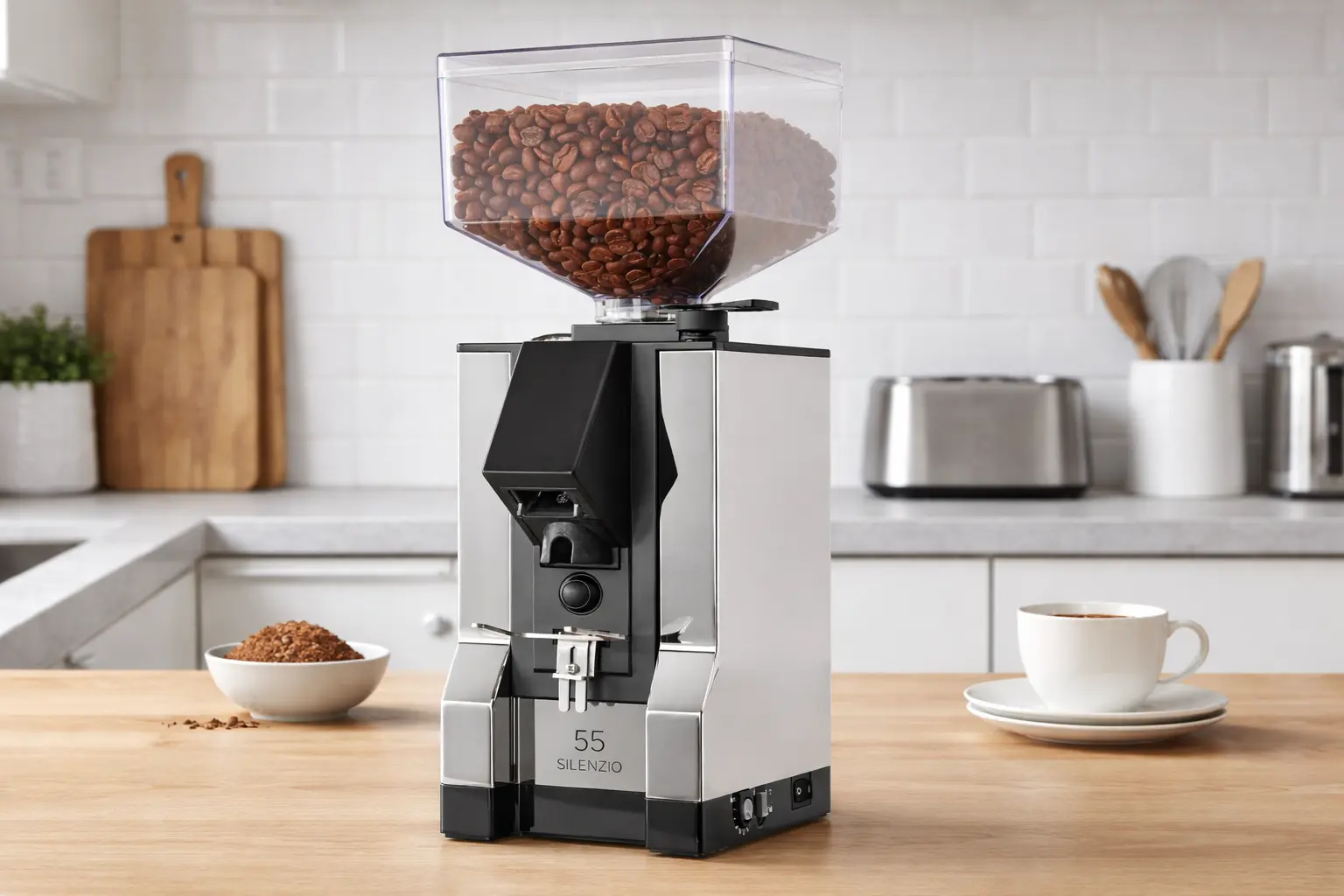
Best quiet stepless step-up
Eureka Mignon Silenzio
The current Silenzio platform uses Eureka’s stepless micrometric adjustment and silent-grinding architecture. It is the stronger fit when fine espresso adjustment and a quieter workflow matter more than quickly switching between distant brew settings.
Check current Amazon offer →What If You Also Brew Pour-Over, Drip, or French Press?
A grinder can be physically capable of both espresso and filter coffee yet still be inconvenient to switch back and forth every day. Espresso often lives within a narrow adjustment range, while filter brewing may require a large move on the dial. If you switch methods frequently, prioritize a grinder with repeatable markings and low retention—or consider separate grinders if workflow matters more than counter space.
The Encore ESP is intentionally designed to span both espresso and filter ranges. Stepless espresso grinders such as the Mignon Silenzio offer excellent fine control but are less convenient for repeatedly jumping between distant brew settings.
Extraction Science: Why Espresso Grind Precision Changes Everything
Understanding the extraction mechanism behind espresso precision is what allows beginners to diagnose shot problems systematically rather than changing variables randomly and hoping for improvement. Three principles cover everything a beginner needs to know.
- Pressure extraction amplifies every grind inconsistency. In drip brewing, gravity moves water through coffee gently and slowly. In espresso, a pump forces water through at 9 bar of pressure — approximately 130 pounds per square inch. At this pressure, every variation in particle size is magnified. Fine particles restrict flow far more aggressively than coarse ones; coarse particles allow water through far more easily. A grind that produces a wide range of particle sizes produces a puck with dramatically uneven flow resistance across its surface, which leads to channeling — water forcing through the easiest path rather than extracting evenly. This is why espresso grinders must produce tighter particle distributions than drip grinders, and why burr quality matters more for espresso than for any other brewing method.
- Shot time is useful only when tied to a fixed dose and beverage yield. Record how long your successful baseline takes, then use faster or slower flow as diagnostic evidence rather than forcing every coffee into one universal time window. Grind size is one major lever for changing flow when the rest of the recipe is stable.
- Fines produce crema but also channeling. All burr grinders produce ultra-fine particles alongside their primary grind output. In espresso, fines serve two functions simultaneously: they pack into the spaces between larger particles and create the flow resistance that builds pressure and produces crema; and when produced in excess, they cause channeling by creating pockets of extreme flow resistance that redirect water pressure to adjacent, less-restricted areas. The balance between enough fines for crema and too many fines for consistent extraction is why burr quality and size matter for espresso: high-quality burrs produce a controlled, predictable fines profile. Cheap burrs produce erratic, uncontrollable fines at espresso-fine settings, making consistent shots nearly impossible regardless of how carefully you prepare the puck.
Shot Time Is a Diagnostic, Not a Universal Target
Measure the time required to reach a fixed beverage yield, but interpret it alongside taste and flow. A shot that reaches its target yield much faster than your successful baseline may need more resistance; one that takes much longer may need less. Basket, coffee, dose, pre-infusion, pressure profile, and desired beverage ratio all change what “normal” looks like.
| Observation | Check first | Possible next move |
|---|---|---|
| Target yield arrives much faster than your baseline | Dose, puck damage, grinder setting | If preparation is stable, move slightly finer |
| Target yield arrives much slower than your baseline | Basket fill, blockage, grinder setting | If the system is clean and correctly dosed, move slightly coarser |
| Time repeats but taste is still unbalanced | Yield, temperature, coffee, water | Change one variable at a time; do not chase the clock |
| Time varies widely at the same setting | Dose, distribution, retention, warm-up | Fix consistency before changing the grinder again |
A Beginner Espresso Grinder Dial-In Workflow
- Use a dose that fits the basket and keep it stable.
- Choose a repeatable target beverage yield; about 1:2 can be a neutral starting reference for many coffees.
- Start within the grinder maker’s espresso guidance when available.
- Distribute and tamp the puck the same way each shot.
- Pull to the target yield, record time and taste, then change only one variable.
- If flow is obviously fast or slow and the rest of the workflow is stable, make a small grind adjustment.
- Once flow is repeatable, use yield and temperature to refine taste rather than forcing a universal shot time.
Common Beginner Espresso Grinder Mistakes
| Mistake | Why it causes trouble | Better approach |
|---|---|---|
| Buying a filter-focused grinder and assuming “fine” means espresso-ready | The finest range may not have enough resolution for a single-wall basket | Choose a grinder explicitly designed with an espresso adjustment range |
| Changing dose, yield, and grind at the same time | You cannot tell which change helped | Stabilize the recipe and change one variable per shot |
| Judging the grinder by one target time | Time depends on the whole recipe and machine | Compare time-to-yield with taste and your own successful baseline |
| Ignoring retention after a grind change | Old grounds can mask the new setting | Learn the grinder’s normal retention behavior and purge only as needed |
| Switching between espresso and filter without recording settings | Returning to the same espresso range becomes inconsistent | Record successful settings and use repeatable reference marks |
Espresso Grinder Troubleshooting Matrix
| What you notice | Likely area to inspect | Useful next test |
|---|---|---|
| Fast, thin shot at a stable dose and yield target | Grind, puck damage | Verify preparation, then try slightly finer |
| Very slow or stalled shot | Overdosing, overly fine grind, blocked basket/group | Check fill and cleanliness, then try slightly coarser if needed |
| Large shot-to-shot variation | Dose, distribution, retention, grinder repeatability | Standardize workflow before replacing equipment |
| Grinder is at its finest setting and flow is still too fast | Calibration, burr condition, grinder capability | Check calibration and basket/prep; then consider a more espresso-focused grinder |
| Setting changes do not show up immediately | Retention | Clear the retained dose according to the grinder’s normal workflow |
Cleaning and Maintenance: Keeping Your Espresso Grinder Performing
Espresso grinders require more frequent cleaning than drip grinders because fine grinding generates more friction, more heat, and more coffee oil coating on burr surfaces per gram of coffee ground. Rancid coffee oil at espresso fineness produces a bitter, stale aftertaste that is almost impossible to distinguish from a grind or bean problem without eliminating the maintenance variable first. If your espresso suddenly tastes worse without any recipe change, clean the grinder before changing anything else.
- Brush the chute and accessible grounds path regularly; follow the manufacturer’s instructions before removing burrs.
- Clean coffee oils before they become rancid, especially when using darker roasts.
- After a grind-setting change, purge only the amount your grinder actually retains rather than wasting a fixed dose by rule.
- Inspect burrs, carriers, and calibration if settings drift abnormally or the grinder cannot reach its usual espresso range.
- Unplug the grinder before cleaning or maintenance and follow the manufacturer’s safety instructions.
Espresso Grinder Buying Checklist
| Question | What to confirm | Red flag |
|---|---|---|
| Is it designed for espresso? | Product explicitly states espresso capability — not just “fine” as an option on a drip grinder | “Also grinds for espresso” on a grinder with fewer than 30 settings; Fellow Ode listed as espresso-capable |
| What type of portafilter do I have? | Pressurized baskets tolerate more grind variation. For single-wall baskets, prioritize a grinder with an espresso-focused fine-adjustment range such as the Encore ESP, Smart Grinder Pro, or a stepless Mignon model. | Assuming the Encore works for all espresso setups — it does not for non-pressurized baskets |
| How many grind settings does it have? | 40+ settings minimum for pressurized espresso; 54+ settings for non-pressurized; stepless preferred for prosumer | Fewer than 20 settings; no dedicated espresso micro-adjustment range |
| Does it grind directly into the portafilter? | Portafilter cradle or fork eliminates a transfer step and reduces static clumping — particularly useful for beginners | No portafilter cradle on a grinder marketed for espresso — indicates it was not designed for this use case |
| Do I have a scale? | A scale accurate to 0.1g is essential for espresso — dose variation of 1g changes shot timing significantly | Planning to dose by grinder timer alone without weighing — timer dosing drifts as beans and retention change |
| Are replacement burrs available? | Baratza and Eureka both sell replacement espresso burrs; burrs dull over time and affect grind consistency | No-brand espresso grinders with no parts ecosystem — the grinder becomes disposable when burrs dull |
Final Takeaway: The Best Espresso Grinder for Beginners
The best beginner espresso grinder is the one that provides enough fine-range control for your basket, repeats settings reliably, and fits the way you dose coffee. The Baratza Encore ESP is the simplest espresso-focused value option in this guide; the Breville Smart Grinder Pro adds a timed hopper workflow and broad brew range; and the Eureka Mignon Silenzio is the step-up for users who want stepless control and quieter operation. Use shot time as a diagnostic, not a universal target, and prioritize repeatability over chasing one specification.
FAQs: Best Coffee Grinders for Espresso
Can I use a regular coffee grinder for espresso?
What is the best espresso grinder for beginners?
Why is espresso grinding harder than drip or pour-over grinding?
What is the correct espresso shot timing for a beginner?
What is channeling and how does grind affect it?
Do I need a pressurized or non-pressurized portafilter for a beginner espresso setup?
What is the difference between flat burr and conical burr espresso grinders?
How much should I spend on a beginner espresso grinder?
Why does my espresso shot run too fast even at the finest setting?
How often should I clean my espresso grinder?
CoffeeGearHub shortlist
Build the espresso setup around repeatability
Use these CoffeeGearHub pages to compare the grinder, measure the shot, and connect the grinder choice to the rest of the espresso workflow.
Manufacturer References
We checked the current manufacturer specifications while updating this guide. Product revisions and regional configurations can change, so confirm the exact model before purchase.
Continue Learning
In this guide
- The 30-Second Answer
- Why Espresso Grinders Are Categorically Different
- Pressurized vs Non-Pressurized Portafilter: Which Grinder Do You Need?
- What to Look for in a Beginner Espresso Grinder: 5 Variables That Matter
- Flat Burr vs Conical Burr for Espresso
- How Much Should a Beginner Spend on an Espresso Grinder?
- Best Coffee Grinders for Espresso: Our Top Picks
- What If You Also Brew Pour-Over, Drip, or French Press?
- Extraction Science: Why Espresso Grind Precision Changes Everything
- Shot Time Is a Diagnostic, Not a Universal Target
- A Beginner Espresso Grinder Dial-In Workflow
- Common Beginner Espresso Grinder Mistakes
- Espresso Grinder Troubleshooting Matrix
- Cleaning and Maintenance: Keeping Your Espresso Grinder Performing
- Espresso Grinder Buying Checklist
- Final Takeaway: The Best Espresso Grinder for Beginners
- FAQs: Best Coffee Grinders for Espresso
- Manufacturer References
- Continue Learning