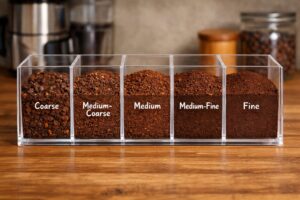
Last Updated: February 25, 2026 • 20–25 min read • Pillar Guide: Grind Science + Brew Methods + Dial-In Workflow
✍️ Editorial note: This guide is researched and written by the editors at CoffeeGearHub.com using published brewing science, extraction principles, and established specialty-coffee community knowledge. Recommendations reflect research consensus. All product links are affiliate links — we may earn a commission at no cost to you.
The 30-Second Answer
Coffee grind sizes are matched to brew method by contact time and filter type. Coarse (sea salt) for French press. Medium for drip machines. Medium-fine for pour-over and AeroPress. Fine (table salt) for espresso and moka pot. Extra coarse for cold brew. Extra fine for Turkish coffee. If your cup tastes sour or sharp, grind finer. If it tastes bitter or harsh, grind coarser.
- Sour / sharp / salty: grind finer — you need more extraction
- Bitter / harsh / drying: grind coarser — you have too much extraction
- Weak but not sour: confirm grind is reasonable first, then consider using more coffee
- Consistency is everything: a burr grinder makes adjustments meaningful and repeatable
Who This Guide Is For — Jump to What You Need
☕ Just need a quick answer
Go straight to the Grind Size Chart or Brew Method Guide.
🔬 Want to understand the science
Read Extraction Science and Advanced Variables.
🔧 Fixing a bad-tasting cup
Jump to the Troubleshooting Matrix or Dial-In Workflow.
🛒 Looking for a grinder
See Grinder Recommendations and the Comparison Grid.
Table of Contents
Coffee Grind Sizes Chart (Quick Reference)
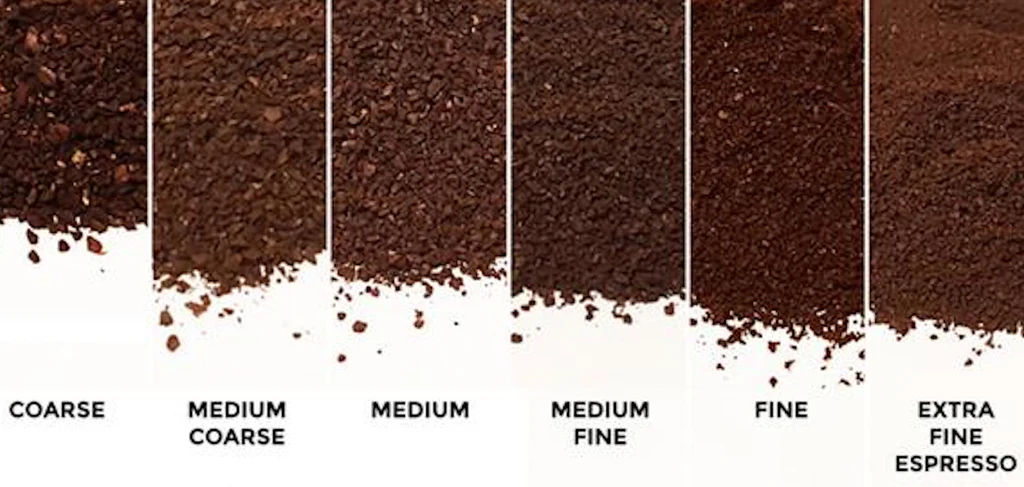
This chart covers every mainstream coffee grind size — from extra coarse cold brew down to Turkish powder — with the brew methods, typical contact times, and what happens when you go too coarse or too fine. Use it as your starting point, then let taste and timing guide adjustments. The single rule worth memorizing: sour means finer, bitter means coarser.
| Grind Size | Texture | Best Brew Methods | Typical Brew Time | If Too Coarse | If Too Fine |
|---|---|---|---|---|---|
| Extra Coarse | Cracked peppercorn | Cold Brew | 12–24 hours | Weak, watery concentrate | Harsh, woody concentrate |
| Coarse | Sea salt | French Press, Cupping | 4–6 minutes | Sour, thin, underdeveloped | Muddy, bitter, silty |
| Medium-Coarse | Rough sand | Chemex, Clever Dripper | 3:30–5:00 | Hollow, flat | Dry, papery finish |
| Medium | Sand | Drip coffee makers, flat-bottom pour-over | 4:30–6:30 | Bland, weak | Bitter, heavy body |
| Medium-Fine | Fine sand | V60, Kalita Wave, AeroPress | 2:30–3:30 | Sour, sharp | Astringent, slow drawdown |
| Fine | Table salt | Espresso, Moka Pot | 25–35 sec (espresso) | Fast, sour shots | Chokes, bitter shots |
| Extra Fine | Powdered sugar | Turkish Coffee | 1–2 minutes | Watery, weak | Over-extracted sludge |
💡 Pro tip: Grind size labels on grinders are not standardized across brands. Two “medium” settings on different machines can produce very different particle distributions. Always use texture, brew time, and taste to confirm you’re in the right zone — the numbers on your grinder are a starting point, not a guarantee.
Why Coffee Grind Sizes Matter (Extraction Science Without the Confusion)
Grind size is the most powerful variable in coffee brewing because it controls two distinct physical processes at once. The first is surface area: a finer grind exposes far more of the coffee particle to water, which dramatically increases how quickly flavor compounds dissolve. The second is flow resistance: finer particles pack together more tightly, slowing water movement and increasing contact time. Change grind size and you’re changing both chemistry and physics simultaneously — which is why a single grind adjustment can transform a cup more than any other tweak.
Coffee doesn’t extract all at once. Flavor compounds dissolve in a predictable sequence: quick-releasing acids and bright aromatics come out first, followed by sugars and body-building compounds, and finally the heavy bitter tannins and astringent phenols that nobody wants. The goal of correct coffee grind sizes isn’t maximum extraction — it’s stopping in the sweet middle, after the sugars are out but before the bitterness takes over. Grind too coarse and water moves too fast to reach that zone. Grind too fine and water lingers too long and goes past it.
Under-Extraction vs Over-Extraction: What You’re Actually Tasting
When a cup tastes sour, sharp, or hollow, the water didn’t spend enough time in contact with the grounds to pull out the full range of flavor — specifically the sweetness and body that balance early-extracting acids. When a cup tastes bitter, harsh, or drying, the opposite happened: water contacted the grounds for too long or too intimately, dragging out compounds that should have stayed in the grounds. Understanding this helps make grind adjustments feel intuitive rather than arbitrary.
| What You Taste | What It Means | Best First Fix |
|---|---|---|
| Sour, sharp, salty, thin | Under-extraction — acids present, sweetness missing | Grind finer (or slightly extend brew time) |
| Bitter, harsh, drying, woody | Over-extraction — bitter compounds pulled | Grind coarser (or shorten contact time) |
| Hollow, flat, “empty” | Usually under-extracted or uneven flow | Grind slightly finer; improve pouring consistency |
| Muddy, silty, heavy sediment | Excessive fine particles for the brew method | Grind coarser; consider upgrading grinder |
Why Consistency Beats Having the “Perfect” Setting
A grind setting only produces predictable results when it creates a uniform particle distribution. The real enemy of good coffee isn’t wrong grind size — it’s uneven grind size. Budget blade grinders and worn burr sets produce a mix of extremely fine dust and oversized chunks in the same batch. The fine particles over-extract (contributing bitterness) while the large chunks under-extract (contributing sourness) — which is why cheap-grinder coffee can taste both sour and bitter at once, a combination that seems contradictory until you understand what’s happening in the cup.
This is also why changing grind settings on a low-quality grinder often doesn’t produce the expected result: you’re shifting the center of a very wide, chaotic distribution rather than making a clean, precise adjustment. If adjustments feel unpredictable, the issue may be the grinder rather than your technique.
The Coffee Grind Size Dial-In Workflow (Stop Guessing, Start Tasting)
When a cup tastes off, the fastest path to fixing it is a repeatable, single-variable approach. The workflow below is used by home brewers and café baristas for exactly the same reason: when you change only one thing at a time, you can always identify what actually improved the cup. Change grind and dose simultaneously and you’ll never know which adjustment mattered.
Step 1: Lock Your Recipe First
Before adjusting anything, establish a fixed dose and ratio and write it down. This is your anchor — the thing that stays constant while you test grind. A reasonable starting point for most methods is a 1:16 ratio by weight (for example, 20g of coffee to 320g of water for pour-over and drip). Espresso starts around 1:2 (18g in, 36g out). AeroPress is more flexible but 1:12 to 1:15 gives a good baseline for brewed-style recipes. Once you have these numbers fixed, don’t touch them until grind is sorted.
Step 2: Use Brew Time as Your Early Warning System
Brew time is the fastest objective signal that grind size is in or out of range before you even take a sip. It won’t tell you everything — you still need to taste — but a wildly fast or slow brew is almost always a grind problem. A V60 that drains in 90 seconds is almost certainly too coarse. A flat-bottom pour-over that still hasn’t finished at six minutes is almost certainly too fine, or has channeling from excessive agitation. The target windows below are starting points, not rigid rules, but they help you arrive at the right neighborhood quickly.
| Brew Method | Target Time Window | Too Fast Means | Too Slow Means |
|---|---|---|---|
| V60 / cone pour-over (300–400g) | 2:45–3:15 total drawdown | Grind too coarse | Grind too fine or excess fines |
| Flat-bottom pour-over | 3:00–3:45 | Grind too coarse | Grind too fine or excess agitation |
| Drip machine | 4:30–6:30 | Machine issue or very coarse grind | Grind too fine for basket |
| French press (steep) | 4 minutes then press | N/A (immersion) | N/A (immersion) |
| AeroPress | 1:00–2:30 depending on recipe | Grind too coarse | Grind too fine or too much dose |
| Espresso | 25–30 seconds (18g in / 36g out) | Grind too coarse | Grind too fine or channeling |
Step 3: Adjust Grind by Taste (The Only Rule That Actually Matters)
Time gets you in the ballpark. Taste tells you where to go from there. Make one small grind adjustment, brew again with the exact same recipe, taste the result, and decide on the next move. “Small” matters here — on a stepped grinder, one or two clicks is enough to produce a perceptible change. On an espresso grinder, even smaller adjustments can shift your shot time by several seconds. The feedback loop of brew → taste → adjust → brew is what separates confident dialing in from endless frustration.
🔬 The two-rule system: Sour or sharp → grind finer. Bitter or harsh → grind coarser. Hollow or flat → grind slightly finer and check pouring consistency. Dry or astringent → grind coarser and reduce agitation. Everything else follows from these.
Step 4: Fine-Tune With Temperature and Ratio — But Only After Grind Is Close
Grind is the primary lever. Temperature and ratio are the secondary levers you reach for once grind is in a reasonable range. Cooler water can reduce harshness in over-extracted-leaning brews; hotter water helps pull sweetness from light roasts that resist extraction. Adding more coffee by weight strengthens body and richness; less coffee lightens the cup. The mistake is reaching for these variables too early — adjusting temperature on a cup that tastes sour because the grind is too coarse will just produce a different kind of sour. Sort grind first.
Coffee Grind Sizes by Brew Method: The Deep Guide
Each brew method has a different relationship with grind size because of how water moves through the grounds, how long it stays in contact, and what kind of filter separates liquid from solids. What follows covers the most common home brew methods with target settings, the reasoning behind them, and exactly what to do when flavor goes sideways.
French Press: Coarse
French press is a full-immersion brewer with a metal mesh filter, which means two things: grounds sit in water for the entire brew time (typically four minutes), and fine particles slip straight through the mesh into your cup. Both factors push you toward a coarse grind. The longer contact time means coarser particles still extract fully. The porous metal filter means fine particles — which would be safely caught by paper — end up as gritty sludge and excess bitterness.
Target texture is sea salt. Start at a 1:15 ratio, steep for four minutes with a gentle stir at the beginning, then press slowly and decant immediately — don’t leave grounds in contact with brewed coffee or extraction continues. If the cup tastes sour or thin, go slightly finer or extend steep time by 30–60 seconds. If it tastes bitter or muddy, go coarser and decant faster. Most French press bitterness is caused by fine particles, not by genuinely over-extracted coarse grounds — a better burr grinder that produces fewer fines usually fixes the problem completely without requiring any other change.
Cold Brew: Extra Coarse
Cold brew trades temperature for time. Extraction at room temperature or below is dramatically slower than hot brewing, so you compensate with 12–24 hours of contact time instead. That long exposure is precisely why you need the coarsest grind in your range — with an extra coarse grind (cracked peppercorn texture), water moves slowly through the bed and takes its time pulling sweetness and body without reaching the harsh, woody compounds that extract last and taste worst. A medium grind left for 18 hours would over-extract badly even at cold temperatures.
Start with a 1:5 ratio by weight for concentrate (then dilute 1:1 or 1:2 with water or milk to serve). Steep 14–18 hours at room temperature or in the refrigerator. If the concentrate tastes harsh or woody, either grind coarser or cut steep time. If it’s weak and flat, steep longer or tighten the ratio rather than grinding finer — going finer risks crossing into over-extraction territory over that kind of contact time.
Drip Coffee Maker: Medium
Automatic drip machines are engineered around a medium grind flowing through a paper basket filter at a pace controlled by the machine’s pump and shower head. The flow rate and bed geometry are fixed — you can’t change them the way you adjust pour rate in manual brewing — so the grind has to meet the machine’s design expectations. Too fine, and the bed resists flow, water backs up, and contact time extends past the intended range, producing bitterness. Too coarse, and water races through before full extraction, producing a weak, bland cup.
Target texture is sand. If the cup tastes weak, go slightly finer (or add more coffee before changing grind, since some machines run naturally fast). If it tastes bitter, go slightly coarser. Day-to-day inconsistency in a drip machine almost always comes from variable dose — a scale removes this problem entirely and keeps your dial-in stable across brews.
Pour-Over: Medium to Medium-Fine
Pour-over is the most grind-sensitive of the common manual brew methods because water movement through the bed is largely determined by grind size and pouring behavior. Unlike immersion methods where all grounds are in contact with water at once, pour-over relies on water moving evenly through the coffee bed from top to bottom. If grind is too fine, the bed compacts, flow slows, and drawdown stalls — especially if you also add aggressive swirling. If grind is too coarse, water channels through the path of least resistance and misses large portions of the bed entirely, producing a hollow or sour cup.
The right grind depends on dripper geometry. Flat-bottom drippers like the Kalita Wave restrict flow more than conical drippers, so they work better with a medium grind. Cone drippers like the Hario V60 have a single large hole and drain faster, which is why they reward a slightly finer medium-fine grind to slow things down enough for full extraction. Target drawdown for a 300–400g brew is roughly 2:45–3:15 for cone brewers and 3:00–3:45 for flat-bottom brewers.
If your pour-over stalls — drawdown slowing dramatically partway through — the cause is almost always fine particles clogging the filter, either from grinding too fine or from aggressive swirling that drives fines into the paper. Going one step coarser and reducing agitation usually solves it. If the cup tastes sour, grind finer or extend your brew by pouring more slowly. If it tastes bitter and drying, grind coarser and check whether you’re over-agitating.
AeroPress: Medium-Fine, Flexible
AeroPress is the most forgiving brewer on this list because it combines immersion (grounds steep in water) with pressure (you press through a filter), which means small grind errors are partially corrected by adjusting steep time or press technique. Most standard recipes use medium-fine as a starting point, but AeroPress actually rewards experimentation — going finer with shorter steep times can produce espresso-style concentrates, while going slightly coarser with longer steeps produces cleaner, lighter cups.
For AeroPress grind specifically, the KINGrinder K6 — the site’s standard hand grinder recommendation for this brewer — typically performs well in the 20–30 click range from closed for standard recipes. If pressing feels like too much resistance, grind coarser or reduce dose slightly. If the cup tastes thin, grind slightly finer or steep 30 seconds longer before pressing.
Espresso: Fine, Precise
Espresso is the brew method where grind size carries the most weight and demands the most precision. The reason is pressure: espresso uses 9 bars of force to push water through a tightly packed puck, and pressure amplifies small grind differences dramatically. A single click on an espresso grinder can shift your shot time by three to five seconds. Two clicks can mean the difference between a balanced shot and one that chokes the machine or runs so fast it’s barely extracted.
The standard starting recipe is 18g of ground coffee in, 36g of liquid espresso out, in 25–30 seconds. If your shot runs under about 20 seconds, the puck is offering insufficient resistance — grind finer. If it runs over 35 seconds or slows to a near-stop, the puck is too dense — grind coarser. If the shot sprays or channels despite correct timing, the issue is puck preparation rather than grind: use a WDT tool to break up clumps, distribute grounds evenly, and tamp level. Inconsistent grinders that create mixed particle sizes cause channeling by creating weak spots in the puck — this is the argument for a quality burr set in espresso more than any other method.
Moka Pot: Fine, But Not Espresso Fine
Moka pot occupies a grind zone between drip and true espresso — finer than sand, coarser than table salt. Think fine sand, or slightly coarser than espresso. The moka pot uses steam pressure (roughly 1–2 bars, far less than espresso) to push water upward through the coffee basket, and that pressure makes it sensitive to grind in a similar way to espresso, just with more tolerance. Too fine and flow stalls, pressure builds unevenly, and the cup tastes harsh; too coarse and water races through and tastes hollow.
One of the most common moka mistakes is tamping the basket as you would for espresso. Don’t. Fill the basket completely to the top of the filter plate, level gently with your finger or a flat edge, and leave it alone. Tamping creates exactly the same resistance problem as grinding too fine — over-pressure, uneven extraction, and harsh results. If bitterness is a recurring problem, also try using pre-heated water in the base rather than cold water, which reduces the time grounds are exposed to heat before brewing begins.
Turkish Coffee: Extra Fine
Turkish coffee is one of the only brew methods where powder-fine grind is genuinely correct. The grounds are never filtered out — they settle to the bottom of the cup and the liquid above is what you drink. For this to work, the particles need to be fine enough to suspend in hot liquid momentarily during brewing and then settle cleanly, producing a clear liquid above the sediment layer. A coarser grind produces watery liquid over chunky grounds that don’t settle cleanly. Target texture is powdered sugar or flour — as fine as most home grinders can produce, which is why Turkish coffee ideally requires a dedicated Turkish grinder.
Brew Ratio Quick-Reference by Method
Grind size and brew ratio work together — a ratio that’s right for a medium grind may taste over-strong or thin if you change the grind significantly. Use this table as your baseline when locking in your recipe before dialing in grind.
| Brew Method | Starting Ratio (coffee:water) | Example Dose | Grind Target | Notes |
|---|---|---|---|---|
| Pour-Over (cone) | 1:16 to 1:17 | 20g coffee / 320–340g water | Medium-fine | Adjust ratio after grind is dialed in |
| Pour-Over (flat-bottom) | 1:16 to 1:17 | 20g coffee / 320–340g water | Medium | Flat-bottom drippers are slightly more forgiving |
| Drip Machine | 1:15 to 1:17 | 60g coffee / 1000g water | Medium | Use scale for consistent dose day to day |
| French Press | 1:14 to 1:16 | 30g coffee / 450g water | Coarse | Decant immediately after pressing |
| AeroPress | 1:12 to 1:15 | 15g coffee / 200–225g water | Medium-fine | Adjust ratio by recipe style |
| Espresso | 1:2 to 1:2.5 | 18g in / 36–45g out | Fine | Yield affects flavor significantly — dial carefully |
| Moka Pot | ~1:8 (fill basket fully) | Basket weight / base fill | Fine-ish (not espresso fine) | Never half-fill basket; never tamp |
| Cold Brew Concentrate | 1:5 by weight | 100g coffee / 500g water | Extra coarse | Dilute 1:1 or 1:2 before serving |
Troubleshooting: Fix Bad Coffee Fast (Grind-First Logic)
Most flavor problems in home coffee can be traced back to grind size as the first cause. The table below gives you a diagnosis-and-fix pathway for the most common complaints — starting with grind and only moving to other variables once grind has been ruled out. Work through the fixes in the order listed: the first fix is almost always the right one.
| Problem | What It Usually Means | Fix (Do This First) |
|---|---|---|
| Sour, sharp, lemony | Under-extraction — acids present, sweetness missing | Grind finer by 1–2 steps |
| Bitter, harsh, burnt-tasting | Over-extraction — bitter compounds pulled | Grind coarser by 1–2 steps |
| Weak / watery | Too-fast flow or insufficient dose | Grind finer first; if still weak, add more coffee |
| Hollow / flat / “nothing there” | Under-extracted or channeled bed | Grind slightly finer; improve pouring consistency |
| Muddy / sludgy / gritty | Too fine or too many fines for this method | Grind coarser; consider upgrading grinder |
| Both sour AND bitter | Uneven extraction from inconsistent grinder | Upgrade to a quality burr grinder — blade grinders cause this |
| Pour-over stalls mid-brew | Fines clogging filter from fine grind or agitation | Grind coarser; reduce swirling; rinse filter before brewing |
| Espresso sprays / channels | Puck preparation + grind interaction | WDT tool + level tamp; slightly coarser if still choking |
| Moka pot sputters aggressively | Grind too fine or basket tamped | Coarsen grind; never tamp; check gasket condition |
Advanced Variables That Interact With Coffee Grind Sizes
Once your grind is dialed in, you’ll notice that the setting occasionally needs small adjustments even when you haven’t changed your recipe. That’s because grind size doesn’t operate in isolation — it interacts with roast level, bean freshness, environmental conditions, pouring technique, and water chemistry in ways that can shift your extraction balance without you touching the grinder. Understanding these interactions is what separates a brewer who dials in once and stays frustrated from one who consistently produces excellent cups.
Roast Level and How It Changes Your Grind Target
Roast level directly affects how easily a bean extracts, because the roasting process changes the physical and chemical structure of the bean. Light roasts are denser and harder — the cellular walls are largely intact, flavor compounds are tightly bound, and water has more difficulty dissolving them. This means light roasts often benefit from a slightly finer grind, higher water temperature, or both. Dark roasts are more porous and fragile — roasting has broken down the cell structure and volatile compounds are closer to the surface, making them extract quickly and easily. A dark roast at the same grind setting as a light roast will almost always taste over-extracted. Going one or two steps coarser on dark roasts is often enough to bring them into balance.
Bean Freshness and CO₂ Degassing
Freshly roasted beans release carbon dioxide — a natural byproduct of the roasting process — for days to weeks after roasting. In pour-over and espresso, this CO₂ repels water during the early part of extraction, which can create channels in the bed and produce uneven, underdeveloped results. If you’re brewing with very fresh beans and getting unexpectedly sharp or flat cups, the cause may be excess degassing rather than grind. A slightly finer grind combined with a longer bloom period (30–45 seconds letting grounds absorb a small amount of water before the main pour) helps compensate. In espresso, extremely fresh beans often produce unstable, sputtering shots — letting them rest three to seven days after roasting before grinding produces much more predictable results.
Humidity, Temperature, and Why Your Grind Seems to Change on Its Own
It’s not your imagination: the same grind setting that produced a perfect shot on Monday may run slow on a rainy Wednesday. Humidity changes how coffee grounds clump together after grinding, which affects how densely they pack in the bed and therefore how much resistance they offer to water flow. In high humidity, grounds clump more and pack tighter; in dry conditions, static increases and grounds can distribute unevenly. For espresso, where tiny changes in puck density have large effects, this can require a grind adjustment of one to two clicks just to compensate for weather. For pour-over and drip, the effect is smaller but still noticeable over large humidity swings between seasons.
Agitation and Its Relationship With Grind
In pour-over brewing, agitation — swirling the slurry, stirring mid-brew, or using an aggressive spiral pour — increases extraction by constantly presenting fresh water to coffee particles. Done correctly, a little agitation can improve sweetness and body. Done excessively, it drives fine particles into the filter paper, compresses the bed, and causes stalling or channeling. If your pour-over regularly stalls or produces bitter, over-extracted cups despite a reasonable grind, less swirling may solve the problem more effectively than going coarser. Agitation and grind interact: a coarser grind can tolerate more agitation; a finer grind demands a gentler pour.
Water Chemistry and Flavor Ceiling
Water is roughly 98% of your brewed coffee, and its mineral content significantly affects how flavor compounds are extracted and perceived. Water that’s too soft lacks the magnesium and calcium ions that bind to and extract aromatic compounds, producing flat, lifeless cups no matter how well-dialed the grind. Water that’s too hard over-extracts easily and can produce harsh or chalk-edged cups. Grind is still the first variable to adjust when something tastes wrong — but if your cups consistently taste flat despite correct grind and good technique, water quality is the likely ceiling. Filtered water or purpose-made coffee water typically sits around 50–150 ppm total dissolved solids and produces noticeably cleaner, sweeter cups than hard tap water.
Blade Grinder vs Burr Grinder: Why It Matters for Coffee Grind Sizes
Every grind adjustment recommendation in this guide assumes you’re working with a burr grinder. If you’re using a blade grinder — the spinning propeller-style machines sold for around $15–25 — many of these adjustments simply won’t work as described, and it’s worth understanding why.
A blade grinder doesn’t grind coffee: it chops it randomly. The result is not a distribution of uniformly sized particles but a chaotic mixture of powder-fine dust and large, barely touched chunks. The fine particles over-extract immediately (producing bitterness), the large chunks under-extract (producing sourness), and the result is the classic frustrating cup that tastes both sour and bitter simultaneously. You can’t “set” a blade grinder to a specific size — running it longer just produces more dust relative to chunks, not a coarser or finer uniform particle.
A burr grinder works differently. Two burrs — either conical or flat — grip the bean and crush it to a consistent size determined by the gap between them. Adjusting that gap is what you’re doing when you move the grind setting. The result is a far narrower particle distribution: most particles are close to the same size, which means extraction is far more even and adjustments produce predictable results. This is why “grind finer” produces a noticeably different cup on a burr grinder but might produce no meaningful change on a blade machine.
Recommended Gear to Dial In Coffee Grind Sizes
Three tools remove the largest sources of variability in home brewing: an inconsistent grinder, an unmeasured dose, and uncontrolled water temperature. Getting all three right doesn’t require expensive equipment — but each one makes the difference between a dial-in that sticks and one that falls apart the next morning.
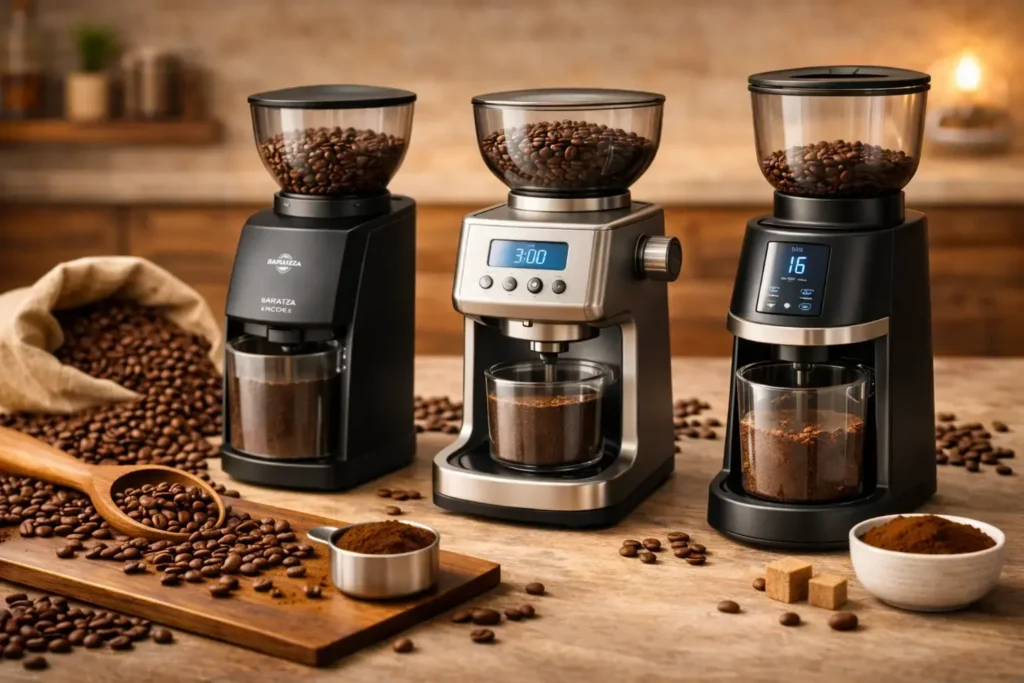
Burr Grinder
Best for: Every brew method
Why it matters: Consistent particle size makes every grind adjustment meaningful and reproducible — without a burr grinder, dial-in adjustments are largely guesswork
Disclosure: CoffeeGearHub may earn from qualifying purchases.
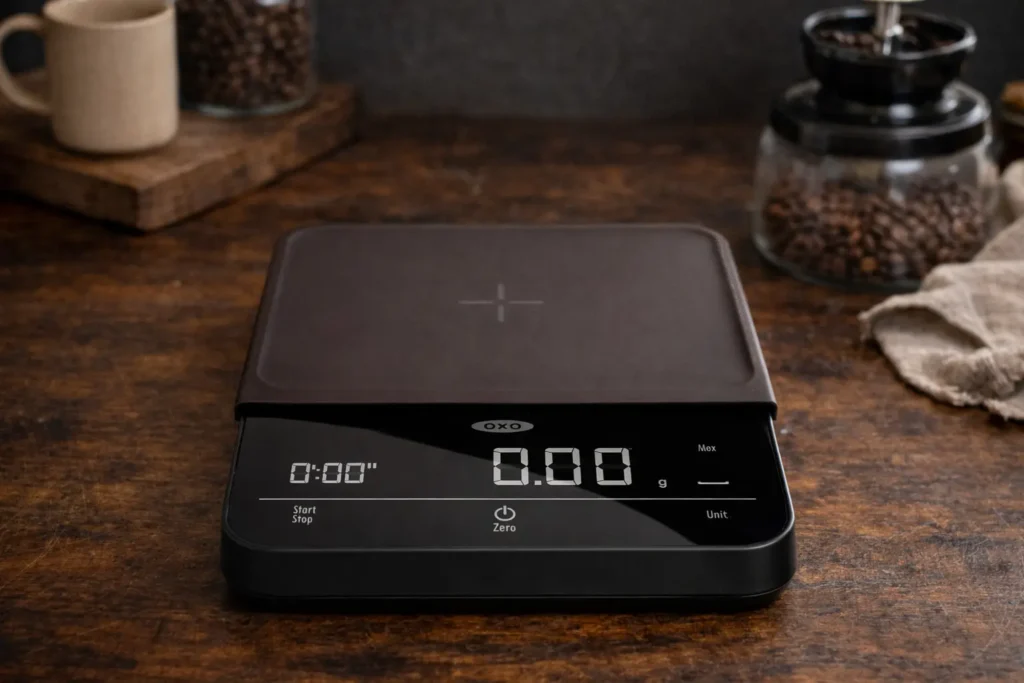
Coffee Scale
Best for: Pour-over, drip, espresso
Why it matters: A stable dose and stable yield make every dial-in repeatable — without a scale, variables compound and you can’t isolate whether grind or dose caused the change
Disclosure: CoffeeGearHub may earn from qualifying purchases.
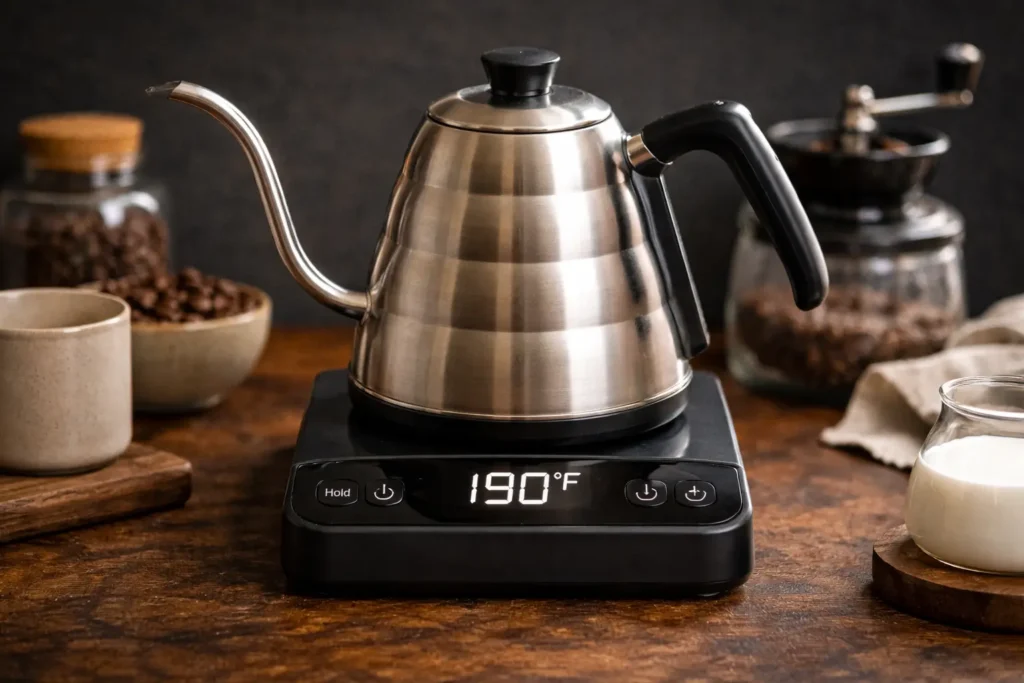
Gooseneck Kettle
Best for: Pour-over, AeroPress
Why it matters: Controlled pour rate reduces channeling, keeps the coffee bed even, and improves extraction consistency — particularly important when fine-tuning agitation alongside grind
Disclosure: CoffeeGearHub may earn from qualifying purchases.
The Site’s Recommended Hand Grinder: KINGrinder K6
For AeroPress, pour-over, and moka pot, the KINGrinder K6 is the hand grinder we recommend consistently across this content cluster. Its click-based step adjustment system makes 1–2 click changes easy to track and repeat, the conical steel burrs produce a narrow, consistent particle distribution, and it carries almost no retained coffee between brews. For pour-over, the K6 typically works well in the 25–35 click range from closed depending on dripper geometry. For AeroPress, start around 20–30 clicks. For moka pot, 15–25 clicks from closed is a reasonable starting zone.
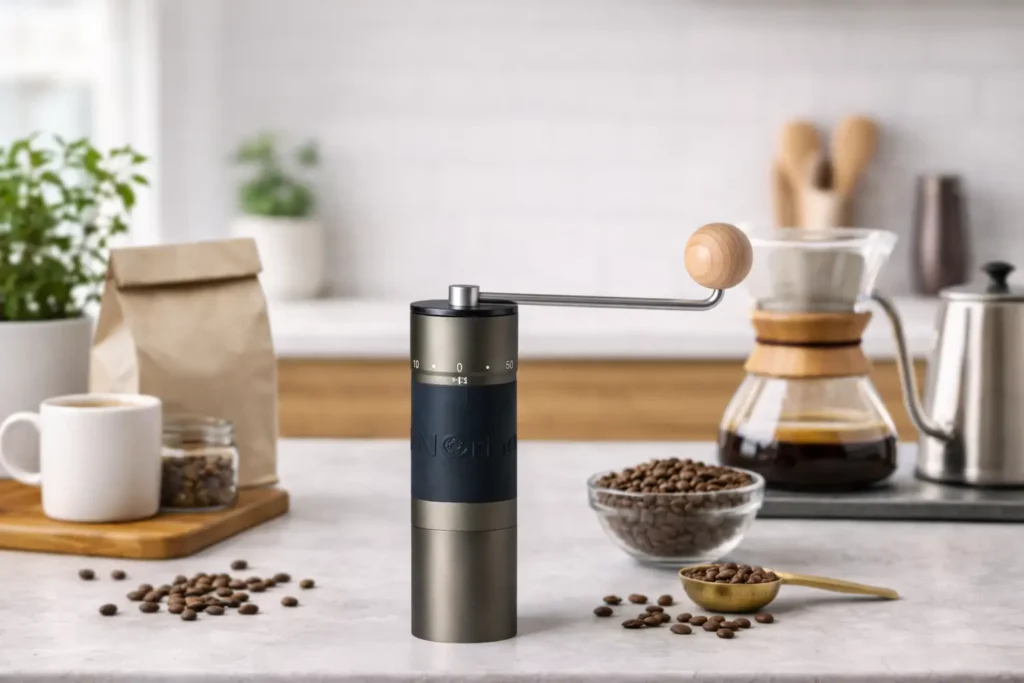
KINGrinder K6 — Best Hand Grinder for AeroPress, Pour-Over & Moka
Precise click-based adjustment, consistent steel burrs, and near-zero retention make the K6 the most useful hand grinder for dialing in multiple brew methods. Start with the click settings above and adjust by 2–4 clicks at a time until cups taste balanced and sweet.
- 1-click adjustments — easy to track and repeat
- Near-zero retention keeps every brew from fresh grounds
- Covers AeroPress, pour-over, moka pot, and drip
Disclosure: CoffeeGearHub may earn from qualifying purchases.
Burr Grinder Comparison Grid
These are the most widely used and reviewed burr grinders across common home-brewing budgets. The right choice depends primarily on the brew methods you care about most — espresso demands finer adjustment range and higher consistency than filter methods, which typically changes what you need to spend. Note that the KINGrinder K6 above covers the hand-grinder category for most manual brew methods.
| Grinder | Best For | Key Strength | Main Tradeoff | Link |
|---|---|---|---|---|
| Baratza Encore | Drip / Pour-over | Reliable entry-level consistency across filter methods | Not well-suited for true espresso grind range | Check Price |
| OXO Brew Conical Burr | Drip / Daily use | Clean workflow, strong value for the price | Less precise adjustment for espresso | Check Price |
| Breville Smart Grinder Pro | Espresso-capable | Wide grind range, built-in dosing timer | Higher grind retention than premium single-dosers | Check Price |
| 1Zpresso JX-Pro | Pour-over / travel | High consistency per dollar, portable | Manual effort required | Check Price |
Disclosure: CoffeeGearHub may earn from qualifying purchases.
Full breakdown including burr geometry, grinder types, and what to buy for each brew style: Best Burr Grinders for Home Coffee.
How to Choose the Right Coffee Grind Size: Three Rules That Work
If you’re still uncertain after reading through everything above, these three rules cover the vast majority of grind decisions you’ll ever need to make at home. They’re not comprehensive — they don’t account for every edge case or exotic recipe — but they give you a reliable starting framework that you can refine from experience.
The first rule is to match the filter. Metal filters (French press, AeroPress with metal cap) allow fine particles into the cup, so you need a coarser grind to keep those particles at a manageable size. Paper filters (pour-over, drip, standard AeroPress) trap fine particles, so you can grind finer without adding muddy texture to the cup. The filter type is your first signal about where your grind target should land.
The second rule is to match contact time. Long contact time requires coarser grind; short contact time allows finer grind. French press sits at four minutes — coarse. Espresso runs in 25–30 seconds — fine. Cold brew steeps for 18 hours — extra coarse. This relationship holds across every brew method and is the underlying reason grind size varies as much as it does.
The third rule is to let brew time confirm. Before tasting, look at how quickly your brew is progressing. If a pour-over drains significantly faster or slower than the target window, you likely need a grind adjustment before the flavor issue becomes obvious. Time is your early warning system; taste is your confirmation. Together, they’re faster and more reliable than any chart.
💡 On “one click” adjustments: On stepped grinders, a single click can be a surprisingly large change — especially on budget models with few steps. On espresso grinders, one small step is often subtle. The goal is always the smallest adjustment that produces a perceptible flavor shift. If your grinder’s steps feel too large — you’re always stuck between “too sour” and “too bitter” — that’s a grinder limitation rather than a technique problem, and it’s the most common sign that an upgrade will make a real difference.
FAQs: Coffee Grind Sizes
What is the best grind size for pour-over coffee?
Most pour-over brewers work best with a medium to medium-fine grind. Flat-bottom drippers like the Kalita Wave tend to prefer medium, while cone brewers like the V60 usually perform better at medium-fine. Use drawdown time — targeting roughly 2:45 to 3:15 for most cone pour-overs — and taste to confirm you’re in the right range.
What grind size is best for a drip coffee maker?
Most drip coffee makers are designed around a medium grind with a sand-like texture. If your coffee tastes weak or watery, go slightly finer. If it tastes bitter, go slightly coarser. A scale to measure your dose helps keep results consistent day to day.
What grind size should I use for French press?
French press works best with a coarse grind, roughly sea salt texture. Too fine causes sludge and bitterness because fine particles slip through the metal filter. Too coarse produces sour, thin cups from insufficient extraction.
Why does my pour-over stall and draw down too slowly?
Stalling usually means your grind is too fine or your grinder is producing too many fine particles. Grind a bit coarser, reduce aggressive swirling during the brew, and make sure you’re rinsing the filter before adding coffee. Aggressive agitation that drives fines into the paper can also cause stalling even at a reasonable grind size.
How fine should espresso be ground?
Espresso grind should be fine and consistent — roughly table salt texture. The standard test is shot time: if your shot runs under about 20 seconds, grind finer. If it runs over 35 seconds or nearly stops, grind coarser. Tiny adjustments matter at espresso grind levels — one or two clicks on most espresso grinders changes shot time by several seconds.
Does grind size affect caffeine content?
Grind size affects extraction efficiency, not the bean’s caffeine content directly. A finer grind with longer contact time will pull a marginally higher percentage of available caffeine, but the difference is small. Brew ratio — how much coffee you use relative to water — has a much larger practical effect on caffeine per cup.
Can humidity change my grind setting?
Yes, and it’s a real effect worth knowing about. Humidity changes how coffee grounds clump after grinding, which affects how densely they pack in the brew bed and how much resistance they offer to water flow. In high humidity, expect grounds to pack tighter and possibly require a slightly coarser grind. In dry conditions, static can cause uneven distribution. Small grind adjustments across seasons are normal and expected.
Why does my coffee taste both sour and bitter?
This combination almost always signals uneven extraction caused by an inconsistent grinder — typically a blade grinder or a worn burr set — that produces both very fine dust and large chunks in the same batch. The fine particles over-extract (bitterness) while the large chunks under-extract (sourness). Upgrading to a quality burr grinder and going slightly coarser usually solves this combination immediately.
Is pre-ground coffee okay to use?
Pre-ground coffee is convenient but has two significant limitations: it stales quickly once ground because oxidation accelerates dramatically after grinding, and you lose the ability to adjust grind size for taste. For occasional use it’s fine, but grinding fresh immediately before brewing is the single easiest upgrade for better coffee quality.
What grind size is best for cold brew?
Cold brew works best with an extra coarse grind, roughly cracked peppercorn texture. The extremely long steep time — 12 to 24 hours — means even a very coarse grind fully extracts over that period. If your cold brew tastes harsh or woody, grind coarser or reduce steep time. If it’s weak, steep longer rather than grinding finer.
What grind size should I use for moka pot?
Moka pot works best with a grind that’s slightly finer than drip but noticeably coarser than true espresso — fine sand or table salt texture. Too fine causes pressure spikes, sputtering, and bitterness. Too coarse produces a weak, hollow cup. Never tamp the moka basket; fill it and level gently.
Do different grinders produce different medium grinds?
Yes — grind size labels are not standardized across brands or models. The number 5 on one grinder may produce a completely different particle size than number 5 on another. Always use texture as your reference point, confirm with brew time, and finalize with taste rather than trusting printed numbers.
Final Take: Master Coffee Grind Sizes, Master Every Cup
Coffee grind size is the single most impactful variable you control as a home brewer — more so than water temperature, more so than brew ratio, more so than equipment brand. The reason is that grind affects both the chemistry and the physics of extraction simultaneously, which is why a single adjustment can transform a cup more completely than anything else. Once you can reliably diagnose sour versus bitter versus weak and connect each symptom to a grind direction, you stop guessing and start brewing with genuine confidence.
The framework throughout this guide comes down to three things: match your grind to your brew method’s contact time and filter type, use brew time as your early warning system, and let taste make the final call. Everything else — temperature, ratio, agitation — is refinement after grind is solved. Get grind right and the rest of the variables become genuinely enjoyable to explore rather than frustrating sources of unpredictability.
Continue Learning
BREWING GUIDES
Ready to put grind size into practice? The coffee brew ratio guide covers the correct ratio for every brewing method — pour over, drip, French press, AeroPress, espresso, and cold brew — so your dose and grind work together from the first brew.
☕
Written by the CoffeeGearHub Editorial Team
CoffeeGearHub is a specialty coffee equipment resource run by home brewers and coffee enthusiasts. Our guides are researched using published brewing science, manufacturer specifications, and established specialty-coffee community knowledge. We review and update our pillar content regularly. About CoffeeGearHub →