
Do You Need a Grinder for Espresso?
Editorial standards: this guide explains grinder requirements using espresso extraction principles, manufacturer information, and practical workflow. CoffeeGearHub does not claim hands-on testing where it has not occurred.
At a glance
The short answer
For repeatable non-pressurized espresso, a capable burr grinder is effectively part of the brewing system. Pressurized baskets tolerate a wider grind range, but fresh grinding still gives you much more control than pre-ground coffee.
Editorial analysis
Spend for adjustment, not marketing
The important grinder traits are repeatable fine adjustment, adequate burr consistency, manageable retention, and a workflow you can use every day. Machine price alone cannot compensate for a grinder that cannot dial in espresso.
The 30-Second Answer
You need an espresso-capable grinder if you want repeatable control with a non-pressurized basket. A pressurized basket can be more forgiving of pre-ground coffee, but fresh grinding gives you the ability to change flow as the coffee, dose, and conditions change. The important requirement is not a specific brand or number of settings—it is repeatable fine adjustment in the espresso range.
Who this guide is for
- New espresso-machine owner: start with why the grinder matters.
- Pre-ground user: see pre-ground vs fresh-ground.
- Unsure about basket type: see pressurized vs non-pressurized.
- Ready to compare grinders: jump to beginner grinder examples.
Why the Grinder Matters So Much in Espresso
Espresso depends on controlled flow through a compact coffee puck. Grind size is one of the main variables that sets that flow resistance, so a grinder that allows small, repeatable adjustments gives you a direct way to correct shots that reach the target beverage yield too quickly or too slowly.
The machine still matters for temperature, water delivery, steam performance, serviceability, and workflow. The grinder and machine solve different parts of the system, so there is no universal rule that one must always receive more of the budget.
⚠️ Budget check: before upgrading the machine to fix inconsistent shots, confirm that the grinder can make small, repeatable espresso adjustments and that dose, yield, and puck preparation are controlled. If the grinder is the bottleneck, a machine upgrade will not solve that specific problem.
Pre-Ground vs Fresh-Ground Espresso
Pre-ground coffee can work, especially with a pressurized basket, but it removes your ability to change grind size when the shot flow is wrong. Fresh grinding gives you both fresher aroma and a controllable variable.
| Factor | Pre-ground | Fresh-ground |
|---|---|---|
| Grind adjustment | Fixed before brewing | Can be changed for the machine, basket, coffee, and conditions |
| Repeatability | You can repeat dose/yield, but not correct the grind | You can repeat and refine the full recipe |
| Aroma | Changes more quickly after grinding because more surface area is exposed | Whole beans retain aroma longer before grinding |
| Pressurized basket | Often workable because the basket adds flow resistance | Still offers more control |
| Non-pressurized basket | Harder to dial in because the grind cannot be corrected | Preferred for deliberate flow adjustment |
How quickly flavor changes after grinding depends on the coffee, packaging, storage, environment, and recipe. Avoid fixed “minutes after grinding” rules; the practical advantage of fresh grinding is both aroma retention and adjustability.
What a Grinder Controls in an Espresso Setup
- Flow through grind size. Finer grind generally increases puck resistance; coarser grind generally reduces it.
- Repeatability. A burr grinder gives you a setting you can record and return to.
- Freshness plus adjustability. Grinding immediately before brewing preserves more aroma and lets you re-dial as the coffee or conditions change.
Grind is not the only variable. Basket design, dose, puck preparation, water, temperature, pressure delivery, and cleanliness also influence the result.
Pressurized vs Non-Pressurized Baskets: How Grinder Requirements Change
The basket changes how directly the coffee puck controls flow. A pressurized or double-wall basket adds restriction at the basket itself, so it tolerates a wider grind range. A non-pressurized or single-wall basket relies much more on the coffee puck.
| Pressurized basket | Non-pressurized basket | |
|---|---|---|
| Flow resistance | Basket adds extra restriction | Puck preparation and grind create most of the resistance |
| Grind tolerance | More forgiving | Requires finer, more repeatable adjustment |
| Pre-ground coffee | Can be workable | Harder to dial in because grind is fixed |
| Grinder priority | A capable burr grinder is useful but not always mandatory on day one | An espresso-capable burr grinder is effectively part of the core setup |
| Upgrade logic | Fresh grinding adds control and consistency | Prioritize fine-range adjustment and repeatability |
Check the exact basket supplied with your machine. Some machines include both basket types, and accessories vary by model.
Can a Coffee Shop Grind Espresso for You?
Yes—as a temporary convenience. A shop can grind coffee finely for espresso, but it cannot know the exact setting your machine, basket, dose, and coffee will need once you start brewing at home.
This approach works best with a pressurized basket or when you are comfortable accepting less control. If a non-pressurized shot runs too fast or too slowly, the grind is already fixed and cannot be corrected. Buying smaller amounts and using them promptly can make the workaround more practical while you decide whether to buy a grinder.
Why a Burr Grinder Is the Better Tool for Espresso
A blade grinder can make coffee very fine, but it does not give you a controlled burr gap or a repeatable setting. That makes it difficult to make the small, deliberate flow adjustments required by a non-pressurized espresso basket.
| Burr grinder | Blade grinder | |
|---|---|---|
| Adjustment | Changes a defined burr gap or calibrated setting | Changes average fineness mostly by grinding longer |
| Repeatability | You can record and return to a setting | Harder to reproduce the same particle distribution |
| Espresso dial-in | Espresso-capable models allow small changes near the fine end | No reliable step-by-step adjustment for shot flow |
| Pressurized basket use | Works well and leaves room to improve | May produce drinkable results in some forgiving pressurized-basket workflows, but with less control |
| Non-pressurized basket use | Preferred because flow can be dialed in deliberately | Not a practical choice for repeatable dial-in |
Bottom line: you do not need an expensive grinder, but you do need repeatable adjustment if you want to control non-pressurized espresso. Pre-ground coffee or a blade grinder can be a temporary bridge with a pressurized basket; they are not equivalent to having an espresso-capable burr grinder.
What to Look for in an Espresso Grinder
Do not shop by the total number of settings alone. What matters is whether the grinder reaches the espresso range and gives you enough control within that range to change shot flow predictably.
| Factor | Why it matters | Useful signs |
|---|---|---|
| Fine-range resolution | Small grind changes can noticeably change espresso flow | Manufacturer states espresso capability; stepped micro-adjustment or stepless control |
| Repeatability | You need to return to a successful recipe | Numbered collar, click references, or clear stepless markings |
| Range | Some users also brew filter coffee | Enough range for your actual methods without sacrificing espresso control |
| Workflow and retention | Grounds left in the grinder can make dose changes less predictable | Easy purge/cleaning routine, sensible hopper or single-dose workflow |
| Serviceability | Grinders are wear items | Replacement burrs/parts, calibration guidance, documented support |
For a pressurized basket, the grinder requirement is more forgiving. For a non-pressurized basket, prioritize fine adjustment and repeatability over headline features.
Two starting points
Electric stepped vs manual fine-step grinding
These two examples cover different beginner workflows: an electric grinder with a dedicated espresso adjustment range and a hand grinder with fine external steps.
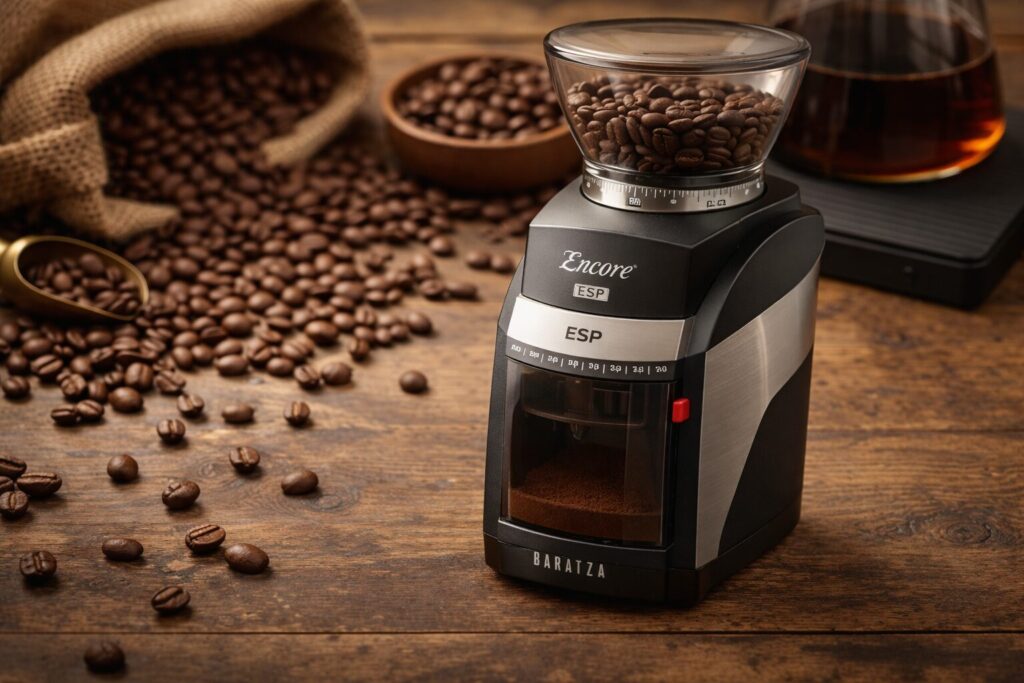 Baratza Encore ESPStepped electric grinder with a higher-resolution espresso range and broader filter range.Check current Amazon offer →
 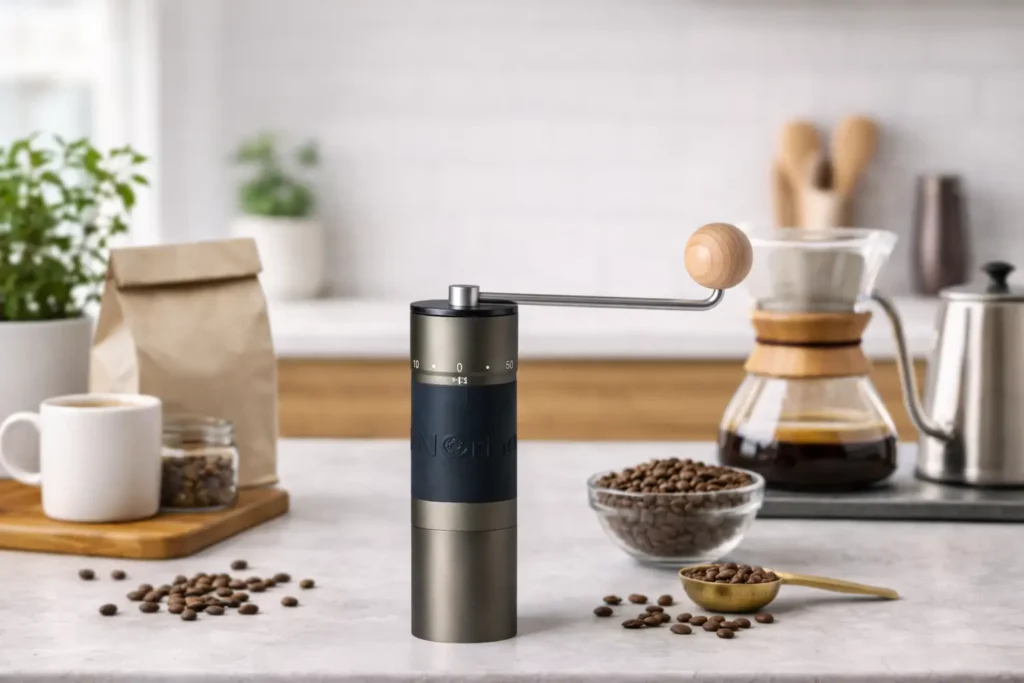 KINGrinder K6Manual grinder with fine external adjustment for users comfortable hand-grinding.Check current Amazon offer →
Affiliate disclosure: Amazon links may earn CoffeeGearHub a commission at no additional cost to you. Prices and availability can change.
Beginner Espresso Grinder Examples
These examples cover different adjustment styles and workflows. They are not ranked as universal winners; choose based on basket type, willingness to hand-grind, whether you also brew filter coffee, and preference for stepped versus stepless control.
Baratza Encore ESP — stepped electric all-rounder
The Encore ESP is designed to give more adjustment resolution at espresso settings while retaining a broader filter range. It fits users who want one electric grinder to cover espresso and other methods.
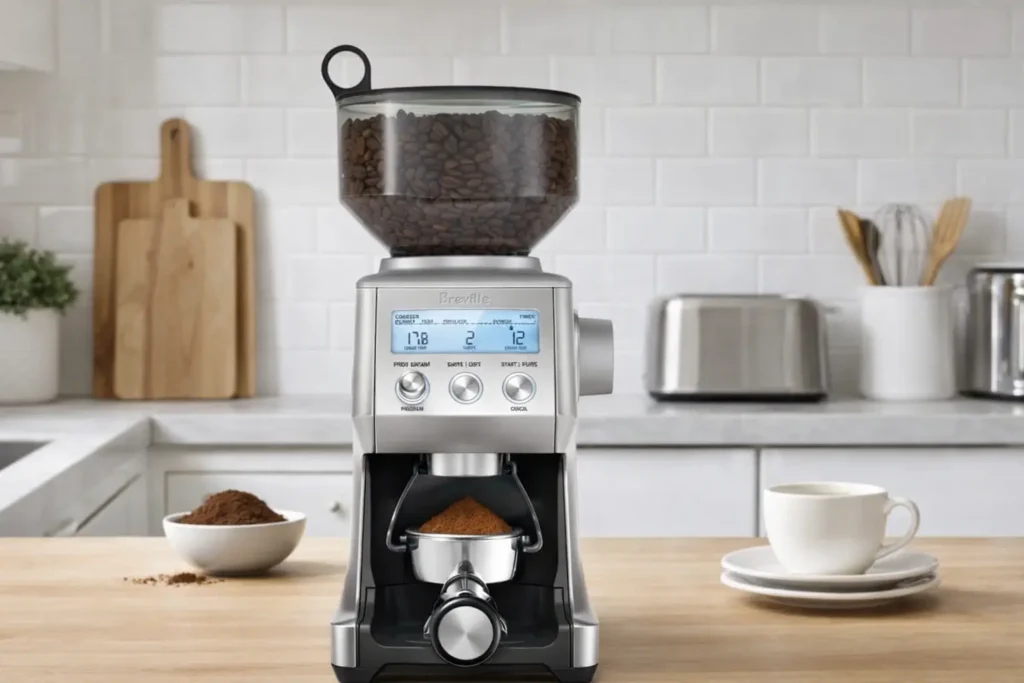
Breville Smart Grinder Pro — timed dosing workflow
The Smart Grinder Pro combines stepped grind adjustment with timed dosing and portafilter support. It suits users who value a hopper-based workflow and visible dose controls.
KINGrinder K6 — manual fine-step option
The K6 is useful when you want fine external adjustment without paying for an electric motor. Hand-grinding at espresso fineness takes more effort and time, so the trade-off is workflow rather than grind control alone.
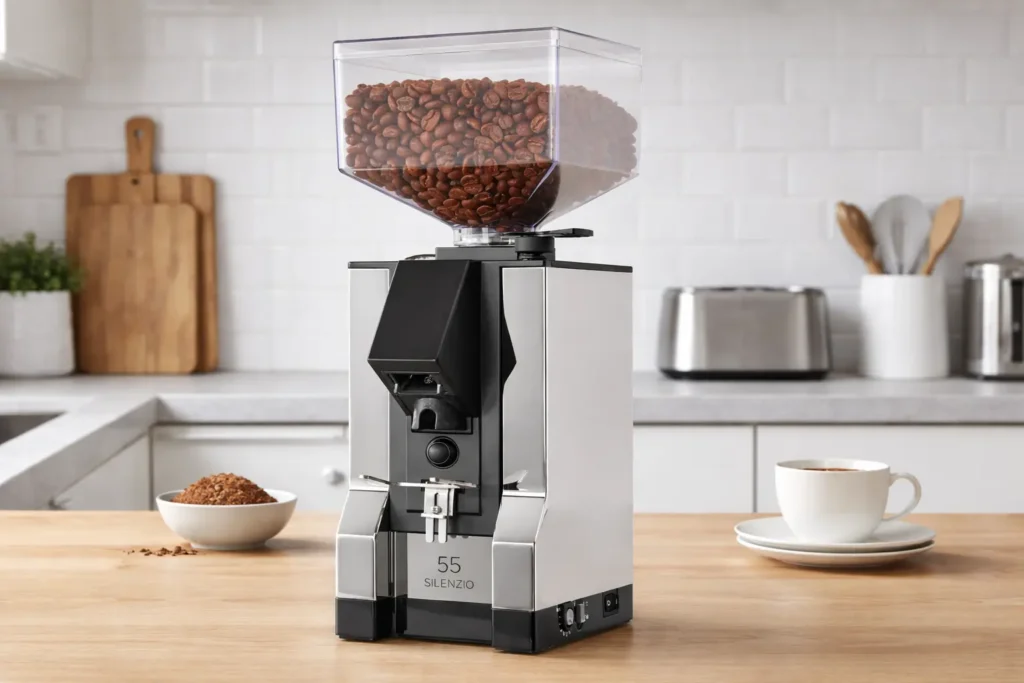
Eureka Mignon Silenzio 55 — quiet stepless espresso focus
The current Silenzio 55 fits users who want fine stepless control and quieter operation and expect espresso to remain the primary use case.
Should You Spend More on the Grinder or the Espresso Machine?
There is no universal percentage split. The right budget depends on which component is limiting the workflow. A capable machine paired with a grinder that cannot make small espresso adjustments will be frustrating, but an expensive grinder also cannot give a machine temperature control, steam capacity, or automation it does not have.
| If your limitation is… | Prioritize | Why |
|---|---|---|
| You cannot slow or speed the shot predictably | Grinder | You need finer adjustment resolution near espresso settings |
| Your grinder is capable but milk workflow is too slow | Machine | Steam system and heating architecture are machine limits |
| Shots vary because dose and puck prep vary | Technique / scale | Replacing hardware will not fix an uncontrolled recipe |
| You want less manual work | Machine workflow | Assisted or super-automatic features change preparation more than grinder upgrades do |
For a first non-pressurized espresso setup, make sure the grinder is genuinely espresso-capable before spending heavily on advanced machine features.
Why Espresso Needs More Grind Control Than Most Brew Methods
Espresso sends water through a compact puck under pressure, so small differences in resistance can create large differences in flow. Grind size is one of the main variables that sets that resistance.
- Fine adjustment matters. A small grind change can noticeably change how quickly the target beverage yield is reached.
- Distribution matters too. Uneven density in the puck can create preferential flow paths, so a capable grinder still needs consistent dosing, distribution, and tamping.
- Time is diagnostic, not a quality score. Record the time to target yield, but evaluate the shot by taste and repeatability rather than forcing every coffee into one universal window.
Shot Timing: Use It to Diagnose Flow
Time is most useful when paired with a fixed dose and target beverage yield. It tells you how quickly water moved through the puck; it does not tell you by itself whether the espresso tastes good.
| Observation | What to check | Useful first move |
|---|---|---|
| Target yield arrives much faster than your normal baseline | Grind, dose, puck damage, basket fill | Verify dose/prep, then grind finer |
| Target yield arrives much slower than your normal baseline | Grind, overdosing, blocked flow path, puck prep | Check basket/cleanliness, then grind coarser |
| Time looks normal but shot tastes sour or thin | Yield, temperature, coffee, channeling | Change one variable based on taste rather than forcing a different time |
| Time looks normal but shot tastes harsh or drying | Yield, temperature, roast, cleanliness | Try a slightly shorter yield or coarser grind one change at a time |
| Time changes every shot | Dose, distribution, tamp, grinder retention, warm-up routine | Standardize the workflow before buying new equipment |
How to Start Dialing In With a New Espresso Grinder
Establish a repeatable baseline first. Keep dose and target yield stable, use the grinder maker’s espresso guidance if available, record the setting and shot time, then change one variable at a time.
First-session process
- Choose a coffee you can buy again and note the roast date.
- Use a dose that fits the basket and weigh it consistently.
- Start within the grinder manufacturer’s espresso reference range when one is published.
- Distribute the grounds evenly and tamp level until the puck is fully compressed.
- Pull the shot on a scale and stop at a repeatable target yield; a ratio around 1:2 is a useful neutral starting point for many coffees.
- Record the time to that yield, but treat time as a diagnostic rather than a pass/fail target.
- If flow is clearly too fast and the shot tastes thin or sharp, grind finer. If flow is very slow and the shot tastes harsh or drying, grind coarser.
- Once flow is controllable, adjust yield and other variables by taste one change at a time.
- Log the recipe that worked so you have a starting point for the next session.
Useful tools
- 0.1g scale: keeps dose and beverage yield measurable.
- Tamper sized to the exact basket: helps create a level, fully compressed puck.
- Distribution/WDT tool: optional, but useful if it improves repeatability.
- Coffee with a roast date: use roaster guidance when available and track how the recipe changes over the life of the bag.
- Shot log: record grinder setting, dose, yield, time, and taste.
Common Grinder Mistakes in Beginner Espresso
| Mistake | Why it causes trouble | Better approach |
|---|---|---|
| Using pre-ground coffee with a non-pressurized basket and expecting to dial it in | The grind is fixed before it reaches your machine | Use an espresso-capable burr grinder or a more forgiving pressurized-basket workflow |
| Using a blade grinder as if it had espresso settings | There is no repeatable burr-gap adjustment | Use a burr grinder that reaches espresso fineness with controllable adjustment |
| Changing several variables at once | You cannot tell which change caused the result | Change one variable at a time |
| Not weighing dose or beverage yield | The recipe changes without you knowing it | Use a scale while learning |
| Buying by total setting count alone | Many settings are useless if the espresso range has poor resolution | Look for espresso capability and fine-range control |
| Assuming one setting works for every coffee | Coffee, dose, basket, and conditions change flow | Use the last recipe as a starting point, then re-dial |
Troubleshooting: Is the Grinder the Problem?
| Symptom | Check first | Useful next step |
|---|---|---|
| Target yield arrives much too fast | Dose, puck damage, grind setting | Verify dose/prep, then grind finer |
| Target yield arrives much too slowly | Overdosing, blocked flow path, grind too fine | Check basket and cleanliness, then grind coarser |
| Shot time varies widely at the same setting | Dose, distribution, tamp, retention, warm-up routine | Standardize the workflow before blaming the grinder |
| You run out of usable adjustment before flow is controllable | Grinder espresso range | Confirm burr calibration; if the grinder lacks enough fine-range control, compare an espresso-capable model |
| Shot behavior changes over several days | Coffee age, humidity, retention, setting drift | Keep dose/yield stable and make a small grind adjustment |
| Same ratio, different taste | Temperature, puck prep, coffee, water, cleanliness | Remember that ratio and time do not describe extraction quality by themselves |
Espresso Grinder Buying Checklist
| Question | What to confirm |
|---|---|
| Is it a burr grinder? | Conical or flat burr mechanism rather than a blade/chopper |
| Does the maker state espresso capability? | It reaches espresso fineness and has meaningful adjustment within that range |
| What basket am I using? | Pressurized baskets are more forgiving; non-pressurized baskets demand finer control |
| Can I repeat a setting? | Numbered steps, click references, or useful stepless markings |
| Does the workflow fit me? | Manual vs electric, hopper vs single-dose, noise, retention, and cleaning routine |
| Are service parts available? | Replacement burrs, calibration instructions, and manufacturer support |
Final Answer: Do You Need a Grinder for Espresso?
For repeatable non-pressurized espresso, an espresso-capable burr grinder is effectively part of the core setup. It gives you the adjustment needed to control flow as coffee, dose, and conditions change.
There are workable exceptions. Pressurized baskets are more tolerant of pre-ground coffee, and some people intentionally choose that convenience. The important distinction is control: if you want to dial in a non-pressurized basket, fresh grinding with repeatable fine adjustment is the practical path.
Do not use a fixed rule for how much of the budget must go to the grinder. Make sure the grinder is capable enough for the basket and workflow, then spend on the machine features—temperature control, steam capacity, automation, serviceability—that matter to you.
FAQs: Do You Need a Grinder for Espresso?
Do I need a grinder for espresso?
Can I use pre-ground coffee?
Can I use a blade grinder?
Does grinder quality matter more than machine quality?
Does a pressurized basket change the grinder requirement?
How does grind freshness affect espresso?
CoffeeGearHub shortlist
Compare grinder options before leaving the site
Use these CoffeeGearHub pages to compare current grinder options and related espresso guidance.
Continue Learning
In this guide
- The 30-Second Answer
- Why a Grinder Matters More Than Any Other Espresso Variable
- Pre-Ground vs Fresh-Ground: What Actually Changes in Your Espresso Shot
- What a Grinder Controls and Why It Cannot Be Skipped
- Pressurized vs Non-Pressurized Portafilter: Does It Change the Grinder You Need?
- Can a Coffee Shop Grind Espresso for You?
- Why Blade Grinders Do Not Work for Espresso
- What to Look for in an Espresso Grinder
- Best Grinders for Beginner Espresso Setups: Our Top Picks
- Should You Spend More on a Grinder or the Espresso Machine?
- Extraction Science: Why Espresso Demands Grind Precision More Than Any Other Method
- Shot Timing: How Grind Size Controls What Your Espresso Tastes Like
- How to Start Dialling In With a New Espresso Grinder
- Common Mistakes Beginners Make With Espresso Grinding
- Troubleshooting: Shot Problems Caused by Grinding
- Espresso Grinder Buying Checklist
- Final Answer: Do You Need a Grinder for Espresso?
- FAQs: Do You Need a Grinder for Espresso?
- Continue Learning