
Breville Bambino Plus vs Barista Express (2026): Which Should You Buy?
Editorial standards: this comparison is based on Breville’s published specifications for the BES500 and BES870XL, published owner and reviewer feedback, and CoffeeGearHub’s existing espresso guides. Specifications and bundles can vary by region and retailer. CoffeeGearHub does not claim hands-on testing where it has not occurred.
At a glance
What this Bambino Plus vs Barista Express comparison covers
Where the two machines pull essentially the same shot, why the grinder decision matters more than anything else, automatic versus manual milk steaming, heat-up speed and daily workflow, counter space and maintenance, how each setup ages, the alternatives worth a look, and which buyer each machine suits.
Editorial analysis
The real choice is grinder in the box versus milk on autopilot
The Bambino Plus and Barista Express come from the same Breville family and share more than most comparisons admit: the same 54 mm portafilter, the same 18 g dose, low-pressure pre-infusion, and digital temperature control. In the cup, the espresso each machine can produce is very close.
What separates them is everything around the shot. The Barista Express puts a grinder in the box and teaches you to steam milk by hand. The Bambino Plus leaves the grinder to you but heats up in seconds and can texture milk automatically. Your answer depends on which of those trade-offs fits your kitchen and your mornings.
The 30-Second Answer
Buy the Bambino Plus if you mostly drink lattes and cappuccinos, want espresso ready in seconds, have limited counter space, or already own (or are willing to buy) an espresso grinder. Buy the Barista Express if you want one box with the grinder included and you are happy to learn manual milk steaming.
Both pull very similar shots. The bigger long-term difference is the grinder: a Bambino Plus paired with a capable separate grinder has more room to grow, while the Barista Express is the simpler, all-in-one start. Our Bambino Plus review and Barista Express review cover each machine in depth.
Compare current options
Start with these representative choices
The two machines, plus the grinder most often paired with the Bambino Plus. Our best home espresso machines guide compares more options.
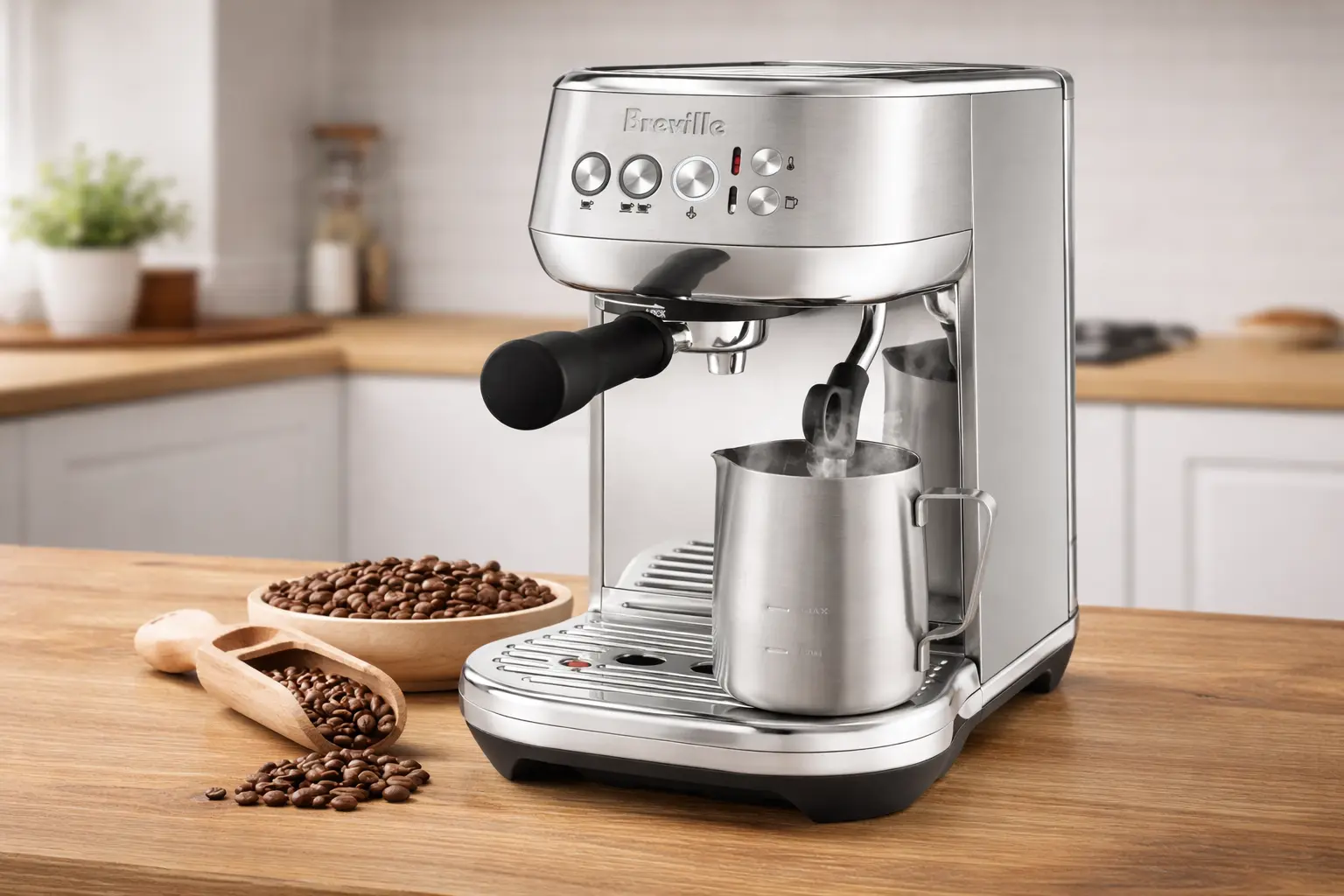
Breville Bambino Plus — Best for milk drinks and small kitchens
Three-second heat-up, automatic milk texturing, and a compact footprint. Needs a separate grinder for best results.
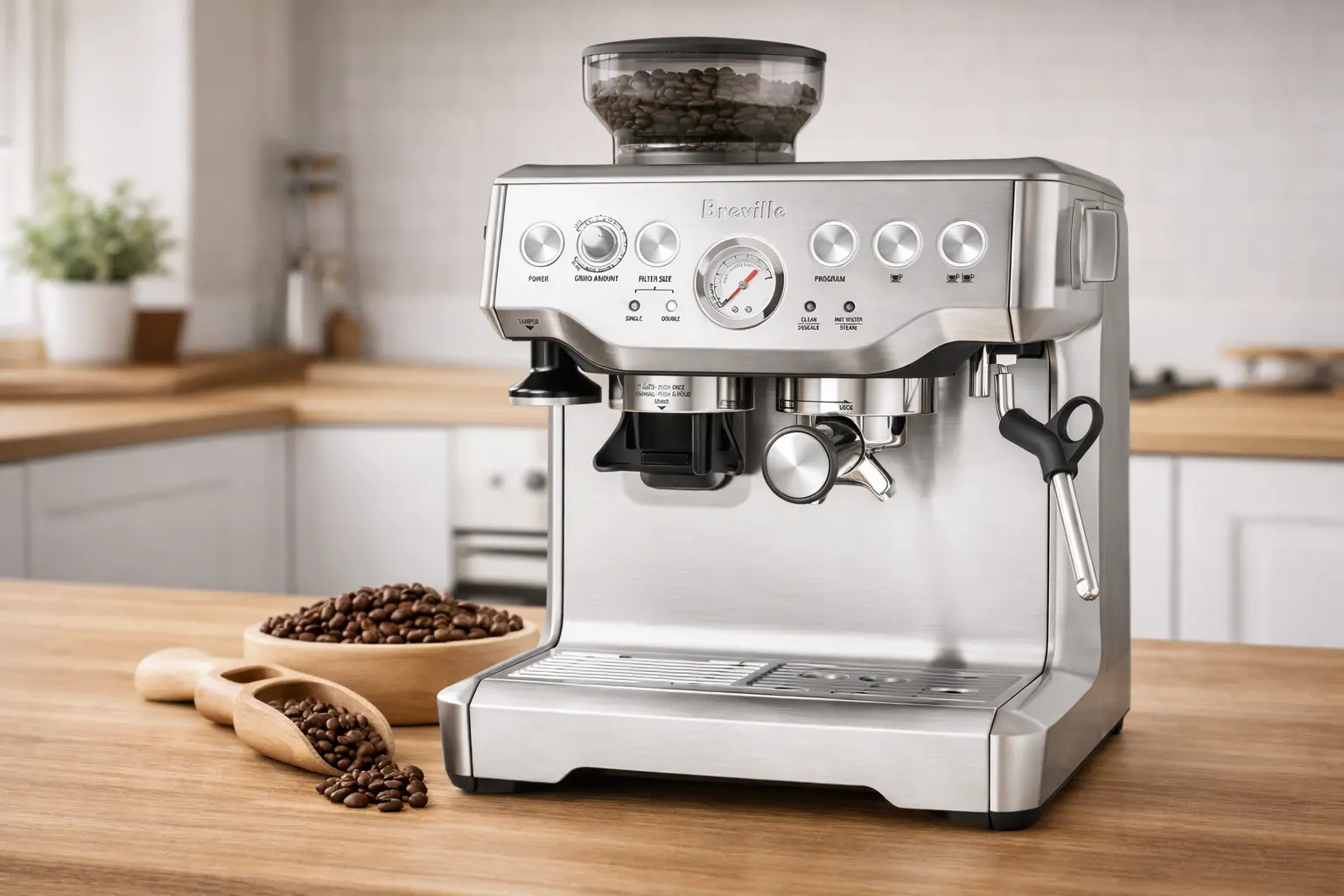
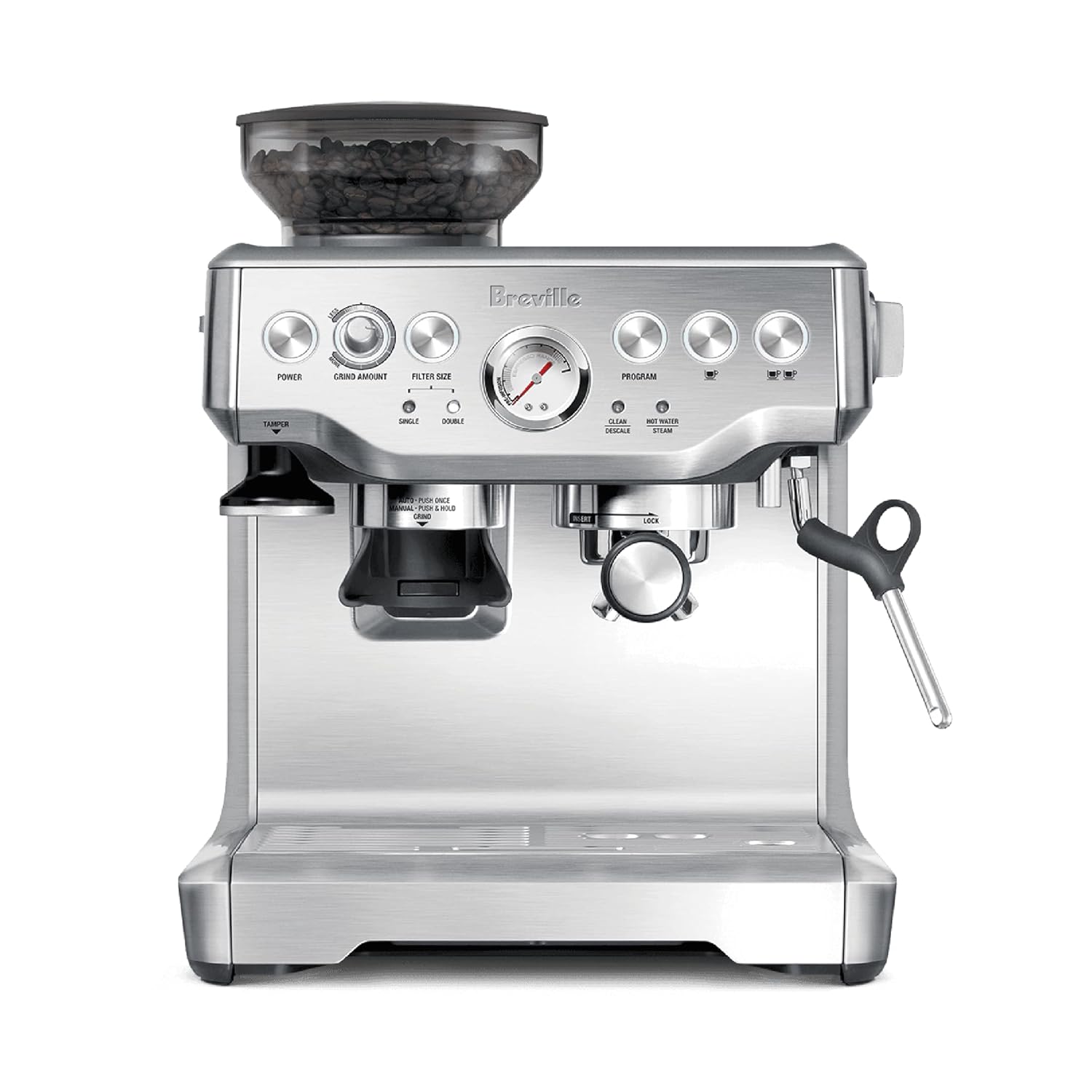
Breville Barista Express — Best all-in-one start
Built-in conical burr grinder, pressure gauge, and hot water outlet in one machine. Milk is steamed by hand.
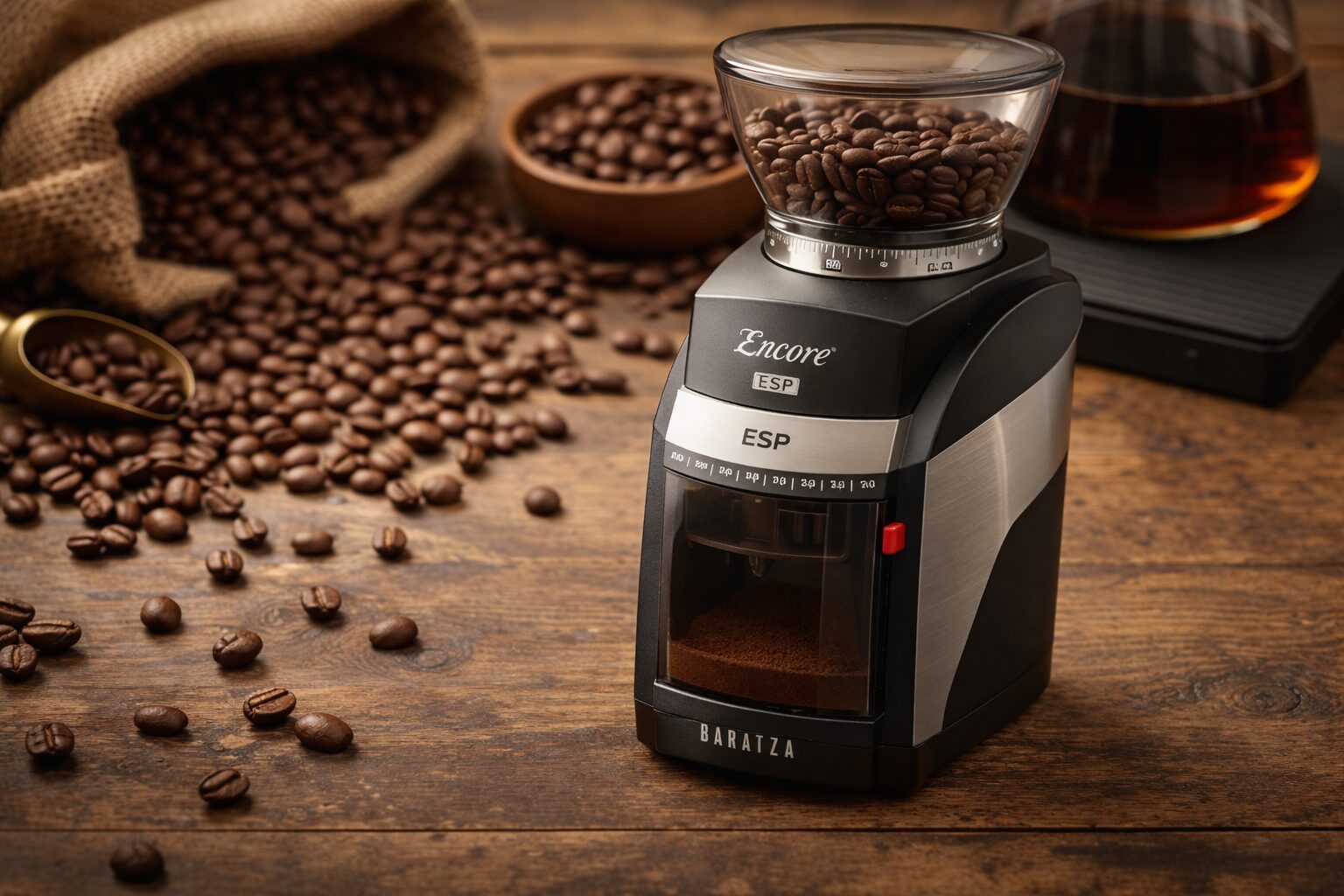
Baratza Encore ESP — Grinder to pair with the Bambino Plus
An espresso-capable burr grinder with fine adjustment in the espresso range, and repair parts available for the long term.
Affiliate disclosure: Amazon links may earn CoffeeGearHub a commission at no additional cost to you. Prices and availability can change.
Bambino Plus vs Barista Express at a Glance
The table summarizes Breville’s published specifications for the two machines. Most rows that look like big differences on paper, such as tank size, matter much less in daily use than three rows near the top: whether a grinder is included, how fast the machine heats, and how it handles milk. The sections below explain which differences actually change your experience.
| Bambino Plus (BES500) | Barista Express (BES870XL) | |
|---|---|---|
| Grinder | None; buy separately or use pre-ground with dual-wall baskets | Built-in conical burr grinder with dose control |
| Heating | ThermoJet, ready in about 3 seconds (Breville rating) | Thermocoil, about a minute before the first shot |
| Extraction | Low-pressure pre-infusion, then about 9 bar; PID | Low-pressure pre-infusion, then about 9 bar; PID |
| Portafilter / dose | 54 mm, 18 g | 54 mm, 18 g |
| Milk | Automatic steam wand (3 temperatures, 3 textures) or manual | Manual steam wand |
| Hot water outlet / pressure gauge | No / No | Yes / Yes |
| Size and weight | About 7.7 in wide; about 11 lb | About 12.5 in wide; about 23 lb |
| U.S. warranty | 2-year limited | 1-year limited |
The Shot Itself Is Nearly Identical
Start with what the two machines share, because it is more than most buyers expect. Both use a 54 mm portafilter with an 18 g dose, the same basket size across Breville’s entry and mid-range machines. Both begin each shot with low-pressure pre-infusion, which gently wets the puck before full pressure arrives and makes channeling less likely. Both then extract at roughly 9 bar, and both use PID digital temperature control to keep brew water stable from shot to shot.
That shared foundation means the espresso each machine can produce is very close. If you put the same freshly ground coffee into each portafilter, dosed and tamped the same way, most people would struggle to tell the shots apart. The idea that the bigger, heavier Barista Express must pull a better shot is understandable but not supported by the specifications.
What actually changes the cup is the grind. Espresso is unforgiving: small differences in particle size change how fast water flows through the puck and how much flavor it extracts. That is why the grinder question, covered next, matters more to your coffee than any difference between the two machines themselves. Our espresso brew ratio guide explains how dose, yield, and time work together.
The Grinder Is the Real Decision
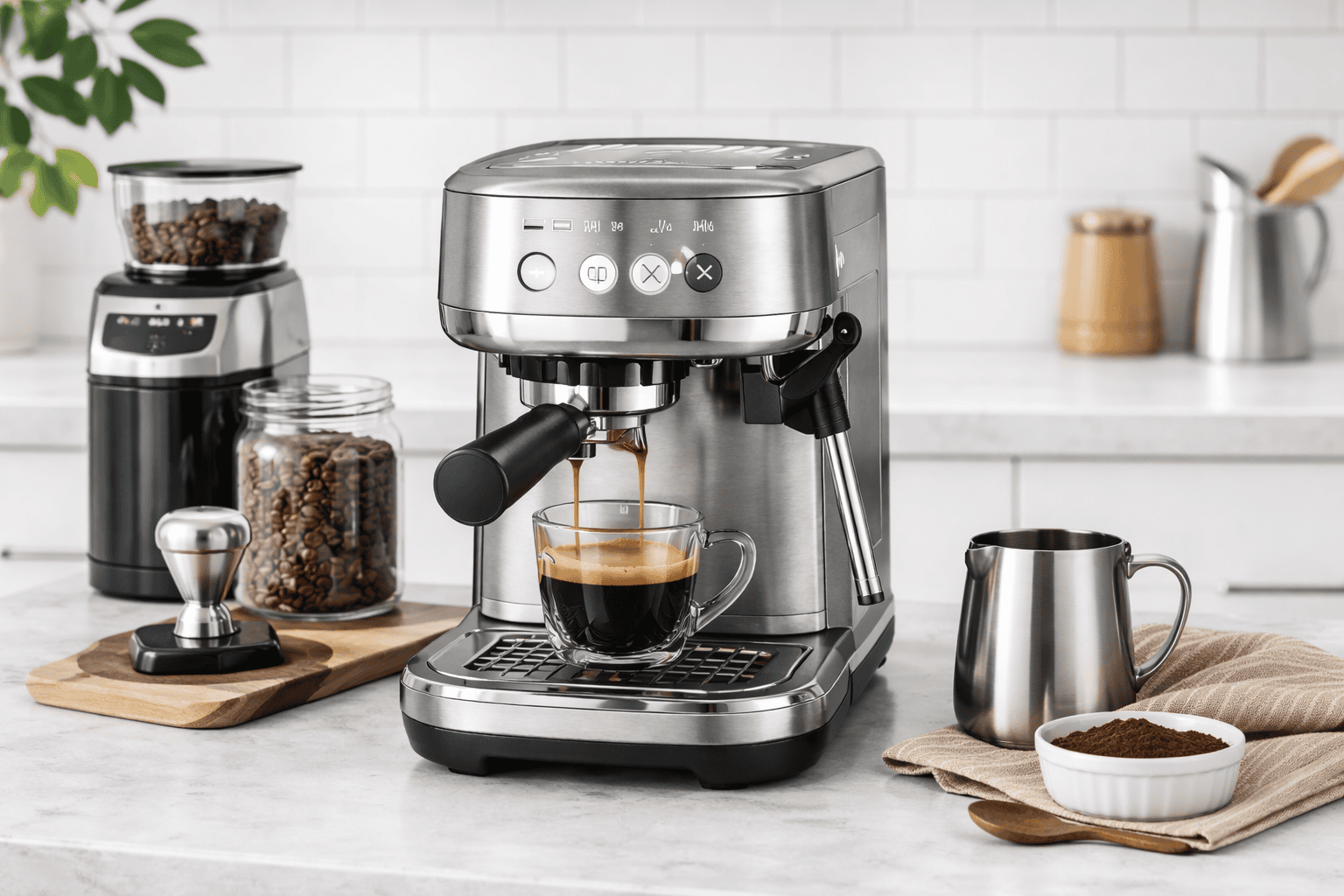
The Barista Express includes a conical burr grinder built into the machine, with a dose-control dial that grinds directly into the portafilter. For many buyers this is its whole appeal. You unbox one machine, add beans, and you have everything needed for fresh espresso. The built-in grinder handles most medium and dark roasts well, especially in milk drinks, and it saves both money and counter space compared with buying two separate devices.
Its limitation is range and precision. The built-in grinder offers a relatively small number of settings for espresso, and very light roasts often need finer, more precise adjustment than it can comfortably provide. Many owners find a setting that works and stay there happily for years. Others, usually those who start buying lighter specialty roasts, eventually adjust the internal burr or add a separate grinder, at which point the built-in one becomes redundant weight on the machine.
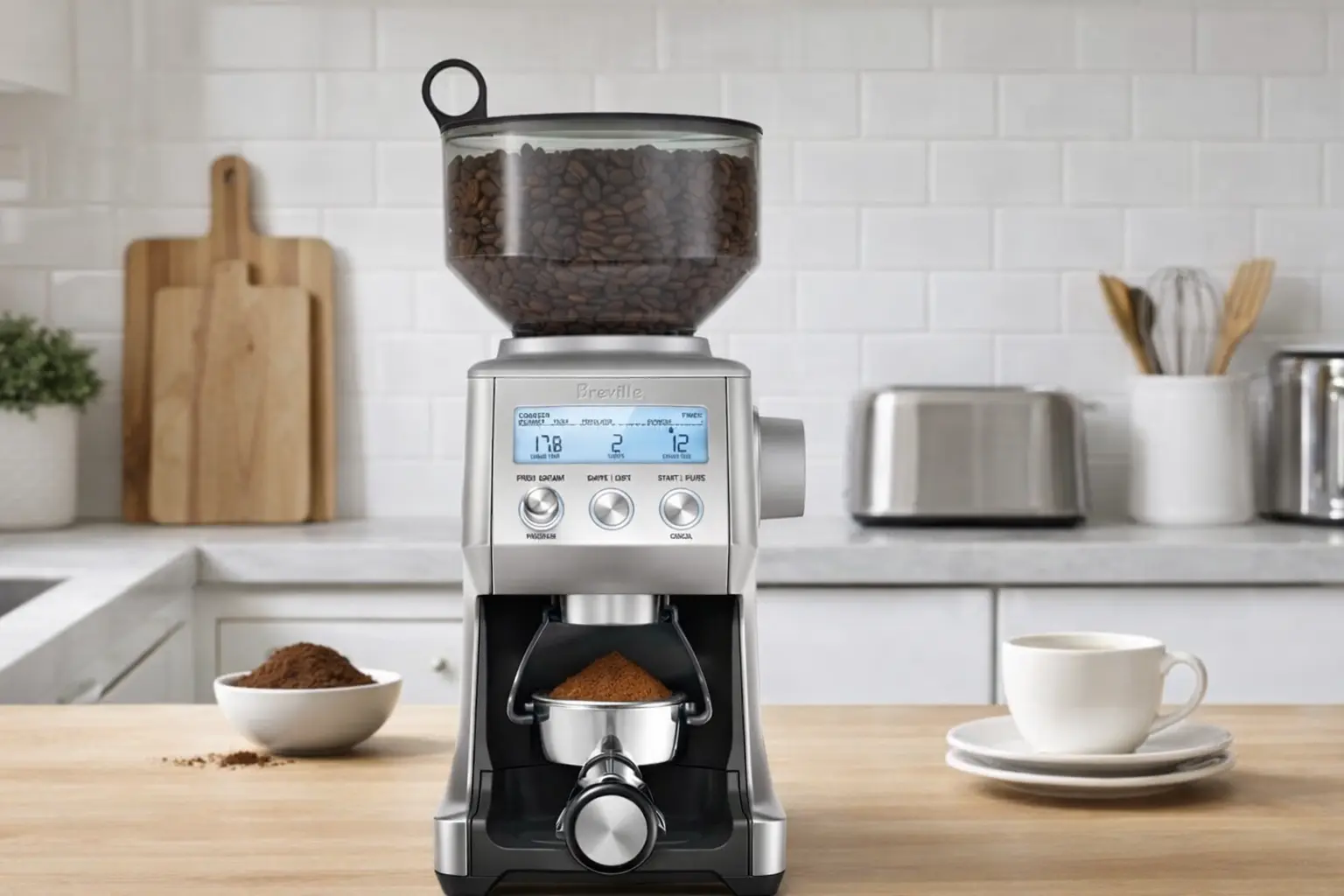
The Bambino Plus has no grinder at all. You can use pre-ground coffee with its dual-wall (pressurized) baskets, which are designed to build pressure even with a less precise grind, but the results are limited. To get the most from the machine you need an espresso-capable grinder, and that is both its main drawback and its main strength: you get to choose the grinder.
A common pairing is the Baratza Encore ESP, which offers fine adjustment in the espresso range and a long track record of repairability. The Breville Smart Grinder Pro is another frequent choice, with many settings and a dosing timer. Either gives you more control than the Barista Express’s built-in grinder, and either can move to a future machine if you upgrade. Our best espresso grinders guide and do you need a grinder for espresso? explain the options in more detail.
So the grinder decision comes down to this: if you want the simplest possible start and drink mostly medium or dark roasts, the Barista Express’s built-in grinder is a genuine convenience. If you already own a good grinder, want to explore lighter roasts, or prefer to buy equipment that can outlast the machine, the Bambino Plus plus a separate grinder is the stronger long-term setup.
Milk Drinks: Automatic Texture or a Learned Skill
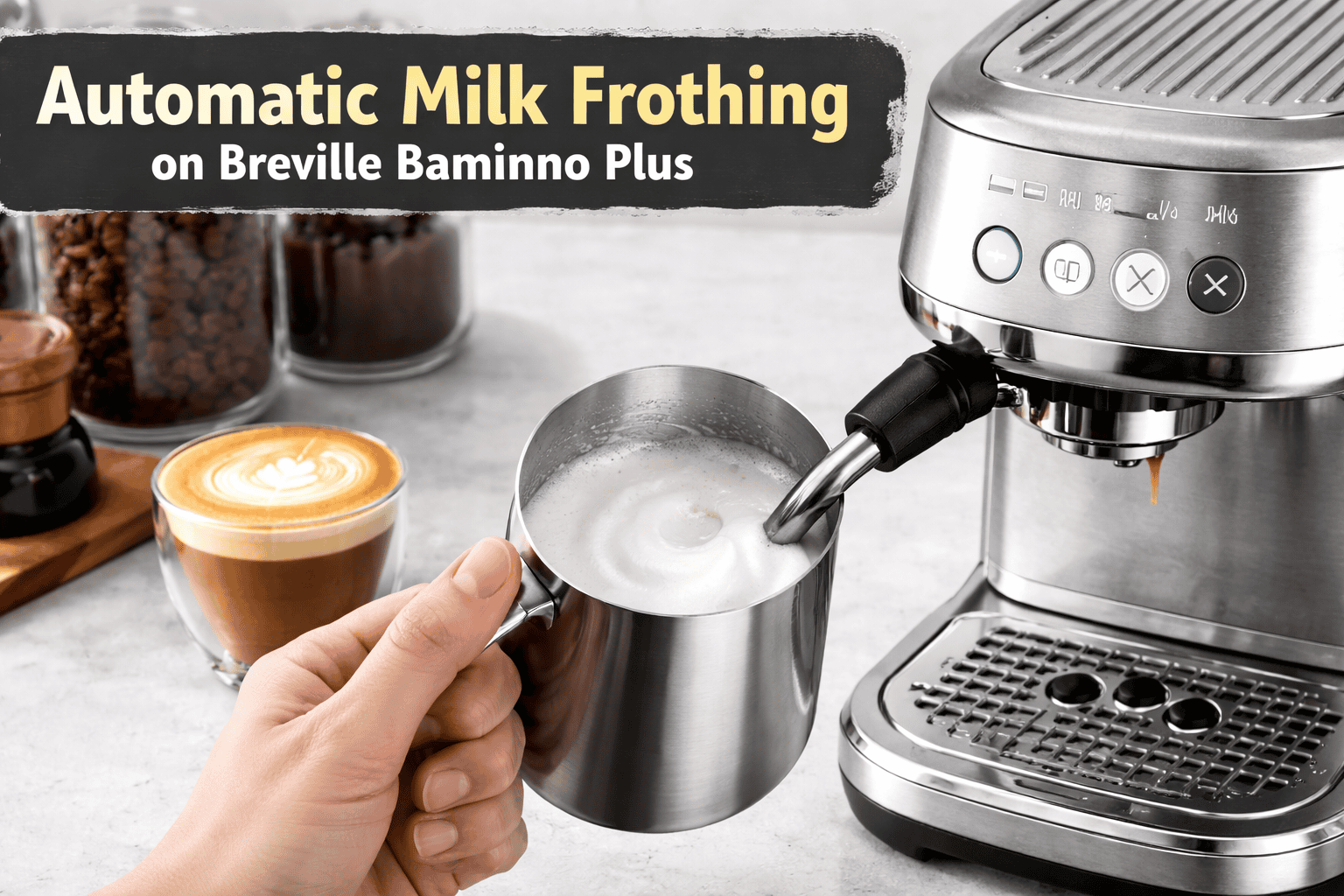
Milk is where the Bambino Plus pulls clearly ahead for many households. Its steam wand works in two ways. In automatic mode, you place the included pitcher on a temperature sensor under the wand, choose one of three temperatures and three foam levels, and the machine textures the milk and stops on its own. In manual mode, it behaves like an ordinary steam wand. For anyone who wants a good latte or cappuccino every morning without practicing technique, the automatic mode is a genuine advantage.
The Barista Express has a manual steam wand only. You control the pitcher angle, the stretching, and the temperature yourself, which takes practice but rewards it: once learned, manual steaming lets you produce silky microfoam for latte art and adjust texture for any drink. The wand is capable, but the first few weeks usually involve some big bubbles and over-hot milk. Our how to steam milk guide walks through the technique.
Whichever machine you choose, a proper stainless pitcher helps. A 12 oz pitcher such as the Rattleware 12 oz pitcher is the right size for single milk drinks and makes it easier to control the vortex. If you are still deciding which drinks you will make most, our latte vs cappuccino vs flat white guide covers the differences in milk texture and ratio.
Heat-Up, Workflow, and the Morning Routine
The Bambino Plus uses Breville’s ThermoJet heating system, which Breville rates at about three seconds to reach extraction temperature. In practice that means you can switch it on, grind, dose, and tamp, and the machine is ready before you are. It also switches from brewing to steaming quickly, so making a milk drink back to back with a shot is fast. For busy mornings, that speed is one of the most underrated advantages in this comparison.
The Barista Express uses a Thermocoil system and generally needs about a minute before the first shot, plus a little extra time if you want the portafilter and cup fully preheated. That is not slow by espresso standards, and many owners simply switch it on and grind while it warms up. It also has two small features the Bambino Plus lacks: a dedicated hot water outlet, which makes americanos and cup warming easy, and a pressure gauge on the front.
That pressure gauge is more useful than it looks for beginners. It shows roughly how much resistance the puck is creating during the shot, so you can see at a glance whether your grind is too coarse or too fine before you even taste the result. It is not a substitute for a scale and timer, but it shortens the learning curve. Our how to dial in espresso guide shows how to use timing, yield, and taste together.
Compare Systems, Not Boxes
On the shelf, the Bambino Plus usually costs noticeably less than the Barista Express. That comparison is misleading on its own, because the Bambino Plus needs a grinder to reach its potential and the Barista Express already has one. The fair comparison is the Barista Express against a Bambino Plus plus a capable espresso grinder, which often ends up costing about the same or somewhat more as a complete setup.
Seen that way, the question becomes what the extra money buys. With the Barista Express, you are paying for convenience and a single footprint. With the Bambino Plus and a separate grinder, you are paying for flexibility: a grinder you chose, automatic milk, faster heat-up, and two devices that can be upgraded or replaced independently. If a component fails out of warranty, you replace one piece rather than the whole setup.
There is one case where the Bambino Plus is clearly the cheaper path: if you already own an espresso-capable grinder. In that situation, the Barista Express’s built-in grinder is money spent on something you do not need. Our best coffee grinders for espresso guide can help you judge whether a grinder you already have is good enough for espresso.
Counter Space, Cleaning, and Ownership
The size difference is substantial. The Bambino Plus is about 7.7 inches wide and weighs around 11 pounds, small enough to fit in a narrow gap or a small apartment kitchen. The Barista Express is about 12.5 inches wide, nearly 16 inches tall with the bean hopper, and roughly twice the weight. Measure your counter and the clearance under your cabinets before choosing, and remember that the Bambino Plus will also need room for a separate grinder beside it.
Daily cleaning is similar for both: knock out the puck, rinse the portafilter and basket, wipe and purge the steam wand after every use, and empty the drip tray. The Barista Express adds a grinder to maintain, which means cleaning the burrs periodically and wiping coffee oils out of the hopper. Both machines need regular backflushing with cleaning tablets and descaling based on your water hardness. Filtered water, for example from a Brita pitcher, reduces scale buildup in either machine. Our espresso machine maintenance guide lays out the schedule.
Warranty terms also differ. Breville lists a 2-year limited warranty for the Bambino Plus in the United States and a 1-year limited warranty for the Barista Express. Terms vary by region and retailer, so check the listing you buy from.
For either machine, a small scale with a timer is the most useful accessory you can add. Weighing your dose and your shot is what turns guesswork into a repeatable recipe. A compact espresso scale such as the Timemore Black Mirror Basic 2 fits on the drip tray, and our best espresso scales guide compares other options.
Where Each Machine Leads in Two Years
It is worth thinking about where each choice leads. Many people who start with the Barista Express use it happily for years, especially if they stick to medium and dark roasts in milk drinks. Others gradually outgrow the built-in grinder, add a separate one, and end up with a large machine carrying a grinder they no longer use. When they eventually upgrade the machine, the grinder goes with it.
The Bambino Plus path is more modular. Because the grinder is separate, it can stay when you upgrade the machine, and many people keep a good grinder through two or three machines. The Bambino Plus itself remains a capable companion for milk drinks even after you outgrow it for straight espresso, which is why some owners keep it as a second machine or pass it to family when they move up.
Neither path is wrong. The Barista Express is a complete, contained system that does its job well for a long time. The Bambino Plus is a smaller first step in a setup you build piece by piece. Knowing which way you lean, simplicity or flexibility, usually settles the decision.
Alternatives Worth a Look
If neither machine feels quite right, two alternatives come up most often. The Gaggia Classic E24 is a traditional single-boiler machine with a commercial-style 58 mm portafilter and a strong following among people who enjoy learning espresso by hand and tinkering over time. It lacks the Bambino Plus’s speed and automatic milk, and like the Bambino Plus it needs a separate grinder, but it suits buyers who want a machine they can grow into. Our Bambino Plus vs Gaggia Classic comparison covers that choice, and our Gaggia Classic Pro E24 review looks at the Gaggia on its own.
If you mostly want convenient milk drinks and are not set on traditional espresso, a capsule machine may be a better fit for your routine. Our Nespresso vs espresso machine comparison explains the trade-offs in flavor, cost per cup, and effort. For the full range of options at every budget, see our best espresso machines for beginners guide.
Our Verdict
The Breville Bambino Plus is the better choice for most people who mostly drink lattes and cappuccinos, want espresso ready almost instantly, have a small kitchen, or already own a capable grinder. Pair it with an espresso grinder such as the Baratza Encore ESP and you have a fast, flexible setup with automatic milk and room to grow.
The Breville Barista Express is the better choice if you want one box with everything included, you are happy to learn manual milk steaming, you drink americanos, and you mostly brew medium and dark roasts. It is a complete, well-proven starter system that many owners never feel the need to outgrow.
Choose Your Breville
Pick the Bambino Plus for speed and automatic milk, or the Barista Express for an all-in-one setup with the grinder built in.
As an Amazon Associate, CoffeeGearHub earns from qualifying purchases.
Editorial bottom line: Both machines pull very similar shots. Choose the Bambino Plus for speed, automatic milk, and a modular setup with a grinder you pick; choose the Barista Express for an all-in-one machine with the grinder included and a pressure gauge to learn on.
Frequently Asked Questions
Is the Bambino Plus or Barista Express better for beginners?
Both suit beginners in different ways. The Bambino Plus is easier day to day because it heats in seconds and can steam milk automatically. The Barista Express is easier to buy because the grinder is included, and its pressure gauge helps you learn to dial in shots; see how to dial in espresso.
Do they make the same espresso?
Very close. Both use an 18 g dose in a 54 mm portafilter, low-pressure pre-infusion, roughly 9 bar extraction, and PID temperature control. Differences in the cup come mostly from the grinder and the beans.
Can I use pre-ground coffee in the Bambino Plus?
Yes, with the included dual-wall (pressurized) baskets, which are designed to compensate for a less precise grind. The results are drinkable but limited; a fresh, espresso-capable grind in the single-wall baskets is a clear step up.
Is the Barista Express grinder good enough for light roasts?
It handles most medium and dark roasts well, especially in milk drinks. Very light roasts often need finer and more precise adjustment than the built-in grinder offers, which is when some owners add a separate grinder.
Which machine is easier to keep clean?
Daily cleaning is similar, but the Barista Express has more to look after because the grinder needs periodic cleaning and the hopper collects coffee oils. Our espresso machine maintenance guide covers both.
Which is better for americanos?
The Barista Express, because it has a dedicated hot water outlet. With the Bambino Plus you would use a kettle for the hot water, which works fine but is one more step.
Sources and Further Reading
Specifications follow Breville’s official product pages for the Bambino Plus (BES500) and Barista Express (BES870XL). Brewing guidance draws on CoffeeGearHub’s existing dial-in, brew ratio, and milk steaming guides. Specifications, warranty terms, and bundles can vary by region and retailer.
CoffeeGearHub product shortlist
Continue with related products on CoffeeGearHub
Review product categories and current verified merchant offers on CoffeeGearHub before leaving the site.
Continue Learning
Machine reviews and comparisons