
Flow Control Espresso Machines: Are They Worth It?
Editorial standards: this guide separates adjustable brew flow from pressure profiling, pressurized portafilters and generic pre-infusion. Product examples are checked against current manufacturer descriptions where available.
At a glance
Flow control is useful after the baseline shot is already good
It gives you another way to shape puck saturation and extraction. It does not replace a capable grinder, even puck preparation or a repeatable recipe.
Editorial analysis
Buy the machine first; treat flow control as a capability, not the reason the machine is good
A machine should still fit your heating, steaming, maintenance and workflow needs with the flow-control paddle fully open. The feature becomes valuable when you can compare controlled profile changes against a stable baseline.
The 30-Second Answer
Flow control is worth considering if you already have an espresso-capable grinder, consistent puck preparation and a machine workflow you like. It lets you change how quickly water reaches the puck during different parts of the shot, which can help you explore gentler saturation, longer pre-infusion or a tapered finish. It is not a shortcut around channeling, stale coffee or an inconsistent grinder.
What Flow Control Actually Means
Flow control changes the rate of water entering the coffee puck during extraction. On many E61-style systems, a paddle or valve restricts or opens the brew-water path. Fully open, the machine behaves close to its normal hydraulic design; partially closed, water reaches the puck more slowly.
That lets you create a gentle saturation phase, hold a lower-flow segment or taper flow later in the shot. Because the coffee puck itself creates resistance, changing flow also changes the pressure that develops at the puck. That interaction is why flow-control discussions often get mixed together with pressure profiling.
Flow Control vs Pressure Profiling vs Pre-Infusion
| Control | What you change | What it is useful for |
|---|---|---|
| Flow control | Water flow rate entering the puck | Shape saturation, extraction rate and late-shot behavior |
| Pressure profiling | Brew pressure over time | Change mechanical force applied across the puck during extraction |
| Pre-infusion | Early wetting phase at lower flow/pressure | Saturate the puck before full extraction pressure/flow |
| Pressurized portafilter | Outlet restriction after the basket | Create backpressure with less demanding grind precision |
A pressurized basket marketed as “flow control” is not the same thing as an adjustable group-head flow-control valve. Flair’s NEO Flex Flow Control Portafilter, for example, restricts the exit path to help build pressure for beginners; it does not provide the same user-adjustable profiling as a paddle-equipped pump machine.
What Changes Inside the Puck?
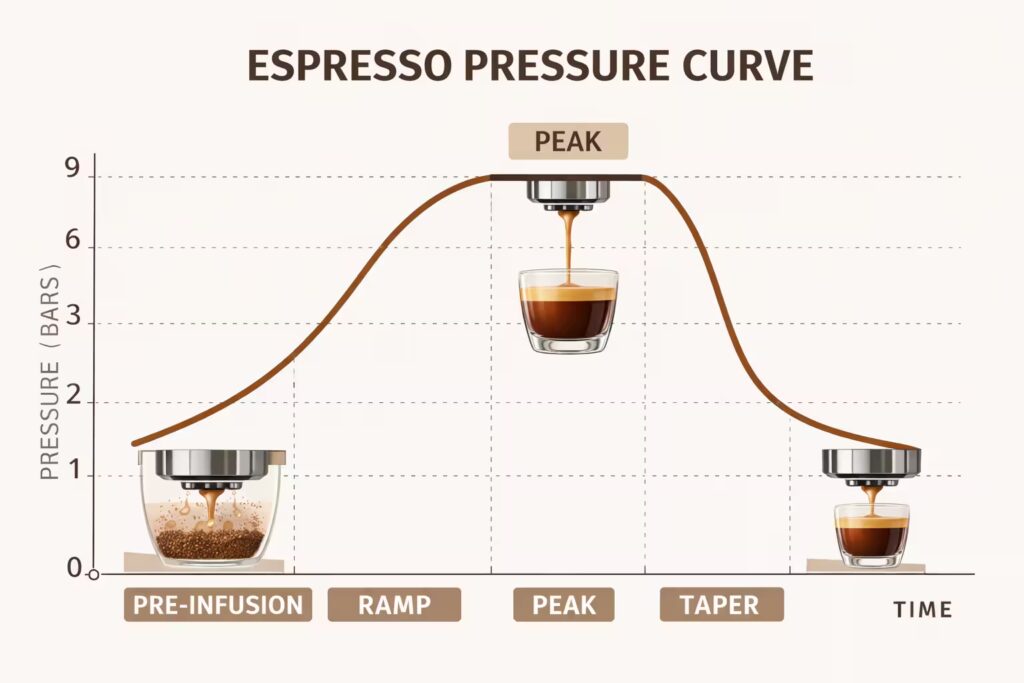
Espresso extraction is a coupled system. Pump or lever input, water flow, puck resistance and pressure all affect each other. Early in the shot, the dry puck offers substantial resistance. As the puck wets and coffee dissolves, its hydraulic behavior changes.
A gentler initial flow can reduce how abruptly water loads the puck. A later taper can reduce flow as the puck becomes more permeable. But those adjustments do not automatically prevent channeling: uneven distribution, poor basket fill, clumps, an unsuitable grind or damaged puck integrity can still create preferential paths.
Think of flow control as a profile-shaping tool, not a puck-repair tool.
Two different ways to shape extraction
Machine flow paddle vs manual lever profiling
These are related but not identical experiences. One changes water flow through a pump-driven group; the other changes pressure through lever force.
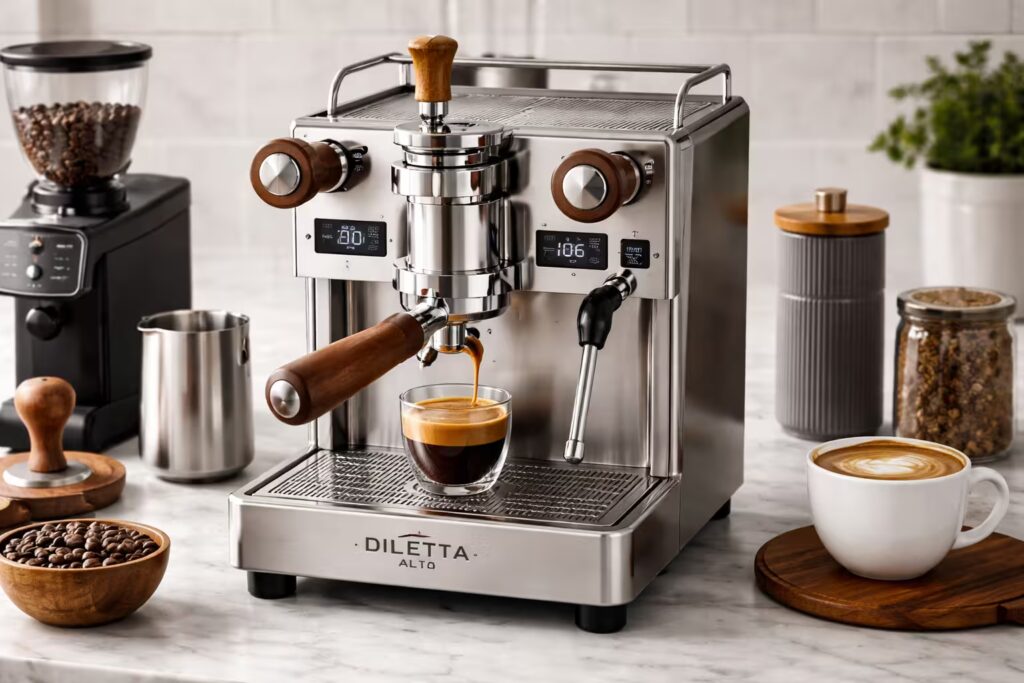
Diletta Alto with flow controlDual-boiler pump machine with optional paddle-based flow control.Check current Amazon listing → Flair PRO 3Manual lever pressure profiling with a gauge—not a pump-driven flow-control paddle.Check current Amazon listing →Affiliate disclosure: CoffeeGearHub may earn a commission from qualifying Amazon purchases at no additional cost to you. Verify exact configuration and included flow-control hardware before purchasing.
Who Benefits Most?
Flow control is more useful when…
- You already dial conventional shots consistently.
- Your grinder supports small, repeatable espresso adjustments.
- You like comparing different roast levels and extraction styles.
- You measure dose and beverage yield and can reproduce a baseline shot.
- You enjoy experimentation enough to record what changed.
It is lower priority when…
- Your grinder is the main source of inconsistency.
- Your puck preparation changes from shot to shot.
- You mostly want milk drinks quickly and do not enjoy experimentation.
- You are still learning dose, yield, grind and basic extraction timing.
- The machine with flow control compromises a more important requirement such as warm-up time, steam capacity or serviceability.
A Better Beginner Protocol: Baseline First, Profile Second
Do not start with an elaborate flow curve. Start with a conventional shot using the machine’s normal or fully open flow setting and establish a repeatable baseline.
- Lock the dose. Use the same basket and dose for the comparison.
- Dial grind and yield conventionally. Make the baseline taste balanced before adding profiling.
- Change one phase only. Try a gentler initial saturation or a late-shot taper—not both at once.
- Keep final beverage yield comparable. Otherwise you may be tasting a ratio change rather than a flow-profile change.
- Compare taste, not just the graph. Keep the change only if it improves the cup you actually drink.
This method teaches what the flow-control change did instead of burying the effect under simultaneous grind, ratio, temperature and profile changes.
Current Examples and What They Actually Control
Diletta Alto — optional pump-driven flow control
Diletta currently lists the Alto as a dual-boiler, PID-controlled 58 mm machine available with optional flow control. Its paddle changes brew flow in a conventional pump-driven espresso machine. Diletta lists a 30-minute warm-up, so this is a traditional prosumer workflow rather than an instant-on machine.
Lelit Bianca — integrated paddle and programmable low-flow support
The current Bianca platform combines a manual paddle with programmable low-flow and pre-infusion settings. That makes it a useful example of a machine designed around both hands-on profiling and repeatable electronic assistance. It is a better reference for “true flow control” than a pressurized basket that merely restricts outlet flow.
Flair PRO 3 — manual pressure profiling
The PRO 3 includes a pressure gauge and manual lever. Flair’s guidance targets pressure ranges rather than a group-head flow valve. This is useful for learning how lever force shapes pressure, but it should be described as manual pressure profiling, not as the same mechanism used by an E61 flow-control paddle.
La Pavoni Europiccola — classic lever pressure control
A springless manual lever lets the user directly change applied force across the shot. As with Flair, this is better understood as lever pressure profiling. It develops many of the same profile-thinking skills while using different mechanics from a pump-driven flow valve.
Upgrade These Before Paying for Flow Control
| Priority | Why it comes first |
|---|---|
| Espresso-capable grinder | Flow profiles cannot compensate for grind steps that are too coarse or inconsistent particle distribution |
| Fresh, suitable coffee | Stale or poorly matched coffee limits what profiling can reveal |
| Scale | You need repeatable dose and yield to compare profile changes |
| Distribution and tamp consistency | Channeling from puck prep can dominate the result |
| Water and temperature basics | Profiling is difficult to evaluate when the baseline extraction changes for unrelated reasons |
Flow-Control Troubleshooting
| Problem | What to check before changing the flow profile | Profile experiment after baseline is stable |
|---|---|---|
| Sour / thin | Grind, dose, yield, water temperature and coffee age | Try slightly more gentle saturation followed by normal flow; compare at the same final yield |
| Harsh / drying | Overly fine grind, excessive yield, high temperature, dark roast | Try a late-shot taper rather than forcing high flow through an increasingly permeable puck |
| Visible channeling | Distribution, clumps, basket fill, tamp level, puck damage | Only after prep is consistent, test gentler initial flow |
| Shot stalls | Grind too fine or flow valve too restricted | Open flow and re-establish baseline before experimenting |
| Every shot tastes different | Stop profiling and make puck prep, grind, dose and yield repeatable first | None until baseline repeatability improves |
How to Evaluate a Flow-Control Machine Before Buying
Flow control is easy to overvalue because the paddle is visible while the fundamentals are not. Before paying extra for profiling capability, evaluate the rest of the machine as if the paddle were not there. A machine with excellent temperature stability, a sensible steam workflow, available parts, and a group you can maintain is usually a better long-term purchase than a weaker platform with a flow-control accessory attached.
| Check | Why it matters | What to ask |
|---|---|---|
| Grinder quality | Flow control cannot compensate for wildly inconsistent particle size or an espresso grinder with adjustment steps that are too coarse. | Can your grinder already produce repeatable shots at a stable dose and yield? |
| Temperature stability | Profiling changes water delivery, but unstable brew temperature can still dominate the result. | Does the machine hold a repeatable brew temperature during the kind of shot you actually pull? |
| Flow or pressure feedback | Profiling is easier when you can see what the machine is doing rather than moving a paddle blindly. | Does the machine provide a group-pressure gauge, flow indication, shot timer, or another useful reference? |
| Repeatability | A profile only becomes useful when you can reproduce it. | Can you return the paddle to the same approximate positions, and can you log the sequence clearly enough to repeat it? |
| Service and parts | Flow-control valves, gauges, gaskets, and E61-style groups add components that eventually need maintenance. | Are replacement parts, seals, and service documentation realistically available where you live? |
| Your coffee habits | The feature creates the most value for users who intentionally change coffees, roasts, and extraction styles. | Do you actually want to profile light roasts, long pre-infusions, declining-flow shots, or experimental recipes? |
A useful buying test: imagine owning the machine with the paddle fixed in one normal position. If the boiler system, warm-up, steam performance, controls, serviceability, dimensions, and grinder pairing would still make sense for you, flow control is a worthwhile capability to add. If the machine only looks attractive because it offers profiling, the feature may be distracting you from a weaker overall fit.
Also separate learning value from daily value. Profiling can teach you how puck resistance changes during a shot and can make difficult coffees easier to explore. But many users eventually settle on one or two repeatable profiles and use them routinely. That is not a failure of the feature—it simply means the best reason to buy flow control is flexibility you will actually use, not the assumption that every shot must be manually manipulated.
Are Flow Control Espresso Machines Worth It?
They can be worth it for an experienced home espresso user who enjoys experimentation and already owns the supporting gear. The value is not that flow control magically produces better espresso. The value is that it gives you another controlled variable for adapting extraction to coffee and taste.
For a first espresso setup, prioritize the grinder, machine workflow, temperature management, steam capability and maintenance path. If a flow-control machine also meets those needs, the feature gives you useful headroom. If you would be sacrificing a better grinder or a machine that fits your routine, flow control is the wrong place to spend first.
FAQs
Does flow control make espresso taste better?
Is flow control the same as pressure profiling?
Is pre-infusion the same as flow control?
Will flow control help with channeling?
Do I need flow control for milk drinks?
Can I add flow control to my existing machine?
What is the best first flow profile?
Is flow control worth it with a mediocre grinder?
CoffeeGearHub espresso paths
Build the baseline before adding profiling
These guides cover the machine, grinder and dial-in fundamentals that make flow-control experiments meaningful.